
Amgen's Stock Gains on FDA Approval of Breakthrough Cancer Drug, Trading Volume Ranks 111th in Liquidity
 Aime Summary
Market Snapshot
On November 26, 2025, AmgenAMGN-- (AMGN) saw a 1.01% increase in its stock price, marking a positive daily performance. The company’s trading volume reached $0.80 billion, ranking it 111th in terms of daily liquidity among listed stocks. While the volume was substantial, it fell short of the top-tier liquidity benchmarks, indicating moderate investor activity. The price movement aligns with broader market optimism around Amgen’s recent regulatory and clinical milestones, though the relatively modest gain suggests mixed sentiment among investors balancing short-term optimism with long-term uncertainties.
Key Drivers Behind the Move
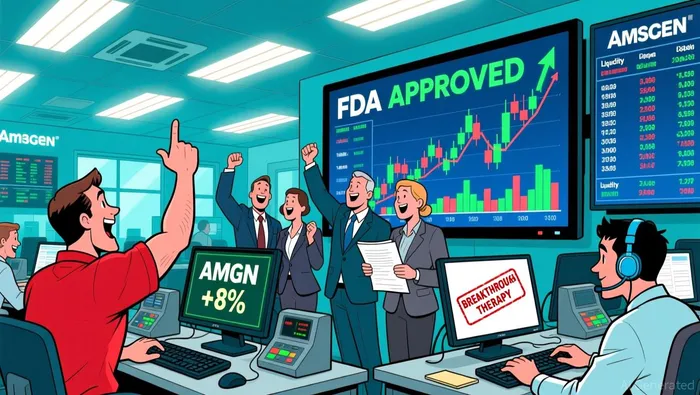
Amgen’s stock price rise coincided with the U.S. Food and Drug Administration’s (FDA) full approval of IMDELLTRA (tarlatamab-dlle) for treating adults with extensive-stage small cell lung cancer (ES-SCLC) who have progressed after platinum-based chemotherapy. This approval, coupled with the National Comprehensive Cancer Network’s (NCCN) designation of IMDELLTRA as the sole Category 1 preferred treatment option for this patient group, underscores a significant expansion of Amgen’s oncology portfolio. The drug’s approval follows robust Phase 3 trial results, which demonstrated a five-month extension in median overall survival compared to standard care—a 40% reduction in the risk of death. These outcomes validate Amgen’s ability to deliver high-impact therapies in difficult-to-treat cancers, reinforcing its reputation as a leader in oncology innovation.
The clinical data underpinning IMDELLTRA’s approval is a critical catalyst. The Phase 3 trial results not only met but exceeded expectations, highlighting the drug’s potential to become a cornerstone treatment in ES-SCLC. For Amgen, this represents a strategic win in a therapeutic area with limited alternatives and unmet medical needs. The NCCN’s endorsement further amplifies the drug’s clinical value, as guideline updates often drive adoption rates and physician preferences. Analysts have emphasized that such milestones can enhance investor confidence by demonstrating Amgen’s capacity to navigate regulatory hurdles and deliver tangible patient outcomes.
However, the broader investment narrative for Amgen remains cautious. While IMDELLTRA’s approval strengthens the company’s near-term pipeline momentum, it does not immediately address persistent challenges such as biosimilar competition and industry-wide pricing pressures. These factors remain top risks for Amgen’s long-term revenue growth, as older therapies face margin erosion from generic alternatives. The news articles highlight divergent analyst projections: some anticipate $37.4 billion in revenue and $8.2 billion in earnings by 2028, while others warn of potential declines to $34.4 billion in revenue and $5.2 billion in earnings under more conservative assumptions. The disparity reflects uncertainty about how effectively Amgen can offset aging product lines with new innovations like IMDELLTRA.
The approval also intersects with Amgen’s broader strategy to expand into high-impact specialty therapies. By securing a preferred treatment status for IMDELLTRA, the company positions itself to capture a larger share of the oncology market, which is critical for offsetting declines in older franchises. This aligns with the company’s focus on targeted therapies and rare diseases, areas where Amgen has historically demonstrated strength. However, the success of IMDELLTRA will depend on its real-world adoption rates, pricing negotiations, and the competitive landscape. Analysts note that while the drug’s clinical profile is strong, its commercial performance will be influenced by factors such as reimbursement structures and patient access.
In summary, Amgen’s 1.01% price increase reflects optimism around IMDELLTRA’s regulatory and clinical achievements, which validate the company’s oncology pipeline. However, the stock’s trajectory will hinge on how effectively Amgen navigates long-term challenges like biosimilars and pricing pressures. The recent approval is a significant milestone but must be contextualized within a broader landscape of risks and opportunities. Investors will likely monitor key metrics such as IMDELLTRA’s market penetration, the progress of other late-stage pipeline candidates, and Amgen’s ability to maintain profitability in an increasingly competitive therapeutic environment.

Stay ahead of the market.
Get curated U.S. market news, insights and key dates delivered to your inbox.
AInvest
PRO
AInvest
PRO



Comments
No comments yet