
AmEx's Sharp 4.46 Drop Hits $1.23B Volume as Sector-Wide Legal and Capital Pressures Emerge
 Aime Summary
Market Snapshot
On November 17, 2025, , marking its worst single-day performance in recent trading sessions. , ranking it 71st among all equities in terms of liquidity. Despite the sharp drop, the volume level suggests moderate market participation relative to broader market activity, indicating the decline may not have been driven by widespread panic but rather by sector-specific or thematic factors. The performance contrasts with the company’s broader financial services peers, many of which showed resilience in the same period.
Key Drivers
The absence of direct news items related to American ExpressAXP-- in the provided data complicates a granular analysis of its price movement. However, two indirect factors from the broader financial services sector may have contributed to the stock’s underperformance.
First, the legal uncertainty surrounding American International Group (AIG) in Illinois highlights a potential ripple effect across the insurance and financial services ecosystem. AIGAIG--, a major insurer, faces a high-stakes court case regarding liability for pollution claims tied to emissions permitted by state regulators. The outcome could redefine insurance coverage for environmental liabilities, indirectly affecting companies like AXPAXP-- that operate in sectors reliant on robust insurance frameworks. While AXP itself is not named in the case, the broader legal and regulatory risks for insurers could heighten market caution toward financial stocks, including those with overlapping risk profiles.
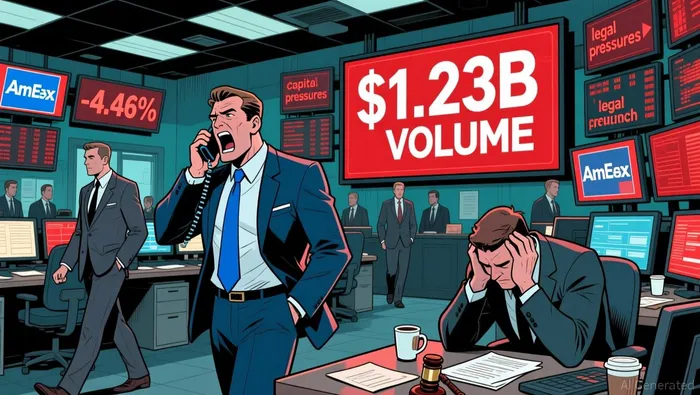
Second, AIG’s recent of Corebridge Financial shares—another subsidiary—underscores liquidity pressures within its corporate structure. , suggesting the parent company is actively managing its capital. While Corebridge is a distinct entity from AXP, the transaction reflects a broader trend of financial firms navigating macroeconomic headwinds, such as spread compression and interest rate volatility. These factors, though not directly tied to AXP, contribute to a risk-off sentiment in the sector, which may have spilled over into AXP’s trading activity.
The downgrade of Corebridge by Morgan Stanley further amplifies sector-wide concerns. The firm cited spread compression and sensitivity to interest rate cuts as key risks, factors that could also weigh on AXP’s profitability if broader economic conditions deteriorate. While AXP’s business model differs from Corebridge’s insurance and asset management focus, the interconnectedness of financial services firms means sector-wide headwinds can drive correlated movements in stock prices.
Finally, the lack of company-specific news in the provided data suggests that AXP’s decline may be attributed to broader market dynamics rather than firm-specific developments. Traders may have reacted to macroeconomic signals, such as expectations for Federal Reserve policy or sector rotation out of financials. Without earnings reports, regulatory updates, or strategic announcements to anchor sentiment, AXP’s stock became a proxy for shifting risk appetite in the financial services space.
In conclusion, while the provided news articles do not directly address American Express, they highlight systemic risks—legal uncertainties, capital management challenges, and macroeconomic sensitivities—that may have indirectly influenced its trading performance. Investors are likely recalibrating positions in anticipation of potential spillovers from AIG’s legal and capital activities, even as AXP’s fundamentals remain unaddressed in the current data set.

Stay ahead of the market.
Get curated U.S. market news, insights and key dates delivered to your inbox.
AInvest
PRO
AInvest
PRO



Comments
No comments yet