
What an AMEX Halt With a $9.69 Last Print Actually Tells You (and When the Chart Becomes Tradeable)
 Aime Summary
What an "AMEX HALT, Last 9.69" Feed Line Actually Tells You
A screen like this one — AMEX HALT ADD INFO LST 9.690000 — shows up on quote terminals all the time, and to a retail investor it reads like a cryptic data spill rather than a message. Strip the noise down and it is saying exactly three things: a security listed on NYSE American (the exchange still nicknamed AMEX) has been placed in a trading halt; the exchange is flagging that additional information is coming or is pending; and the last executed price before the pause was $9.69. None of that tells you a ticker, a company, or a reason — and that is the first lesson worth learning about how halts actually work.
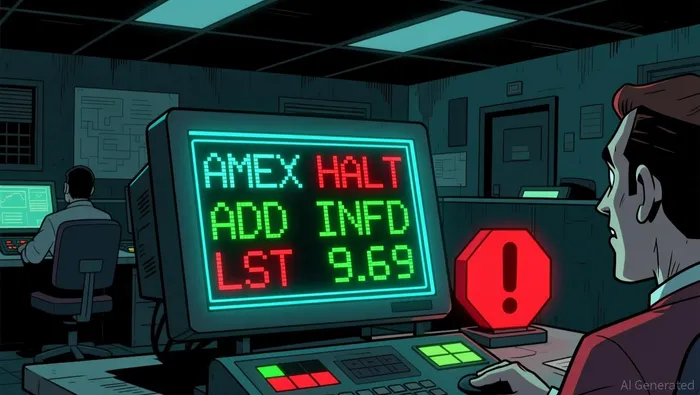
Two different kinds of pause, one shared symptom
A trading halt means the exchange has stopped that single security's trading while the broader market keeps running. But not all halts are the same, and the difference matters enormously for what you should expect when trading resumes.
- Regulatory halts ("pending news" or "additional info"): The exchange or a listing venue pauses a stock when there is material news pending — a merger, a regulatory decision, a restructuring, a capital raise, or sometimes a question about the accuracy of the tape. These are not time-boxed. They last as long as it takes for the company to disclose or for the exchange to sort out the issue. The "ADD INFO" in the feed line is a strong hint this is the regulatory flavor: the exchange is telling you more information is expected.
- Volatility / Limit-Up-Limit-Down (LULD) pauses: These are the automated circuit breakers that trip when a stock moves too fast in five minutes. They are short — typically a minute or a few — and they cool off momentum rather than await news. They are frequent on thinly traded small caps.
The same symptom (no executions) can be caused by either mechanism, so the halted price alone never tells you which you are looking at. The wording in the feed is a better clue, but even that is only a signal until the exchange's halt notice is confirmed.
Why the "last price" is nearly useless as an anchor
The 9.69 is a snapshot, not a verdict. It is the most recent print before the pause, and in a halted thin small cap that print can be stale, wide, or the product of a single crossing rather than an established market. The Alpha Inspiration rule for a meaningful price level is that it must carry memory or mechanics — repeated reactions, a gap boundary, high-volume trade, an anchored VWAP. A last print at a halt carries none of that. Before the halt even matters as a technical event, the quote needs to reopen, print size and cadence, and find its first real post-halt range.
This is why the disciplined technical response to a halt feed line is patience, not analysis. You cannot build support, resistance, or a decision level out of a frozen print. The chart only becomes analyzable after the reopen produces fresh bars, real volume, and a new opening range.
What taps your opening range
When the halt lifts, the setup that matters is not the 9.69 print — it is the opening range of the resumed session and its relationship to that frozen price. Three questions decide whether the reopen is a tradeable event or a trap:
- Does the reopen gap above or below 9.69, and on what volume? A gap up on heavy volume after a positive news halt tells you buyers paid up to establish a new level. A quick gap back through the frozen print signals the earlier level is being rejected rather than accepted.
- Does the volume persist after the first impulse? A single large reopen print is not conviction. Relative volume needs to stay elevated across minutes, not just at the reopen cross. Volume is participation, not automatically a signal.
- Who is now wrong? If the reopen jumps far above 9.69, anyone who sold into weakness near the last print is now trapped and may be forced to chase or to sell strength. If it slams back through, anyone who bought the initial spike is trapped instead. That trapped-inventory dynamic — not the frozen price — is what can fuel the next leg.
The decision map when a ticker you follow is halted
- Before the reopen: Do not prebuild levels off the 9.69 print. Confirm the halt type from the exchange's own halt notice or the company's filing. If it is "additional info pending," the company's disclosure — not the chart — drives everything after.
- At the reopen: Watch the first five minutes for range, volume, and whether price holds or reverses relative to the prior print. Let the market establish a new range before you assign any level meaning.
- During the move: Compare the size of the move to the stock's own normal range. A $0.50 swing may be enormous for a $9.69 stagnant small cap or ordinary for a volatile one. Judge surprise in volatility units, not raw dollars.
- The invalidation: If the reopen fails back through the frozen print and immediately trades below it on volume, any post-halt upside narrative is cancelled until the stock reclaims that level on its own — not because the number is magic, but because it is the boundary where the most recent real buyers are trapped.
The honest bottom line
An AMEX HALT... LST 9.69 line is an event, not a thesis. It tells you a thin NYSE American name was paused, more information is expected, and the last print was under ten dollars. It does not tell you the company, the reason, or where the stock is going. The correct first move for a retail investor is to get the halt notice and the pending disclosure, wait for the reopen to print real bars, and only then decide whether a level has any claim to meaning. In a market that rewards the first-mover story, the edge here is refusing to guess before the information the exchange is waiting on actually lands.

Stay ahead of the market.
Get curated U.S. market news, insights and key dates delivered to your inbox.


AInvest
PRO
AInvest
PRO




Comments
No comments yet