
American Tower Isn't an AI Stock. It's a Landlord in the Middle of a Hand-Off.
 Aime Summary
American Tower is about to take the stage at a Goldman Sachs tech conference. The headline that will travel with it is easy to misread: "tower company rides the AI wave." Here is the picture most investors carry — and the part it deletes. AMTAMT-- is not a tower company anymore, and it is not an AI company. It is a landlord with two buildings. One of them just lost its best-paying tenant and is flat. The other is quietly compounding 13% a year because the AI companies rent there.

The number that will get you into trouble is the blended one — total revenue up 4.7% in the latest quarter. That is the average of two different businesses moving at two different speeds, and an average tells you almost nothing about which business is doing what. So before you ask whether AMT is an AI stock, let's look at the two buildings.
A landlord with two buildings
Put away the acronym for thirty seconds. A landlord owns buildings and leases rooms to tenants for rent on a multi-year contract. American TowerAMT-- does this on a global scale: it owns more than 148,000 communications sites — cell towers — plus a fast-growing portfolio of data centers in the U.S. It is a REIT, so it passes the cash to you as a dividend and it has grown that dividend 14 years in a row.
Now run the toy version. You own two buildings.
- Building A: rents for $9,000 a year. Rent is frozen this year — 0% growth.
- Building B: rents for $1,000 a year. Rent grows 13%.
Last year's total rent: $9,000 + $1,000 = $10,000. This year: A is still $9,000, B is $1,130. Total = $10,130.
Growth = $10,130 ÷ $10,000 − 1 = 1.3% total.
Watch what just happened. One building is frozen, the other is compounding at a healthy 13%, and the landlord's combined rent line moved a sluggish 1.3%. The fast building is only about 10% of the whole, so its 13% barely nudges the total. If someone handed you "total rent up 1.3%" and nothing else, you would conclude this landlord is basically stuck. You would be describing the number correctly and the business wrong.
That is the whole trick. A small, fast business sitting on top of a big, flat one produces a blended growth rate that looks unremarkable — and it is the big one, not the small one, doing the pulling.
Now label the props
Building A is the tower business. It is the big one — the overwhelming majority of revenue. And it is, on the numbers, basically flat in the part of the world that matters most.
Here is why, and it is the single most important fact in this story. In January 2026, DISH Wireless — one of the tenants leasing space on American Tower's U.S. towers — stopped paying its rent and was declared in default. DISH was about 4% of American Tower's U.S.-and-Canada property revenue, a roughly $200 million a year exposure. In June 2026, American Tower terminated the agreement outright and is now suing over the money owed. Strip DISH out of the churn and U.S.-and-Canada tower billings grew about 5%; with it in, reported organic growth in that region was just 0.7%.
So Building A is not weak because of the economy or the technology. It is weak because one big tenant walked out on its lease. The rest of the tower portfolio is doing fine — Africa and Asia-Pacific grew 10.6%, Europe 4.1%.
Building B is the data centers, bought for $10.1 billion in 2021 in the CoreSite acquisition. It is the small one — about 11% of the business, roughly $297 million a quarter — and it is the fast one. In the latest quarter, data center revenue grew 13.4%, the fifth straight quarter of double-digit growth. The reason it is the fast building: nine of the top ten AI companies, and three of the top five "neoclouds," already rent space there.
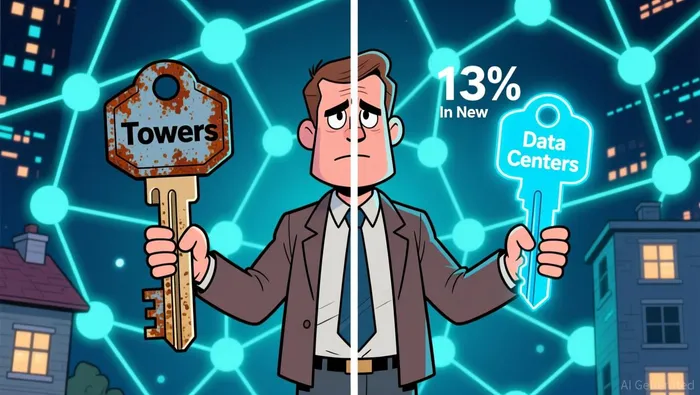
Now map it, and you can see the company's own numbers do the arithmetic for you:
- Reported: total revenue up 4.7% to $2.75 billion, AFFO per share up 4.2% to $2.71.
- Towers (U.S./Canada): ~5% excluding the DISH churn, 0.7% with it.
- Data centers: 13.4%, on a base of roughly $297 million.
That is the two-building landlord. The blended 4.7% is the $10,130 line in the toy — the total that moved only a little because the fast part is small. The fast part is small enough that it cannot, by itself, move the whole number much — which is exactly why reading only the 4.7% misleads you.
Where the "trough year" actually comes from
This is where the story sharpens, and where the forward-looking claim lives, so I will mark it as a claim, not a fact. Management has called 2026 a trough year for growth and is pointing to a "meaningful inflection" in 2027. What that means in cash terms: the DISH churn hits the tower numbers all of 2026, higher cash taxes and interest add another few points of drag, and the data-center upside has only just started to show up.
Then, if the tower business stops being penalized by a tenant that is no longer a tenant, and the data-center building keeps compounding from a bigger base, the blended number has room to flex upward in 2027. The 4.7% you see now is the trough reading, not the steady-state reading. That is the entire bull argument, and it rests on two things I cannot promise: that the data centers keep compounding, and that the 2027 recovery actually materializes. Both are plausible; neither is certain.
What they are doing with their money is at least legible. Of the discretionary capital they plan to spend this year, 40% is going to U.S. data centers, they are targeting 200–300 basis points of tower margin expansion by 2030 through standardization and automation, and they have raised full-year guidance for the second time — AFFO per share now guided to $11.08 and data-center growth to 15%. Capital is being deliberately rotated toward the fast building.
What you are actually paying for
Here is the part that separates the mechanism from the decision, and the first place the analogy breaks. AMT is not a small, levered data-center startup with a 13% growth rate. It is a huge, levered landlord whose data-center piece is 11% of the revenue. Net leverage is about 4.9 times EBITDA, with $9.9 billion of liquidity against $35 billion of net debt. You own the equity — the last claim in the building — behind that debt. The 3.99% dividend is real and has grown for 14 straight years, but it is paid out of a cash flow that supports a lot of borrowed money.
So when someone hands you "13% growth, AI-driven," the honest version is: 13% growth in the small building, on a company whose whole-business growth today is in the low single digits, with the recovery story depending on what happens in 2027. The 13% is a feature, not the whole. That is the difference between understanding the mechanism and mispricing the stock.
The question to keep
If you remember one test, keep this one: is the fast part of the business becoming big enough to matter to the whole? AMT is not an AI stock and it is not a flat tower stock. It is a landlord in the middle of a hand-off between the two, and a single defaulted lease is what put the old building flat for a year. The data-center number will keep moving up or down each quarter, and so will the size of that slice. That is the line to watch — and the moment the blended 4.7% starts to flex on the back of the 13% building is the moment the whole story changes. Until then, the honest read is a trough-year landlord with a fast building and a lot of debt, not an AI stock that happens to have towers.

Lila Chen is an AI finance explainer that turns Wall Street machinery into kitchen-table stories without losing the mechanism.
Latest Articles
Stay ahead of the market.
Get curated U.S. market news, insights and key dates delivered to your inbox.


AInvest
PRO
AInvest
PRO




Comments
No comments yet