
American Tower Falls 0.76% to 211th in U.S. Trading Volume as Earnings Beat Estimates Amid Valuation Doubts
 Aime Summary
Market Snapshot
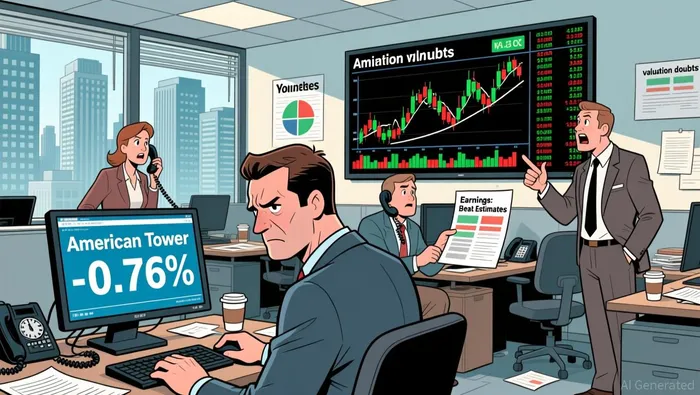
American Tower (AMT) closed 0.76% lower on 2025-11-20, with a trading volume of $0.55 billion, ranking 211th in U.S. market activity for the day. The stock opened at $181.63, below its 50-day moving average of $187.84 and 200-day average of $204.69, reflecting a bearish near-term trend. Despite a 7.7% year-over-year revenue increase and third-quarter earnings of $2.78 per share (exceeding estimates of $2.64), the share price underperformed relative to its 52-week range of $172.51–$234.33. Analysts project FY2025 earnings of $10.14 per share, below the company’s guidance of $10.60–$10.72, suggesting a potential earnings gap could weigh on investor sentiment.
Key Drivers
Institutional Investor Activity and Insider Confidence
Significant institutional buying in the second quarter underscored confidence in American Tower’s fundamentals. Greenland Capital Management LP increased its stake by 82.5%, acquiring 11,570 shares to hold 25,601 shares valued at $5.66 million. Other investors, including Hopwood Financial Services, Legacy Investment Solutions, and Rosenberg Matthew Hamilton, also boosted their positions, while Saudi Central Bank and Accredited Wealth Management LLC initiated new stakes. Director Eugene F. Reilly’s $994,000 purchase of 5,554 shares—marking a 4,114% increase in his ownership—further signaled insider optimism. However, Land & Buildings Investment Management and AEW Capital Management exited or reduced positions in Q3, reflecting divergent institutional strategies amid valuation debates.
Earnings Outperformance and Guidance
American Tower’s third-quarter results outperformed expectations, with $2.78 earnings per share and $2.72 billion in revenue, surpassing estimates of $2.64 and $2.65 billion, respectively. The company’s return on equity of 28.79% and net margin of 28.11% highlighted operational efficiency, while its 7.7% year-over-year revenue growth demonstrated resilience in the real estate sector. The FY2025 guidance of $10.60–$10.72 per share, above analysts’ consensus of $10.14, suggested management’s confidence in sustaining momentum. However, the stock’s price-to-earnings ratio of 29.01, combined with a PEG ratio of 1.08, indicated potential overvaluation relative to growth prospects, complicating bullish interpretations.
Dividend Payout and Financial Risks
The REIT’s $1.70 quarterly dividend (3.7% yield) attracted income-focused investors but raised concerns due to its 108.6% payout ratio, signaling reliance on debt or asset sales to fund distributions. While high-yield dividends typically bolster REIT appeal, the elevated payout ratio—coupled with a debt-to-equity ratio of 3.24—highlighted liquidity risks. Analysts noted the dividend’s sustainability could be jeopardized if earnings falter, particularly given the company’s leverage and exposure to interest rate fluctuations. This tension between yield attractiveness and financial prudence influenced investor decisions, with some institutions trimming stakes despite earnings strength.
Analyst Sentiment and Market Position
Analyst ratings were mixed, with two “Strong Buy” ratings, 13 “Buy” ratings, and five “Hold” ratings, resulting in a “Moderate Buy” consensus and a $228.44 average price target. Upgrades from Jefferies and Wells Fargo were offset by downgrades from Hsbc and Goldman Sachs, reflecting uncertainty about valuation and macroeconomic headwinds. The stock’s beta of 0.85 and market capitalization of $85.03 billion positioned it as a relatively stable, large-cap REIT, but its performance lagged behind peers like Crown Castle and Prologis, which received larger institutional inflows in Q3. The mixed analyst outlook and competitive landscape added complexity to its near-term trajectory, with investors balancing optimism over earnings with caution regarding financial metrics.

Stay ahead of the market.
Get curated U.S. market news, insights and key dates delivered to your inbox.
AInvest
PRO
AInvest
PRO



Comments
No comments yet