
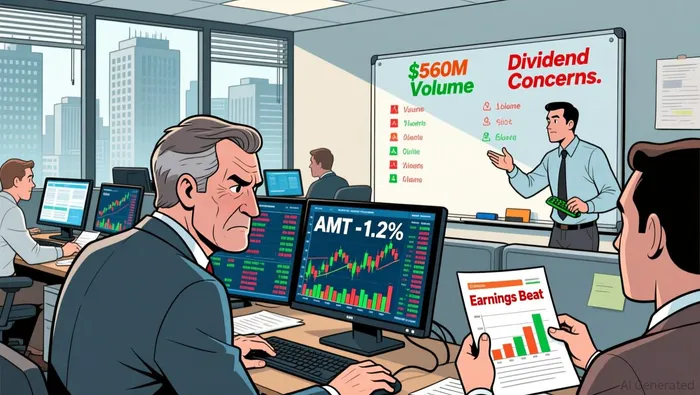
American Tower's 1.2% Drop Amid 211st-Ranked $560M Volume Highlights Earnings Beat vs. Dividend Concerns
 Aime Summary
Market Snapshot
American Tower Corporation (AMT) closed on November 13, 2025, with a 1.21% decline in share price, marking a negative day for the real estate investment trust (REIT). The stock opened at $184.88 and underperformed broader market benchmarks, reflecting investor caution. Trading volume reached $0.56 billion, ranking 211th in daily liquidity, a moderate level for a company with an $86.57 billion market capitalization. Despite the decline, AMT’s quarterly earnings report on October 28 exceeded expectations, with $2.78 earnings per share (EPS) surpassing the $2.64 forecast and revenue of $2.72 billion up 7.7% year-over-year. The stock’s 52-week range of $172.51 to $234.33 and a price-to-earnings (P/E) ratio of 29.53 highlight its valuation relative to peers. A quarterly dividend of $1.70 per share (annualized $6.80) was also announced, yielding 3.7%, though the payout ratio of 108.63% raises sustainability concerns.
Key Drivers
Earnings Momentum and Guidance
American Tower’s recent quarterly results underscored its resilience in the communications infrastructure sector. The company’s $2.78 EPS outperformed estimates by $0.14, driven by 7.7% year-over-year revenue growth to $2.72 billion. Management’s FY2025 guidance of $10.60–$10.72 EPS, exceeding the $10.14 sell-side consensus, signaled confidence in its business model. However, the stock’s 5.31% decline over the past 52 weeks and a 2.76% one-month drop suggest investor skepticism about sustaining this growth trajectory. Analysts remain divided, with a “Moderate Buy” consensus rating but divergent price targets ranging from $210 to $251.
Institutional Investor Activity
Recent filings reveal mixed institutional sentiment. ProShare Advisors increased its stake by 10.4% in Q2, while Geode Capital Management and M&G PLC trimmed holdings, reflecting uncertainty about AMT’s near-term prospects. Director Eugene F. Reilly’s $994,000 investment in 5,554 shares signaled insider confidence, though this paled against broader institutional outflows. Baron Real Estate Fund attributed the stock’s underperformance to delayed U.S. billings and concerns over a small customer’s (DISH) contractual obligations, which could impact churn rates following EchoStar’s spectrum license divestiture. These factors, combined with a high payout ratio, may have dampened enthusiasm among large investors.
Dividend Sustainability and Analyst Outlooks
AMT’s 3.7% yield remains a key draw for income-focused investors, but the 108.63% payout ratio raises red flags about long-term sustainability. Analysts highlighted this risk in recent reports, with Hsbc Global Res downgrading the stock from “Strong-Buy” to “Hold” and Goldman Sachs lowering its price target from $250 to $230. Jefferies Financial Group similarly cut its target to $226, citing valuation pressures. Despite these concerns, the company’s robust balance sheet—with a debt-to-equity ratio of 3.24 and a 28.79% return on equity—provided some reassurance. Institutional ownership at 92.69% underscores the stock’s appeal to long-term investors, though recent selling by funds like Forsta AP Fonden (a 3.5% stake reduction) suggests caution.
Sector and Market Dynamics
AMT’s performance is tied to broader REIT trends and macroeconomic conditions. As a global leader in communications infrastructure, the company benefits from 5G expansion and AI-driven data center demand. However, rising interest rates and inflationary pressures weigh on REIT valuations, particularly for high-payout stocks like AMTAMT--. Analysts at Goldman Sachs noted that while AMT’s core business remains stable, its relative underperformance against the MSCI US REIT Index (up 4.49% in Q3) highlighted sector-specific challenges. Additionally, the stock’s beta of 0.85 indicates slightly lower volatility than the broader market, but this may not offset concerns about margin compression in a high-rate environment.
Insider and Analyst Sentiment
Insider transactions and analyst ratings further contextualize the stock’s trajectory. Director Reilly’s purchase of 5,554 shares at $178.99 per share signaled confidence in AMT’s intrinsic value, though the 4,114.07% increase in ownership was a small absolute stake. Analysts at Royal Bank of Canada and Argus maintained “Buy” ratings, citing the company’s strategic position in the 5G ecosystem, but Weiss Ratings and Barclays emphasized caution. The mixed messaging—from upgraded targets to downgraded recommendations—reflects the tug-of-war between AMT’s strong operational metrics and macroeconomic headwinds.
In summary, American Tower’s recent performance reflects a balance of positive fundamentals (earnings growth, infrastructure demand) and cautionary signals (high payout ratio, institutional outflows). Investors must weigh these factors against broader market dynamics to assess its long-term potential.

Stay ahead of the market.
Get curated U.S. market news, insights and key dates delivered to your inbox.
AInvest
PRO
AInvest
PRO



Comments
No comments yet