
American Signature's Chapter 11 Filing and Creditor Exposure: A Case Study in Retail Liquidity Stress


 Aime Summary
Liquidity Stress and the Path to Bankruptcy
American Signature's Chapter 11 filing in the U.S. Bankruptcy Court for the District of Delaware marks a pivotal moment for a company long reliant on high-debt, asset-heavy operations. According to a report by , the company's top 30 creditors hold combined claims exceeding $80 million, with significant exposure to entities like Man Wah MCO ($14.6 million) and Targetcast LLC ($12.6 million). This concentration of debt, as of Q3 2025, coupled with a net debt to gross asset value of 58.6%, highlights the precarious balance between asset-backed financing and operational cash flow.
The company's liquidity crisis has been exacerbated by its real estate holdings. A $99 million liability tied to the 1140 Avenue of the Americas property is undergoing a cooperative consensual foreclosure, while a $50 million loan for the 400 E. 67th Street/200 Riverside properties has been accelerated due to an event of default as reported in the Q3 2025 results. These developments reflect the vulnerability of retail firms with sprawling physical footprints in a market increasingly dominated by e-commerce and leaner business models. 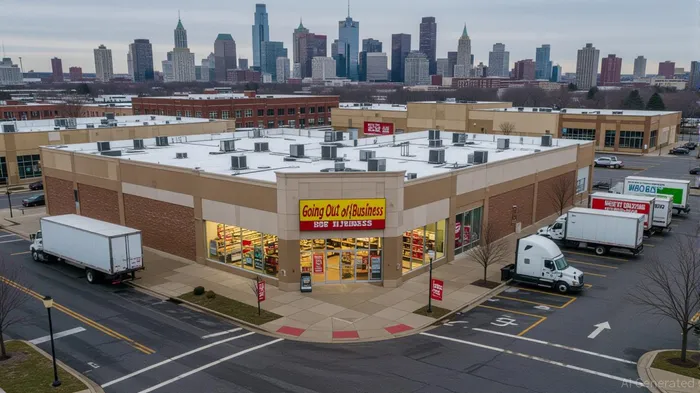
Stalking Horse Bids and DIP Financing: A Stopgap Solution?
To stabilize operations during restructuring, American Signature has secured $50 million in DIP financing from Second Avenue Capital Partners. While this provides temporary breathing room, it does not address the structural challenges of a debt load dominated by fixed-rate obligations with a weighted-average interest rate of 5.3%. The company's proposed stalking horse asset purchase agreement with ASI Purchaser LLC, pending court approval, aims to maximize stakeholder value but introduces uncertainty about the valuation of its real estate and inventory.
For secured creditors, the outcome of these proceedings will hinge on the success of the asset sale and the priority of claims. The 1140 Avenue of the Americas property, for instance, could become a critical asset in the restructuring, but its value may be diminished by the ongoing foreclosure process. Similarly, the accelerated $50 million loan for the 400 E. 67th Street property raises questions about the enforceability of collateral rights in a bankruptcy context.
Ripple Effects for Secured Creditors and the Retail Sector
American Signature's case is emblematic of a broader trend: the increasing pressure on asset-backed lenders to reevaluate risk exposure in the retail sector. Legacy retailers with high leverage and declining foot traffic are becoming default risks, forcing creditors to navigate complex bankruptcy dynamics. For example, the cooperative consensual foreclosure at 1140 Avenue of the Americas-a process that avoids traditional bankruptcy litigation-demonstrates how lenders are adapting to extract value from distressed assets while minimizing legal and operational costs.
However, such strategies are not without pitfalls. The acceleration of the 400 E. 67th Street loan illustrates how even secured creditors can face unexpected losses when borrowers fail to meet covenants. This volatility underscores the need for lenders to stress-test their portfolios against scenarios where retail tenants default, leaving lenders to liquidate commercial real estate in weak markets.
Conclusion: A Cautionary Tale for Retail Finance
American Signature's Chapter 11 filing serves as a cautionary tale for investors and creditors alike. The company's liquidity crisis, rooted in an outdated business model and overreliance on fixed-rate debt, highlights the risks of financing asset-heavy retail operations in a digital-first economy. For secured creditors, the case reinforces the importance of proactive risk management, including diversification of collateral and contingency planning for rapid asset devaluation.
As the restructuring unfolds, stakeholders will watch closely to see whether the stalking horse bid and DIP financing can catalyze a viable path forward. Yet, even a successful restructuring may not fully restore confidence in a sector where the old rules of capital allocation are increasingly obsolete.

Delivering real-time insights and analysis on emerging financial trends and market movements.
Latest Articles
Stay ahead of the market.
Get curated U.S. market news, insights and key dates delivered to your inbox.


AInvest
PRO
AInvest
PRO



Comments
No comments yet