
American Express Shares Drop 2.07% Amid AIG's Leadership Turmoil as $1.05B Volume Ranks 96th in U.S. Trading
 Aime Summary
Market Snapshot
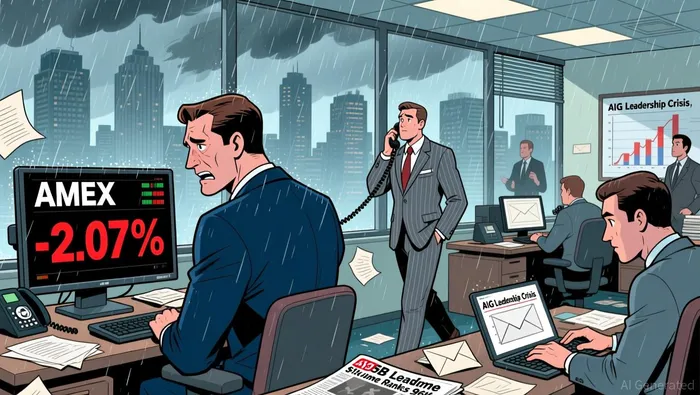
On November 14, 2025, American ExpressAXP-- (AXP) experienced a 2.07% decline in share price, closing below its previous day’s value. The stock traded with a volume of $1.05 billion, ranking 96th in trading activity among U.S. equities. While the drop was notable, the volume suggests moderate investor engagement relative to broader market activity. The performance occurred amid a broader market context where AIG’s strategic announcements and executive changes dominated headlines for the insurance sector, though AXP’s specific drivers remain unaddressed in the provided data.
Key Drivers
The provided news articles focus exclusively on American International Group (AIG), a separate entity from American Express (AXP), and do not directly relate to AXP’s stock performance. However, the broader insurance sector’s volatility, influenced by AIG’s executive turmoil and strategic shifts, may have indirectly impacted market sentiment for financial stocks, including AXPAXP--.
AIG’s Executive Leadership Shake-Up
AIG announced that John Neal, appointed as president effective December 1, 2025, will no longer join the company due to personal circumstances. This follows a pattern of executive instability at AIGAIG--, including the recent departure of David McElroy, who faced sexual assault allegations in 2024. Neal’s withdrawal was precipitated by scrutiny over his undisclosed romantic relationship with a subordinate at a prior employer, QBE, which led to a $550,000 bonus reduction and his resignation in 2017. The mutual agreement between AIG and Neal highlights ongoing reputational and governance risks for the insurer, potentially affecting investor confidence in its leadership pipeline.
Strategic Transactions and Market Positioning
AIG executed a $1 billion secondary offering of Corebridge Financial shares, transferring 6.3% ownership to J.P. Morgan Securities. This move underscores AIG’s liquidity strategy amid its acquisition of Everest Group’s retail insurance portfolios, expected to generate $2 billion in premiums. While these transactions aim to strengthen AIG’s market position, they also raise questions about short-term dilution for shareholders and the complexity of managing a diversified insurance portfolio.
Governance and Organizational Uncertainty
With CEO Peter Zaffino now tasked with redefining AIG’s organizational structure, the lack of a clear replacement for Neal introduces uncertainty about the company’s leadership continuity. AIG’s board has not disclosed details about future executive appointments or strategic priorities, which could delay critical decision-making in a competitive insurance landscape. The absence of transparency risks eroding stakeholder trust, particularly in light of prior controversies involving executive conduct.
Sector-Wide Implications
The insurance sector’s sensitivity to leadership changes and operational complexity is evident in AIG’s case. AXP, as a financial services peer, operates in a different but interrelated space. While AXP’s performance is not directly tied to AIG’s news, sector-wide concerns about governance, regulatory scrutiny, and executive stability could contribute to broader market jitters, indirectly influencing AXP’s stock. Investors may be recalibrating risk assessments for financial institutions amid these developments.
In conclusion, while the provided data does not explicitly link AXP’s 2.07% decline to AIG’s news, the interconnected nature of financial markets and sector-specific risks suggest that AIG’s turmoil could have contributed to a cautious investor mood. The lack of direct information on AXP’s fundamentals or earnings means the analysis remains speculative, but the broader context of executive instability and strategic complexity in the insurance sector provides a plausible framework for understanding the market’s reaction.

Stay ahead of the market.
Get curated U.S. market news, insights and key dates delivered to your inbox.
AInvest
PRO
AInvest
PRO



Comments
No comments yet