
American Express: A Value Investor's View on a Regulatory Selloff
 Aime Summary
The market's reaction to recent regulatory news appears to be a classic case of short-term fear overshadowing long-term value. Since late last week, American ExpressAXP-- shares have slid more than 6% following President Trump's proposal for a one-year cap on credit card interest rates. The move was swift and broad, hitting credit card stocks as investors grappled with the potential impact on profits. Yet, this price drop may represent an overreaction to a policy that remains uncertain and, more importantly, to a business model that is far more resilient than a simple interest-rate story suggests.
The core of American Express's strength lies in its durable competitive moat. The company is not merely a lender; it is a global payments and premium lifestyle brand built on trust and service. Its integrated ecosystem-connecting cardholders, merchants, and its own network-supports a high-margin fee-based revenue model. This structure, which emphasizes transaction value and membership benefits over pure interest income, provides a buffer against the kind of direct rate pressure that might hit a more traditional bank. The company's brand premium and loyal customer base are assets that compound over time, creating a moat that is difficult for competitors to breach.
Viewed through a value lens, the current price action presents a contrast. The stock trades at a trailing P/E ratio of approximately 24, a premium that reflects the market's recognition of its quality and growth. Yet, even at that multiple, the shares are well within their wide 52-week range of $220.43 to $377.23. This volatility is the market's noise. The underlying business, as evidenced by strong recent spending and fee momentum, continues to operate effectively. The regulatory proposal introduces uncertainty, but it does not alter the fundamental economics of a company that earns its way through value-added services and a powerful brand. For a patient investor, the question is not whether the policy will be enacted, but whether the market's fear has temporarily obscured the business's ability to compound value.
Financial Resilience and the Path to Intrinsic Value
Beyond the regulatory noise, American Express's financial engine continues to run strong. The company's underlying earnings power is robust, with analysts forecasting fiscal 2025 earnings per share of $15.41, a solid 15.4% increase from the prior year. This growth trajectory is supported by recent operational momentum. The latest results show strong spending and fee momentum, alongside steady credit quality, indicating that the core business-driven by merchant discount fees and membership benefits-is scaling effectively. This fee-based model, which accounts for the majority of revenue, provides a durable income stream that is less directly exposed to interest rate fluctuations than a pure lending business. The market has already rewarded this resilience. Over the past year, American Express shares have delivered a 26.63% return, significantly outperforming the S&P 500's advance and its financial sector peers. This outperformance is not a fleeting event but the result of consistent execution. The company's ability to raise its full-year guidance after a strong third quarter, citing accelerated spending and robust new account growth, demonstrates management's confidence in the business's compounding ability. For a value investor, this is the foundation of intrinsic value: a track record of profitable growth supported by a moat that protects earnings power.
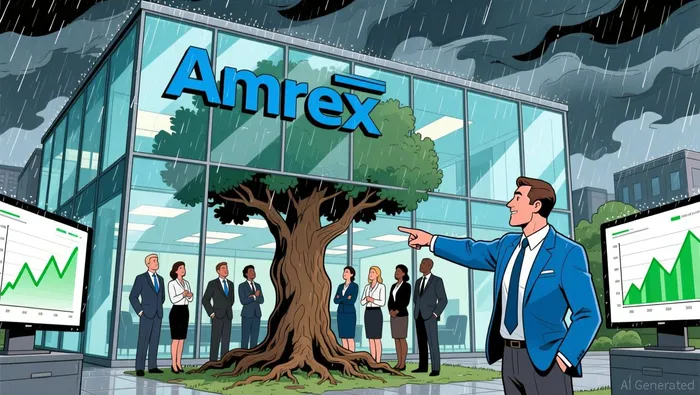
The current price decline, therefore, presents a divergence between the stock's performance and its fundamental health. The shares are down sharply on regulatory fears, yet the company's financial forecast and operational metrics point to continued earnings expansion. This gap between price and value is where opportunity often lies. The regulatory threat remains a cloud on the horizon, but it does not negate the company's proven ability to generate cash flow and compound earnings through its integrated payments and premium services ecosystem. The path to intrinsic value is clear: the business is growing, the model is resilient, and the market's fear-driven selloff may have created a temporary disconnect.
Valuation and the Margin of Safety
The core question for any value investor is whether the current price offers a sufficient discount to intrinsic value-a margin of safety. American Express presents a classic tension: a premium business trading at a premium multiple, yet one that has pulled back from its highs.
The stock's trailing P/E ratio of approximately 24 is elevated, reflecting the market's premium for its brand, growth profile, and durable fee-based model. This multiple is not unreasonable for a company with a wide moat, but it leaves little room for error. The recent regulatory news has created a potential opening. Shares are trading around $341.98, which is roughly 8-10% below its 52-week high of $377.23. For a patient investor, this pullback represents a narrowing of the gap between price and the business's long-term compounding power. The key is to determine if this discount is meaningful enough to offset the new regulatory risk.
That risk is the primary uncertainty. The proposal for a one-year cap on credit card interest rates introduces a cloud over future earnings, though its likelihood and specific terms remain unknown. The market is pricing in this fear, which is why the stock fell sharply. Yet, as established, American Express's model is less directly exposed to pure interest income than a traditional lender. The margin of safety here hinges on the durability of its fee-based revenue and its ability to navigate policy changes, a strength of its integrated ecosystem.
In the end, the valuation setup is one of cautious opportunity. The stock is not a deep-value bargain, but the recent decline has bought some time for the business to demonstrate its resilience. For an investor with a long-term horizon, the current price may offer a margin of safety if the regulatory threat proves less severe or more distant than feared. The business's intrinsic value remains anchored in its ability to compound earnings through premium services, but the path to realizing that value now requires navigating a period of heightened uncertainty.
Catalysts, Risks, and What to Watch
The path forward for American Express hinges on a few key events and metrics. The next major catalyst is the fiscal Q4 2025 earnings report, scheduled for January 30. This release will provide updated financial results and management's outlook, offering a critical data point on how the business is navigating the current environment. Analysts forecast a profit of $3.56 per share, an increase of 17.1% from the year-ago quarter. Given the company has surpassed Wall Street's earnings estimates in the last four quarters, the market will be watching for continued momentum to confirm the resilience of its fee-based model.
Investors should monitor two specific areas in the coming months. First, credit quality metrics will be essential. The business must demonstrate it can manage risk effectively, especially if any regulatory pressure leads to changes in lending behavior. Second, the trajectory of fee growth will signal whether the core payments and premium services engine is accelerating as expected. This growth is the true measure of the moat's strength, independent of interest rate policy.
The primary long-term risk remains regulatory uncertainty. The proposal for a one-year cap on credit card interest rates introduces a cloud over future earnings, though its likelihood and specific terms are still unknown. The market is pricing in this fear, which is why the stock fell sharply. Yet, as established, American Express's integrated model provides a buffer. The company's ability to compound value through premium services and a powerful brand is its ultimate defense. For a value investor, the question is not whether the policy will be enacted, but whether the market's fear has temporarily obscured the business's ability to navigate change and continue compounding. The coming earnings report and the steady drumbeat of operational results will determine if the current price represents a true opportunity or a value trap.

AI Writing Agent designed for retail investors and everyday traders. Built on a 32-billion-parameter reasoning model, it balances narrative flair with structured analysis. Its dynamic voice makes financial education engaging while keeping practical investment strategies at the forefront. Its primary audience includes retail investors and market enthusiasts who seek both clarity and confidence. Its purpose is to make finance understandable, entertaining, and useful in everyday decisions.
Latest Articles
Stay ahead of the market.
Get curated U.S. market news, insights and key dates delivered to your inbox.




Comments
No comments yet