
American Eater Wins Again: DoorDash & McDonald’s Feed Investor Appetites With Fresh Beats
 Aime Summary
DoorDash (DASH) and McDonald’sMCD-- (MCD) both served up hotter-than-expected second-quarter numbers this week, bucking concerns that U.S. consumers were dialing back discretionary spending. DASH: Revenue jumped 25 % Y/Y to $3.28 B and adjusted EPS swung to $0.65 from a loss a year ago. Total orders hit 761 M (+20 %) and Marketplace Gross Order Value (GOV) climbed 23 % to $24.2 B, prompting a higher Q3 GOV outlook. The stock is now +59 % YTD. MCD: Global comparable sales rose 3.8 %, powered by a 2.5 % U.S. rebound as customers spent more per visit on value-priced bundles. Revenue grew 5 % to $6.84 B, while adjusted EPS of $3.19 beat forecasts. Shares are up roughly +6 % YTD, lagging the S&P 500 but reversing a tough spring.
DoorDash Delivers Double-Digit Growth
CEO Tony Xu credited “consistent consumer demand for convenient food consumption,” highlighting expansion into groceries and electronics that keeps average order frequency rising. With GOV guidance of $24.2–$24.7 B for Q3—again ahead of consensus—DASH is leaning on its DashPass loyalty program and the pending Deliveroo acquisition to deepen its moat.
Macro read-through: A still-resilient “convenience economy” suggests U.S. households are prioritizing time savings even as real wage growth slows. That supports delivery platforms—and the restaurants that partner with them—heading into the key holiday period.
Golden Arches Reignite Value Traffic
McDonald’s is proving that price-sensitive diners can be coaxed back with the right messaging. Promotions like the $2.99 Snack Wrap and an upcoming “McDonaldland Meal” tie-in drove menu-mix gains, while loyalty enrollment (25 % of U.S. customers) kept frequency high. Management reaffirmed full-year guidance and plans to open 2,200 stores in 2025, betting on scale to blunt rising commodity costs.
Macro read-through: Middle-income consumers are trading down from casual dining but not abandoning quick service, especially when inflation-adjusted value is clear—an encouraging sign for the broader fast-food cohort.
ETF Angle — PEJ vs PBJ: Who Gets the Bigger Bite?
DoorDash and McDonald’s both sit inside the two best-known “restaurant-plus” funds, but the size of each serving differs. The Invesco Food & Beverage ETF (PBJ) devotes 6.28 % of its assets to DoorDashDASH-- and 4.78 % to McDonald’s, marginally topping the 5.87 % and 4.47 % stakes held by the Invesco Leisure & Entertainment ETF (PEJ).
That extra weight makes PBJ the purer “quick-meal” play, but it also anchors the fund to slower-growing staples such as packaged-food giants—one reason PBJ is only +3 % YTD despite the pop in DoorDash.
PEJ, by contrast, balances its slightly smaller allocations to DASHDASH-- and MCDMCD-- with cyclical travel names like Royal Caribbean and United AirlinesUAL--. The reopening kicker explains why PEJPEJ-- is +8 % YTD, more than twice PBJ’s pace, even though it owns a touch less of each headline stock.
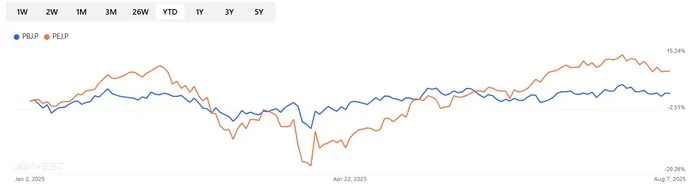
Takeaway: Investors seeking pure-play upside from delivery and restaurant momentum may prefer PEJ, while PBJ offers a steadier grocery-aisle ballast if macro data sours.
Bottom line:
“American eater wins again” aptly captures Q2: consumers still crave both convenience and value, and the platforms meeting those needs are being rewarded. DASH showcases the staying power of delivery as a service, while MCD’s marketing machine proves that even in a tight wallet environment, brand loyalty and sharp pricing can reignite growth. For ETF investors, PEJ captures this reopening-meets-services story more directly, whereas PBJ provides a defensible but slower-moving shelter.
Quickly compare PEJ and PBJ ETFs side-by-side with our ETF Compare Tool

Market Radar delivers concise, daily trading ideas by tracking everything from options activity and market sentiment to high-profile political trades.
Latest Articles
Stay ahead of the market.
Get curated U.S. market news, insights and key dates delivered to your inbox.
AInvest
PRO
AInvest
PRO



Comments
No comments yet