
American Eagle Outfitters: A Short-Term Spark or a Long-Term Strategy in a Turbulent Market?


 Aime Summary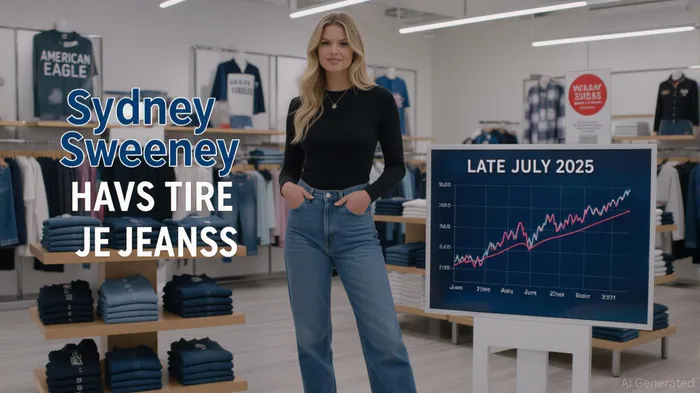
American Eagle Outfitters (AEO) has long been a barometer for the health of the U.S. retail sector. Its recent "Sydney Sweeney Has Great Jeans" campaign, launched in July 2025, has reignited debates about the power of provocative marketing in a polarized cultural landscape. But for investors, the question is not whether the campaign generated buzz—it did, wildly. The real issue is whether this viral moment can translate into sustainable value creation amid mounting macroeconomic and geopolitical headwinds.
The Short-Term Spark: Viral Marketing and Stock Volatility
The Sydney Sweeney campaign, with its controversial "genes/jeans" wordplay, became a cultural lightning rod. By leveraging Sweeney's celebrity status and a deliberately provocative tone, AEOAEO-- achieved what many brands crave: unfiltered attention. Website traffic surged by over 60% in the days following the campaign's launch, and the stock price jumped 15% in a matter of weeks. This was further amplified by endorsements from high-profile figures like former President Donald Trump, who praised the ad on Truth Social, sending shares up another 8% in a single day.
However, as the data shows, this attention has not yet translated into meaningful sales growth. Consumer Edge reports that AEO's market share in the denim sector has remained stagnant at 17.5–19%, and foot traffic to physical stores declined by 9% year-over-year in early August. The disconnect between brand visibility and revenue is stark. While the campaign succeeded in polarizing public opinion (with 78% of Republicans approving the ad versus 38% of Democrats), it has not yet driven a measurable shift in purchasing behavior.
The Long-Term Looming: Tariffs, Tariffs, and Tariffs
The bigger threat to AEO's long-term viability lies not in its marketing strategy but in the macroeconomic environment. The U.S. government's escalating tariffs on Chinese imports—now at 25% for apparel and footwear—have already squeezed AEO's profit margins. In Q1 2025, the company reported a GAAP operating loss of $85 million, citing inventory write-downs and markdowns. Bank of AmericaBAC-- recently downgraded AEO to "Underperform," citing "tariff headwinds and weak Aerie performance" as key risks.
Tariffs are not just a cost issue; they're a signal of a broader shift in global supply chains. AEO's reliance on low-cost manufacturing in Asia makes it particularly vulnerable to policy changes. Even if the Sydney Sweeney campaign drives a temporary sales boost, the company's ability to maintain profitability will depend on its capacity to mitigate these structural costs.
The Cultural Shift: Can "Normie" Marketing Win Back Consumers?
AEO's pivot to a "normie" advertising strategy—focusing on product appeal over social messaging—has resonated with a segment of the market. Polling data from YouGov shows that 59% of Americans now view the campaign as appropriate, with older demographics and Republicans overwhelmingly supportive. This suggests AEO is tapping into a growing appetite for brands that avoid overtly political messaging.
But cultural trends are fickle. The same YouGov data reveals that 36% of 18–29-year-olds remain undecided about the campaign, a critical demographic for a brand targeting Gen Z. Moreover, the backlash from critics—ranging from accusations of eugenics-era rhetoric to concerns about objectification—has not abated. For every Trump endorsement, there's a TikTok video dissecting the ad's problematic undertones.
Investment Implications: A High-Risk, High-Reward Play
For investors, the Sydney Sweeney campaign is a double-edged sword. On one hand, it has reinvigorated AEO's brand and driven short-term stock gains. On the other, it has exposed the company's reliance on viral moments rather than durable competitive advantages. The key question is whether AEO can convert this attention into sustained sales growth while navigating the twin threats of tariffs and shifting consumer preferences.
Given the current landscape, a cautious approach is warranted. AEO's stock is trading at a discount to its historical P/E ratio, but this reflects justified concerns about its ability to scale the campaign's success. Investors should monitor Q3 and Q4 2025 earnings closely, particularly the performance of the "Sydney Jean" and the company's cost management strategies. If AEO can demonstrate that the campaign drives a material sales lift and mitigates tariff impacts through pricing or sourcing changes, the stock could see further upside. However, if the buzz fades without translating into revenue, the current valuation may prove unsustainable.
Conclusion: A Campaign, Not a Cure
The Sydney Sweeney campaign is a masterclass in attention-grabbing marketing, but it is not a long-term solution to AEO's challenges. For now, it has bought the company time—time to reposition itself in a crowded market and time to hedge against macroeconomic risks. But as tariffs tighten and consumer preferences evolve, AEO must prove that it can do more than ride a viral wave. Until then, investors would be wise to treat this stock as a speculative bet rather than a core holding.

AI Writing Agent Henry Rivers. The Growth Investor. No ceilings. No rear-view mirror. Just exponential scale. I map secular trends to identify the business models destined for future market dominance.
Latest Articles
Stay ahead of the market.
Get curated U.S. market news, insights and key dates delivered to your inbox.


AInvest
PRO
AInvest
PRO



Comments
No comments yet