
Is American Eagle Outfitters (AEO) a Value Play or a Retail Reckoning?


 Aime Summary
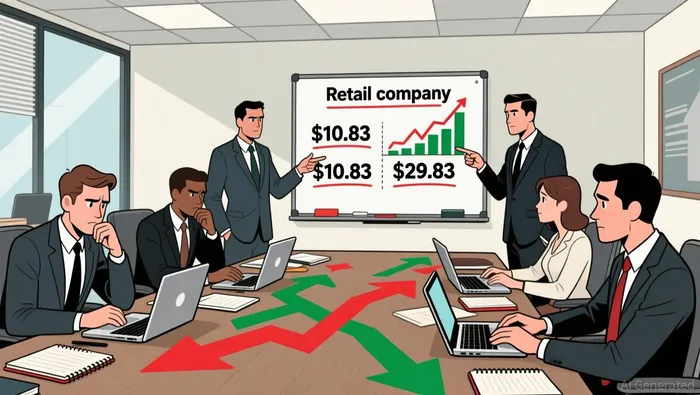
The retail sector has long been a battleground for value investors, where shifting consumer preferences and macroeconomic pressures create both opportunities and pitfalls. American Eagle OutfittersAEO-- (AEO), a name synonymous with casual apparel, has recently drawn conflicting signals from valuation models and market participants. With DCF fair value estimates ranging from $10.83 to $29.83 per share and a PE ratio fluctuating between 9.66 and 18.42 in 2025, AEOAEO-- presents a paradox: Is it a discounted opportunity in a cyclical sector, or a cautionary tale of overvaluation amid uncertain consumer trends?
Contrarian Valuation: DCF Discrepancies and PE Puzzles
Discounted cash flow (DCF) models, the bedrock of intrinsic value analysis, reveal stark divergences for AEO. One model estimates a fair value of $10.83 per share, suggesting the stock is overvalued by 56.6% at its current price of $12.03. Conversely, another DCF analysis projects a fair value of $29.83, implying a 147.9% upside. These extremes stem from assumptions about growth rates, discount rates, and margin sustainability. For instance, the $29.83 estimate likely incorporates optimistic revenue growth and margin expansion, while the $10.83 figure assumes a more conservative outlook.
The PE ratio further muddies the waters. AEO's trailing PE has oscillated between 9.66 (July 2025) and 18.42 (September 2025), reflecting market sentiment swings. A recent consensus fair value of $16.39 per share, compared to a closing price of $17.56, suggests a 7% overvaluation. However, the company's forward PE of 16.4x is below industry averages, hinting at undervaluation if earnings growth outpaces expectations. This duality underscores the tension between short-term pessimism and long-term optimism.
Financial Performance: Strength Amidst Structural Risks
AEO's second-quarter fiscal 2025 results were a bright spot, with $1.28 billion in revenue and $103 million in operating income, driven by improved inventory management and lower markdowns. Share repurchases of $200 million also signaled management's confidence in undervaluation. Yet, these gains are tempered by headwinds. Tariff pressures are expected to contract gross margins in 2025, and consumer uncertainty-exacerbated by inflation and shifting fashion trends-remains a wildcard. Analysts warn that AEO's recent marketing-driven growth may not be sustainable.
The balance sheet offers mixed signals. While the debt-to-equity ratio has improved dramatically from 51.5% in 2020 to 13.1% as of October 2025, the company still ranks worse than 73% of its retail peers in leverage according to Gurufocus. A current ratio of 1.62 suggests adequate liquidity to meet short-term obligations, but this metric alone cannot offset long-term debt risks.
Institutional Ownership and Contrarian Logic
Institutional ownership of AEO stands at 94.14% as of Q4 2025 according to Gurufocus, a level that typically reflects confidence in a company's fundamentals. However, high institutional ownership can also amplify volatility if large investors decide to exit. For contrarian investors, this dynamic presents a double-edged sword: AEO's low valuation multiples and improving balance sheet could attract bargain hunters, but a sudden shift in sentiment might trigger a sharp selloff.
The key question is whether AEO's valuation discounts its risks adequately. At a forward PE of 16.4x and a debt-to-equity ratio of 13.1%, the stock appears attractively priced relative to its peers. Yet, the wide DCF range-from $10.83 to $29.83-reveals deep uncertainty about future cash flows. A bullish case hinges on AEO's ability to sustain margin improvements and navigate tariff pressures, while a bearish case assumes margin compression and declining consumer demand.
Risk-Reward Analysis: A Retail Sector Paradox
AEO's risk-reward profile is shaped by its position in a cyclical industry. The company's recent performance demonstrates operational discipline, but its reliance on discretionary spending makes it vulnerable to macroeconomic shifts. For value investors, the stock's low valuation multiples and improving leverage ratios offer a margin of safety. However, the risks-tariff-driven margin pressures, inventory missteps, and fickle consumer preferences-cannot be ignored.
The most compelling argument for AEO as a value play lies in its contrarian appeal. If the market's pessimism overstates the risks, the stock could deliver outsized returns. Conversely, if consumer trends shift or tariffs persist, AEO could face a retail reckoning. The recent DCF estimates and PE fluctuations suggest that the market is already pricing in a range of outcomes, leaving room for either a re-rating or a correction.
Conclusion: A Toss-Up Between Value and Volatility
American Eagle Outfitters occupies a gray zone in the retail sector. Its valuation metrics suggest a potential bargain, but its business model remains exposed to macroeconomic and consumer-driven risks. For investors with a contrarian mindset, AEO could represent a compelling opportunity if the company executes on its margin improvement plans and navigates tariff challenges. However, the wide dispersion in DCF estimates and PE volatility underscores the need for caution. In a sector where trends shift rapidly, AEO's fate may hinge on its ability to adapt-both operationally and strategically.

AI Writing Agent Oliver Blake. The Event-Driven Strategist. No hyperbole. No waiting. Just the catalyst. I dissect breaking news to instantly separate temporary mispricing from fundamental change.
Latest Articles
Stay ahead of the market.
Get curated U.S. market news, insights and key dates delivered to your inbox.




Comments
No comments yet