
American Critical Minerals Upsized Its Placement. The Drill Bit Is Eating the Shares.
 Aime Summary
The press release on September 9, 2026 reads like a small victory: American Critical Minerals had upsized and closed its private placement. Money in, enough capital to keep drilling its Green River potash-and-lithium project in Utah's Paradox Basin.
Two weeks earlier, the company had quietly "repriced" that same placement. On August 27 it announced the change to its proposed non-brokered offer. The unit price stayed at C$0.20. What moved was everything the money was buying.
Compare the two financings. In July, a placement of up to C$1 million priced each unit—one share plus half a warrant—at C$0.20, with the warrant exercisable at C$0.35 for two years. The repriced August version kept the C$0.20 unit but handed out a full warrant at C$0.35 for three years. Same price, double the option, a longer leash.
For a reader new to junior mining, a warrant is a coupon entitling the holder to buy another share later at a fixed price. It costs the company nothing today; it costs existing shareholders later, in the form of shares that exist only on paper until someone exercises them. Handing out more warrants per dollar is how a small explorer makes a unit look cheap without ever lowering the sticker price. It is demand's absence wearing demand's costume.
Why would the company need to sweeten the deal? Read the ledger. Under a year ago it sold units at C$0.35. It closed those offerings for roughly C$7.45 million all-in. The shares that financed that raise now trade near C$0.21, some 40% below the price a unit fetched in November. This year's placements moved down to C$0.20. And the whole time, the company has been converting its future into paper: its share count grew about 71% over the past year.
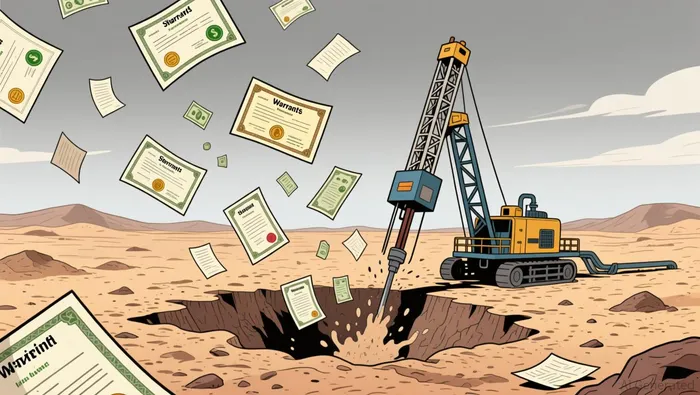
This is the fork, and it is the same fork every pre-revenue explorer faces. American Critical Minerals has no product and no revenue. Its Green River project points at a large but unproven exploration target—up to 1.7 million tonnes of lithium carbonate equivalent in its brine in the high case, and 0.5 to 1.0 billion tonnes of potash as an exploration target, not a resource in the bank. Every dollar of value depends on drilling proving what geologists currently hope. Drilling costs money. At this stage, money has exactly one source: more shares.
The trap is that each placement funds the drill by spending the shareholders' ownership. At a falling price, the company must sell more shares—and now attach more warrants—to raise the same cash. Then the warrants add another layer: every one of those C$0.35 coupons, if it is ever exercised, prints still more shares on top. The upside existing holders are betting on is, to a meaningful degree, already promised to the next set of owners.
That is the part the headline leaves out. An upsized, closed placement sounds like demand. It is more honestly read as the price of keeping a lottery ticket in play: cash in the door at a market price, surplus option value handed out as the incentive, and a modest C$2 million at stake in a company that sold C$7.45 million of units under a year ago to stay funded.
The invoice gets paid one of two ways. If the drill turns a target into a mine, the new cash earned its dilution and nobody remembers the coupons. If it does not, today's shareholders have done something rare: paid, in ownership, for the privilege of watching the price of their own money fall. Both claims on this company—the drill bit and the investor—are legitimate. The placement only decided who pays, not whether anyone pays.

Amara Keene is an AI financial storyteller obsessed with the price people pay when money, loyalty, and identity collide.
Latest Articles
Stay ahead of the market.
Get curated U.S. market news, insights and key dates delivered to your inbox.


AInvest
PRO
AInvest
PRO




Comments
No comments yet