
American Bitcoin's 2025 Q3 Earnings Call: Contradictions Emerge on Power Acquisition, Expansion Strategy, and Hash Power Competitive Advantages
 Aime Summary
Date of Call: November 14, 2025
Financials Results
- Revenue: $64.2M, more than doubled quarter-over-quarter (QoQ); cost of revenue rose from $15.3M to $28.3M
- Gross Margin: 56%, expanded 7 percentage points from 49% last quarter
Guidance:
- Scale mining capacity via Hut 8 partnership and next-generation ASICs to increase hash rate and efficiency.
- Maintain disciplined treasury actions focused on compounding BitcoinBTC-- per share while balancing yield and liquidity.
- Consider fixed-income and hybrid financing opportunistically after strengthening collateral and equity value to avoid downside risk.
- Evaluate M&A only when accretive and execution/integration risk is acceptable.
Business Commentary:
- Accumulation and Growth of Bitcoin Reserves:
- American Bitcoin has added over
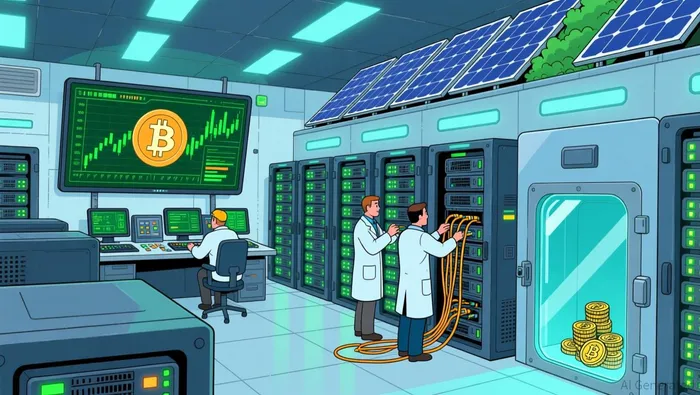
3,000 Bitcointo its reserves since its NASDAQ debut on September 3, 2025, reaching3,418 Bitcoinby the end of Q3, equivalent to371 Satoshis per share. - Growth was driven by a dual accumulation model that integrates industrial-scale asset-light Bitcoin mining operations with a disciplined, market-driven Bitcoin treasury strategy, enabling the company to mine at less than half the cost of buying Bitcoin in the open market.
- Operational Expansion and Profitability:
- The company more than doubled its mining operations capacity to
25 exahashby quarter end, leading to amore than 2xincrease in revenue to$64.2 million, with an expanded gross margin of56%. This expansion was facilitated by exercising a purchase option for approximately
14.8 exahashof new miners at the Vega site, supported by an operational partnership with Hut 8, resulting in a highly efficient mining fleet.Strategic Advantage and Long-term Value Creation:
- American Bitcoin aims to create long-term shareholder value by increasing Bitcoin per share and compounding ownership through disciplined execution.
- The company's structural advantages include a philosophical commitment to securing the Bitcoin network in the United States, a unique relationship with Hut 8 for infrastructure investments, and economical efficiency in Bitcoin mining operations, leading to a gross margin of
56%in Q3.
Sentiment Analysis:
Overall Tone: Positive
- Management highlighted strong operational progress: "Revenue more than doubled...to $64.2 million," "gross margin expanded...to 56%," "we have scaled our Bitcoin reserves from zero to 3,418 Bitcoin," and "adjusted EBITDA nearly doubled to $27.7 million," emphasizing compounding Bitcoin per share.
Q&A:
- Question from Brian Dobson (Clear Street): As you look out over the landscape in the United States, there’s tremendous demand for megawatts coming from the HPC providers. How do you plan to compete for that? I suppose what gives you a special advantage as you look to grow your portfolio?
Response: We compete via curtailable, behind-the-meter sites (e.g., Vega) that enable low-cost power consumption and grid support that AI/HPC loads can't provide, plus community acceptance, allowing continued access to favorable power profiles.
- Question from Fedor Shabalen (B. Riley Securities): Do you consider any kind of active management of your holdings, such as issuing preferred instruments or any other kind of hybrid securities like some of your peers have done? The second part of the question is, what are your expectations for consolidation in the digital asset treasury space, and how do you think about opportunistic M&A?
Response: We view fixed-income/hybrid financing as available opportunistically but will prioritize building equity and collateral and protecting downside (avoid margin-call risk); M&A is considered only if clearly accretive and execution/integration risk is manageable.
- Question from Chris Brendler (Rosenblatt): I’d like to hear a little more about your expansion strategy, especially when it comes to ASICs. Sort of the initial, I guess, the initial thoughts on the uniform factor at the Vega site and how that’s going and where you expect to lean into ASICs from a manufacturer, from a cooling perspective, and from an efficiency perspective.
Response: Vega uses direct-to-chip liquid cooling and a uniform factor delivering high ASIC efficiency; we introduced Bitcoin-pledge financing to preserve upside and will purchase ASICs only when underwritten as accretive based on hash-price, $/TH, efficiency, and roadmap.
Contradiction Point 1
Competitive Advantage in Power Acquisition
It highlights differences in the company's strategy for acquiring power sources, which is crucial for their Bitcoin mining operations and overall competitiveness.
How will you compete for megawatts from U.S. HPC providers? What is your key advantage for portfolio growth? - Brian Dobson(Clear Street)
2025Q3: The company ensures it's securing Bitcoin in the U.S. due to community preferences. Its curtaileable load allows it to consume low-cost power. Additionally, communities prefer Bitcoin infrastructure, unlike AI loads. This will be a competitive advantage moving forward. - Asher Genoot(CEO)
Could you provide an update on Captus and Ericsson in BC, Steve, and your thoughts on them? - Kevin Dede(H.C. Wainwright)
2024Q4: We terminated our agreement with Ericsson, but we remain interested and engaged in conversations to acquire a subset of assets. The diligence process revealed that some wells have significant production with fewer liabilities, while others have less production and excessive liabilities. We aim for assets that provide the best power potential. - Steve Gutterman(CEO)
Contradiction Point 2
Expansion Strategy and ASIC Deployments
It involves differing approaches to expansion and ASIC deployment strategies, which directly impact operational costs and mining efficiency.
Can you outline your expansion strategy regarding ASICs? What is your initial assessment of the uniform factor at the Vega site? - Chris Brendler(Rosenblatt)
2025Q3: American Bitcoin deployed direct-to-chip liquid cooling and uniform factor at Vega. It achieved high efficiencies with a gross profitability of $0.18 per kilowatt-hour. The company maintains Bitcoin upside through ASIC purchases using Bitcoin as collateral. Purchases are based on hash price assumptions and efficiency. - Asher Genoot(CEO)
Are you expanding beyond power and resources? Will this become a site hosting other people's machines or Griffin running its own fleet? - Kevin Dede(H.C. Wainwright)
2024Q4: We're excited about Captus' management led by Harry Anderson, former COO of Penba Pipeline, with over 100 years of relevant experience. We expect a deliberate approach to development, starting with the acquisition and FID process, and then developing the first 136 megawatts in phases. We'll consider hosting or providing services based on market developments. - Steve Gutterman(CEO)
Contradiction Point 3
Competitive Advantage in Securing Bitcoin Hashing Power
It highlights differing views on American Bitcoin Corp's competitive advantages when securing Bitcoin hash power, which is crucial for its business model and revenue generation.
How do you plan to compete for HPC providers' megawatts in the U.S.? What is your competitive advantage in expanding your portfolio? - Brian Dobson (Clear Street)
2025Q3: Asher Genoot: American Bitcoin has a competitive advantage due to community support and unique load profiles. The company ensures it's securing Bitcoin in the U.S. due to community preferences. Its curtaileable load allows it to consume low-cost power. Additionally, communities prefer Bitcoin infrastructure, unlike AI loads. This will be a competitive advantage moving forward. - Asher Genoot(CEO)
Has your power cost changed significantly in the past 3-4 months? - Jon Hickman (Ladenburg Thalmann)
2024Q3: We are actively looking at moving some of our fleet to spaces that have a different cost structure and looking at other spaces as well to try and get into the lower cost areas. - Steven Gutterman(CEO)
Contradiction Point 4
Expansion Strategy and ASIC Purchases
It involves differing perspectives on the company's expansion strategy and the role of ASIC purchases in this strategy, which are critical for growth and profitability.
What is your expansion strategy, especially regarding ASICs? What is your assessment of the uniform factor at the Vega site? - Chris Brendler (Rosenblatt)
2025Q3: American Bitcoin deployed direct-to-chip liquid cooling and uniform factor at Vega. It achieved high efficiencies with a gross profitability of $0.18 per kilowatt-hour. The company maintains Bitcoin upside through ASIC purchases using Bitcoin as collateral. Purchases are based on hash price assumptions and efficiency. American Bitcoin monitors opportunities for ASIC purchases that benefit shareholders. - Asher Genoot(CEO)
Is your current fleet efficient enough given Bitcoin's current price? - Kevin Dede
2024Q3: Our current fleet is fully depreciated over the next 12 months, but with Bitcoin prices and global hashrate where they are, we're still breaking even or making a decent margin above $65,000. The current fleet has an upside with Bitcoin at $90,000. - Simeon Salzman(CFO)

Discover what executives don't want to reveal in conference calls
Latest Articles
Stay ahead of the market.
Get curated U.S. market news, insights and key dates delivered to your inbox.
AInvest
PRO
AInvest
PRO



Comments
No comments yet