
America Is Already at War With Iran. Polymarket Pays 6-to-1 It Turns Into an Invasion
 Aime Summary
The United States has been fighting Iran since February, parked more than 60 aerial refueling tankers in Israel to keep the air war running, and taken missile-fire claims at its biggest Gulf base -- and Polymarket still prices a real invasion of Iranian territory at about 16 cents. The market isn't asking if the war is real. It's asking if anyone crosses the line. That gap is the trade.
The Iran conflict is not a hypothetical. It started in February 2026 and it has not cooled off. But the market I want to walk you through is not "will there be more war" -- that answer is already yes. The contract on Polymarket asks something sharper: will the United States mount a military offensive intended to establish control over any portion of Iranian land before December 31? Air strikes, a naval blockade, a fleet of tankers shuttling between bases -- none of that triggers it. Only a move designed to take and hold Iranian ground does. Everything the US has done so far is the setup, not the resolution.
Why the invasion question is hot right now
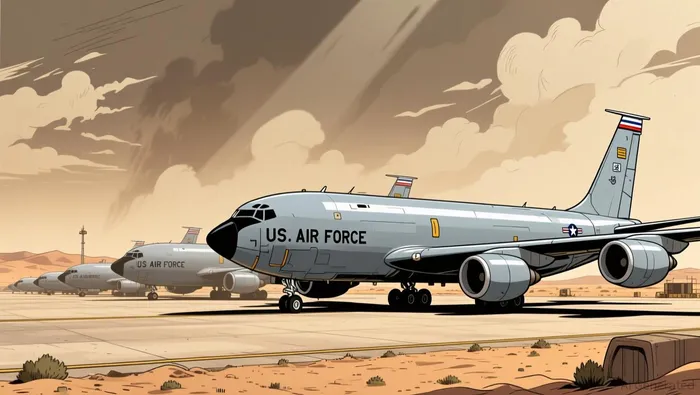
The last three weeks have been a drumbeat. The Pentagon repositioned dozens of KC-135 Stratotanker refueling aircraft from Al Udeid Air Base in Qatar over to Israel, with more than 60 US aerial refueling aircraft reported in the country and at least 33 sitting at Ben Gurion Airport -- a move cryptobriefing called the clearest sign yet of "how seriously Washington is taking the current threat environment." Around the same time the Iranian Revolutionary Guard claimed a surprise attack on Al Udeid, saying it destroyed a long-range radar and refueling aircraft -- claims the US and Qatar did not confirm. Separately, reports say Washington has already pulled hundreds of troops out of Al Udeid, its largest Middle East installation, even as forces remain spread across Iraq, Syria, and the Gulf.
Read that chain once: the US is moving its air power toward the fight, pulling its most exposed personnel back, and taking hostile fire at its central base. That is the posture of a war being fought, not wound down.
The market
Open this market on Polymarket ->
"Will the U.S. invade Iran before 2027?" trades around 16 cents right now, against roughly $900,000 of liquidity and more than $110,000 of volume in the last day on Polymarket. The crowd says 84% this stays an air-and-naval affair through December 31.
The opportunity, with the math and the risk
At 16 cents, $100 buys about 625 shares. If the US mounts an offensive aimed at taking Iranian territory by the deadline, each share pays $1 and you collect roughly $625 -- about $525 of profit, a 6-to-1 return. If it does not, the $100 goes to zero. That is the whole trade, and both halves matter.
Why might 16 cents be cheap? The war is already running, the aircraft are already repositioning toward the theater, and the resolution date is fixed -- about 4.5 months out, with a hard December 31 deadline. A single escalation headline, ground units moving toward the border, a named operation, an announced thrust, would reprice this contract in hours, and with $110,000 changing hands daily the market is liquid enough to move. You are buying a tail, but it is a tail that has been getting nudged closer all summer.
Why might 16 cents be right? Because every repositioning so far has been officially precautionary -- protect the tankers, disperse the aircraft, reduce exposure to Iranian missiles -- not invasion staging. Six months of war has produced strikes and a blockade but no boots on Iranian soil. An invasion of Iran is not a night-raid operation against a smaller state; it would be the largest US ground commitment in decades, and the administration's own diplomacy keeps floating a way out. Eighty-four percent of the market thinks the line does not get crossed.
How to think about it
This is a date-bound watch: it resolves December 31, and it resolves in seconds the moment the right headline lands. What makes it win: Pentagon announcements of ground forces massing toward Iran, a declared operation, any offensive explicitly intended to seize territory. What kills it: a ceasefire or deal, or the war grinding on as a siege-by-air-and-sea into 2027 with nothing taken. The price is a bet on escalation probability, not a promise that troops move.
The honest summary: the market is paying 6-to-1 on a threshold most traders believe won't be crossed, while the war that sits underneath it is already on. That mismatch -- an active conflict at 16 cents on its most dramatic next step -- is the opportunity. Whether you think the line gets crossed is your call. The number is on the board.
Summary
Polymarket's "Will the U.S. invade Iran before 2027?" market trades YES at about 16c (roughly 6-to-1), pricing an 84% chance the ongoing air-and-naval war stays short of a territorial offensive through December 31. With $110k in daily volume and a hard year-end resolution, $100 at 16c returns about $625 -- or zero -- depending on a single escalation headline.
See the live odds and trade on Polymarket ->
Disclaimer
This is a trade idea based on public market odds and cited reporting, not financial advice. Prediction markets are volatile and you can lose your entire stake. Odds move; figures are as of the linked sources at the time of writing. Do your own research.
Sources
_43ca838f1775813865579.png?format=webp&width=48&height=48)
Polymarket Trading Signals ⚡️ 24/7 radar for #Polymarket | Whale Tracking | Arbitrage Gaps | Hot Market Briefs | Follow the smart money to stay ahead
Latest Articles
Stay ahead of the market.
Get curated U.S. market news, insights and key dates delivered to your inbox.


AInvest
PRO
AInvest
PRO




Comments
No comments yet