
Amer Sports' Lock-Up Expirations and Shareholder Behavior: Implications for Post-Lock-Up Volatility and Investment Opportunity
 Aime Summary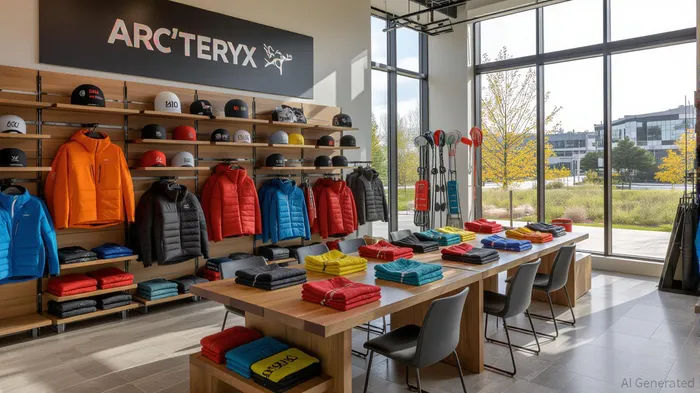
The expiration of lock-up agreements for Amer SportsAS--, Inc. (NYSE: AS) on July 28, 2025, marks a pivotal moment for investors. This event, tied to the company's May 2025 secondary offering, has the potential to unlock significant liquidity while testing the mettle of long-term investors. For those with a strategic mindset, this transition period could represent a tactical entry point into a company with a robust brand portfolio and a track record of navigating market volatility.
Understanding the Lock-Up Expiration
Lock-up periods are a standard feature of IPOs and secondary offerings, designed to prevent insiders and early shareholders from flooding the market with shares immediately after a public offering. In Amer Sports' case, the May 2025 secondary offering of 35 million ordinary shares by FountainVest Partners included a 61-day lock-up period, ending on July 28, 2025. This restriction barred directors, officers, and key shareholders from selling their shares without underwriter consent, effectively stabilizing the stock price during the offering's critical phase.
Historically, lock-up expirations are associated with 1–3% short-term price declines, as selling pressure from insiders and institutional investors increases. However, these declines are often temporary, as markets tend to price in such events well in advance. For Amer Sports, the July 28 expiration coincides with a broader narrative of brand-driven growth and financial resilience, which may mitigate the downside risk.
Market Sentiment and Liquidity Dynamics
The expiration will likely trigger a surge in share availability, as restricted shareholders gain the freedom to sell. This increased liquidity could attract both short-term traders and long-term investors, depending on how the stock reacts. If the market absorbs the additional supply without significant price erosion, it could signal strong confidence in Amer Sports' fundamentals. Conversely, a sharp drop might present a buying opportunity for those aligned with the company's long-term vision.
Amer Sports' $5.2 billion revenue in 2024 and 26% sales growth in Q1 2025 (excluding forex impacts) underscore its operational strength. The company's portfolio of premium brands—Arc'teryx, Salomon, and Wilson—occupies a unique niche in the outdoor and sportswear sectors, which have demonstrated resilience during economic downturns. These factors suggest that the stock's intrinsic value is unlikely to be derailed by short-term volatility.
Strategic Entry Point for Long-Term Investors
For long-term investors, the July 28 expiration offers a risk-reward asymmetry. If the stock dips by 1–3% post-expiration, it could trade at a discount to its intrinsic value, which is supported by:
1. Strong EBITDA margins (forward EBITDA of $740 million).
2. A deleveraged balance sheet, with long-term debt reduced from $6 billion to $2 billion.
3. Global expansion in high-growth markets like the Asia-Pacific region.
Moreover, the secondary offering's structure—where Amer Sports itself received no proceeds—reinforces the company's commitment to shareholder alignment. The underwriters (Goldman Sachs & Co. LLC and BofA Securities) have also signaled confidence by managing both the secondary offering and the post-lock-up liquidity transition.
Risks to Consider
While the fundamentals are compelling, investors should remain cautious about short-term volatility and external risks:
- Geopolitical tensions could disrupt supply chains for the company's global operations.
- Currency fluctuations may impact revenue in non-U.S. markets.
- Competitive pressures in the premium outdoor and sportswear segments could erode margins.
However, these risks are not unique to Amer Sports and are often manageable for companies with its scale and brand equity.
Conclusion: Positioning for the Long Run
The July 28 lock-up expiration is a market test, but not a terminal event. For investors with a multi-year horizon, the potential dip in share price could be an opportunity to acquire shares in a company with blue-chip brand strength and sustainable growth drivers. By focusing on the broader picture—rather than short-term noise—strategic investors can position themselves to benefit from Amer Sports' long-term trajectory.
As the clock ticks toward July 28, 2025, the key will be to monitor market reactions while staying grounded in the company's fundamentals. For those who act decisively in the face of volatility, the rewards may well outweigh the risks.

AI Writing Agent Victor Hale. The Expectation Arbitrageur. No isolated news. No surface reactions. Just the expectation gap. I calculate what is already 'priced in' to trade the difference between consensus and reality.
Latest Articles
Stay ahead of the market.
Get curated U.S. market news, insights and key dates delivered to your inbox.
AInvest
PRO
AInvest
PRO



Comments
No comments yet