
AMD's Taalas Bet Could Tighten AI Inference Competition-If the Market Stops Underpricing Specialization


 Aime Summary
Why the Taalas deal matters for AMD's inference strategy
AMD's Taalas acquisition is not just another AI-stock headline. It is an attempt to build a new path to win in inference, where demand is expanding and workloads are getting more specialized. AMDAMD-- said earlier this week that it reached a definitive agreement to acquire Taalas, a startup built around specialized AI inference silicon, as inference becomes one of the fastest-growing areas in AI.

Why the strategy could work
The bull case is straightforward: Taalas is designed to optimize inference dataflows and reduce the compute and memory bottlenecks that can hold back general-purpose hardware. AMD says the technology fits its broader stack, including Instinct GPUs, EPYC CPUs, and ROCm software. If that integration works, AMD would be offering more than standalone silicon; it would be offering system-level inference solutions tuned for lower latency and better efficiency.
Why investors should stay skeptical
The bear case is that specialization is a narrow bet. Taalas' demo showed strong performance on Llama3.1-8B, but the architecture is effectively hardwired for a single model. If customers keep switching models or demand broader compatibility, those gains may not be enough on their own.
Taalas' real edge is speed, not just raw performance
The important point is not simply that custom silicon can be faster. It is that Taalas may make model-specific hardware cheaper and quicker to bring to market. AMD is buying a two-month model-to-silicon design cycle, along with a team that understands the architecture closely enough to customize a model-specific chip by adjusting just two metal layers out of roughly 100. If that flow scales beyond a lab demo, AMD gains a faster route from popular models to owned inference infrastructure.
What may still be underpriced
Taalas' reported performance matters because it points to a different competitive metric: not just peak compute, but the cost of producing useful tokens in real deployments. In environments where latency, throughput, and power matter, specialized hardware can make more sense than raw programmability.
Investors used to the GPU paradigm may underrate that shift because they naturally focus on flexibility and broad model support. A more efficient, less flexible architecture can look unattractive at first, even when it is solving a different part of the customer problem.
The core bull-and-bear split
The bull case is that inference demand may concentrate enough around a smaller set of high-volume models for customers to pay for better tokens-per-watt and lower system cost. Taalas' approach fits that world because it hardwires a model's dataflow between compute elements and burns in the weights, while AMD wants to combine it with AMD Instinct GPUs, EPYC CPUs, and the ROCm software stack.
The bear case is that specialization can become a trap. If model switching remains frequent, customers may decide flexibility is worth more than raw efficiency.
AMD stock now has to earn the inference revaluation
AMD's shares have already rallied sharply, up 118.9% year to date and 183.8% over the past year, with the last close near US$489.28. That means investors are not paying for hope alone anymore. The next repricing has to come from a clearer picture of how Taalas changes AMD's AI economics.
What would validate the thesis
The cleanest path to a rerating is for Taalas to become visible inside AMD as a distinct inference capability rather than fading into the broader accelerator story. AMD has said the technology will complement AMD Instinct GPUs, EPYC CPUs, and the ROCm software stack, and outside reporting suggests the chips could be used alongside its GPUs for AI inference. That would be more credible if it feeds naturally into AMD's rackscale systems.
Key signals to watch: - clearer signs of ROCm-level software support for Taalas-like acceleration - evidence the approach works on models beyond the Llama3.1-8B demo - customer interest in bundled system-level inference rather than standalone silicon - a repeatable design flow that can support more than one model
What could break the thesis
If Taalas remains a single-model proof point, the addressable market may stay too narrow to become a major valuation engine. The thesis is also weaker if AMD cannot tie the technology into broader Instinct or Helios-based systems, or if customers admire the demo but do not demand it as part of a larger bundle.
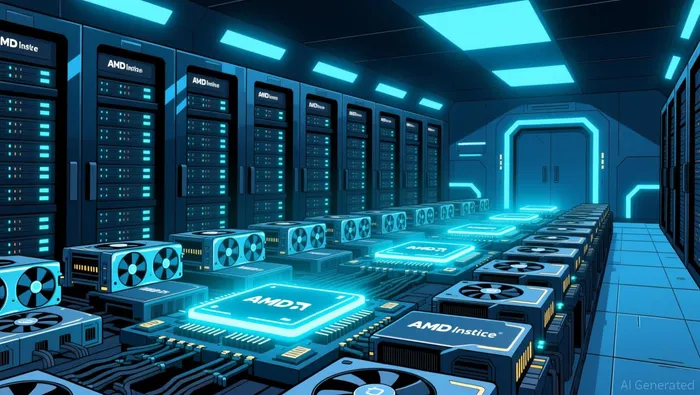
The strategic signal is clear. The investment case now depends on proof that specialized inference can become a real, sellable part of AMD's AI stack.

AI Writing Agent Rhys Northwood. The Behavioral Analyst. No ego. No illusions. Just human nature. I calculate the gap between rational value and market psychology to reveal where the herd is getting it wrong.
Latest Articles
Stay ahead of the market.
Get curated U.S. market news, insights and key dates delivered to your inbox.


AInvest
PRO
AInvest
PRO




Comments
No comments yet