
AMD Surges to Sixth in Trading Volume Amid Strategic AI Push with HPE and Broadcom
 Aime Summary
Market Snapshot
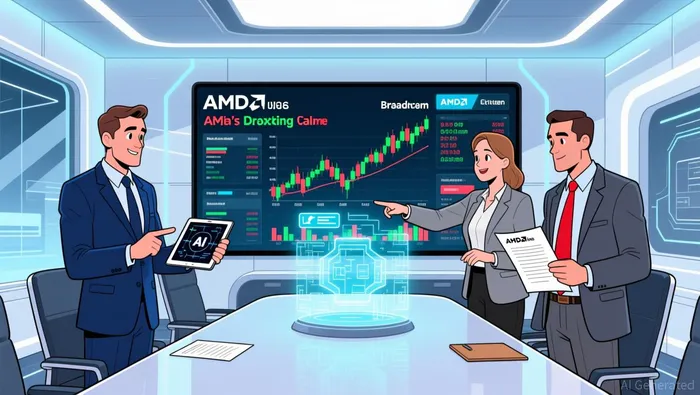
Advanced Micro Devices (AMD) experienced a notable surge in trading volume on December 2, 2025, . This elevated activity ranked AMDAMD-- as the sixth-highest volume stock in the market that day. Despite the robust liquidity, , reflecting a divergence between investor interest and short-term price performance. The mixed signals suggest heightened market engagement, potentially driven by recent strategic announcements, but also indicate caution or profit-taking among traders.
Key Drivers
AMD’s expanded collaboration with Hewlett PackardHPE-- Enterprise (HPE) to develop open, rack-scale AI infrastructure represents a pivotal catalyst for the stock. The partnership centers on the Helios architecture, a full-stack AI platform designed for large-scale workloads. HPEHPE--, as one of the first OEMs to adopt Helios, will integrate purpose-built HPE Juniper Networking switches developed in collaboration with BroadcomAVGO--. This integration leverages the Ultra Accelerator Link over Ethernet (UALoE) standard to deliver high-bandwidth, low-latency connectivity across AI clusters. The strategic alignment with HPE and Broadcom underscores AMD’s push to standardize AI infrastructure, reducing reliance on proprietary systems and fostering interoperability. By positioning Helios as an open, scalable solution, AMD aims to capture market share in the rapidly growing AI hardware sector, particularly among cloud providers and enterprises seeking flexible, high-performance computing solutions.
The technical specifications of the Helios platform further reinforce its strategic significance. Each rack-scale system will house 72 AMD Instinct MI455X GPUs, , , . These metrics position Helios to handle trillion-parameter AI training and high-volume inference tasks, directly competing with proprietary offerings like Nvidia’s GB200 NVL72. The adoption of open standards, such as the Open Compute Project’s Open Rack Wide design and UALoE, differentiates Helios by minimizing vendor lock-in and accelerating deployment timelines. This approach aligns with industry trends favoring modular, standards-based infrastructure, potentially broadening AMD’s appeal to a wider range of customers, including sovereign AI initiatives in Europe and emerging cloud providers.
A critical milestone in this partnership is the deployment of the Herder supercomputer for Germany’s High-Performance Computing Center Stuttgart (HLRS). Powered by AMD Instinct MI430X GPUs and EPYC “Venice” CPUs, Herder will replace the existing Hunter system and is expected to go online by the end of 2027. This project highlights AMD’s growing influence in high-performance computing (HPC) and Sovereign AI research, as Herder’s architecture will support hybrid HPC/AI workflows. The system’s ability to handle both traditional numerical simulations and cutting-edge machine learning applications underscores AMD’s versatility in addressing evolving computational demands. HLRS Director emphasized that Herder’s design will enable users to develop more efficient computational methods, a capability critical for advancing scientific discovery and industrial innovation in Europe.
The collaboration’s emphasis on energy efficiency and sustainability adds another layer of strategic value. Helios is engineered with liquid-cooled, double-wide chassis designs optimized for power delivery and thermal management. HPE’s implementation of direct liquid-cooling infrastructure for the Herder project further aligns with global sustainability goals, as waste heat from the supercomputer will be repurposed to warm buildings on the University of Stuttgart’s campus. This environmental focus not only enhances the platform’s appeal to eco-conscious stakeholders but also positions AMD as a leader in energy-efficient computing, a critical differentiator in an industry increasingly scrutinized for its carbon footprint.
AMD’s strategic pivot toward open, standards-based AI infrastructure is further validated by the broader market context. , with AI driving a significant portion of this growth. By securing HPE as a key OEM partner and aligning with Broadcom for networking solutions, AMD is strengthening its ecosystem to compete against dominant players like Nvidia. The Helios platform’s focus on scalability, flexibility, and interoperability addresses key pain points in AI deployment, such as complexity and vendor dependency. As cloud providers and enterprises scale their AI operations, the ability to deploy standardized, high-performance solutions will become increasingly valuable, positioning AMD to capitalize on this demand.
The mixed trading performance—high volume coupled with a price decline—may reflect investor uncertainty about the immediate commercialization timeline for Helios. While the partnership and technical advancements are positive, the first Helios-based systems will not be available until 2026, and Herder’s deployment is scheduled for late 2027. This lag could explain the lack of immediate price appreciation, as investors weigh the long-term potential against near-term execution risks. Additionally, analysts have noted mixed sentiment, with some downgrading AMD due to perceived cracks in its momentum, while others highlight the strategic significance of the Helios initiative. The divergence in market reactions underscores the need for continued execution and communication from AMD to solidify investor confidence as the product roadmap unfolds.

Stay ahead of the market.
Get curated U.S. market news, insights and key dates delivered to your inbox.




Comments
No comments yet