
AMD's Strong Outlook and Stock Price Correction Amid Q2 Earnings: A Strategic Entry Point for AI-Chip Investors?
 Aime Summary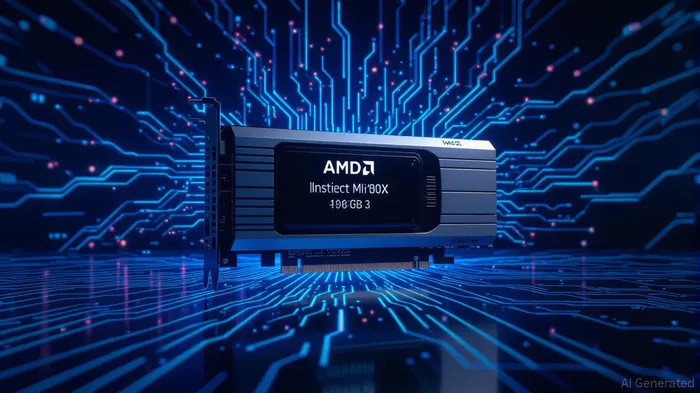
The recent 5% post-earnings selloff in Advanced Micro DevicesAMD-- (AMD) has sparked debate among investors about whether the pullback represents a strategic entry point in the AI-chip revolution. While the stock closed at $174.31 on August 5, 2025, down 1.4% from its previous close, the underlying fundamentals of AMD's business suggest a compelling long-term story. This article examines the interplay between AMD's Q2 2025 earnings, its AI segment's momentum, and valuation dynamics to assess the investment case.
Earnings: A Mixed Bag with Long-Term Promise
AMD's Q2 2025 earnings report revealed a revenue beat of $7.69 billion, up 32% year-over-year, driven by robust demand for its Ryzen Zen 5 desktop processors and Radeon graphics chips. However, adjusted EPS of 48 cents fell short of the 49 cents expected, reflecting a 30% decline from the prior year. The stock's post-earnings decline was fueled by two key factors:
1. Export Restrictions: U.S. export controls on the MI308 data center processor cost AMDAMD-- $800 million in inventory charges, with shipments to China still pending Trump administration approval.
2. Guidance Caution: While AMD projected $8.7 billion in Q3 revenue (above Wall Street's $8.32 billion), it excluded MI308-related revenue, signaling near-term headwinds.
AI Segment: Gaining Traction in a High-Stakes Market
AMD's Data Center segment, a critical battleground for AI growth, reported $3.2 billion in revenue, up 14% year-over-year. The adoption of fifth-gen EPYC Turin processors and Instinct MI300X GPUs in hyperscale applications—by clients like MetaMETA--, MicrosoftMSFT--, and Nokia—underscores its competitive positioning. The MI300X's 192GB HBM3 memory, surpassing NVIDIA's H100's 80GB HBM2e, positions it as a viable alternative for memory-intensive AI workloads.
However, AMD's AI GPU market share remains modest, estimated at less than 10% in 2025, compared to NVIDIA's 92% dominance. Intel's Gaudi chips, priced 50% lower than NVIDIA's H100, are also capturing cost-conscious enterprises. Despite this, AMD's strategic partnerships and product roadmap—such as the upcoming MI350X GPU—suggest it is well-positioned to challenge NVIDIANVDA-- in the inference segment.
Valuation: A Premium for Growth, but at What Cost?
AMD's valuation metrics appear stretched by traditional standards. The stock trades at a forward P/S ratio of 8.16X, significantly above the industry average of 3.88X, and a forward P/E of 44.25X. This premium reflects investor optimism about its AI and data center growth, but it also raises questions about sustainability.
NVIDIA's dominance in AI training and its broader ecosystem (e.g., CUDA) justify its higher valuation, but AMD's outperformance in the Client & Gaming segment—projected to grow 69.3% year-over-year to $2.52 billion—adds diversification. Meanwhile, Intel's low P/E ratio reflects skepticism about its AI ambitions, despite its $20 billion Ohio manufacturing facility.
Competitive Landscape: Navigating Risks and Opportunities
The AI chip market is growing at a 30-40% CAGR, driven by demand in healthcare, finance, and automotive sectors. AMD's strategic partnerships with cloud providers and enterprise clients, including Meta and OpenAI, are critical to its expansion. However, regulatory risks—such as export restrictions on MI308—remain a wildcard.
NVIDIA's Blackwell GPU and DGX GH200 supercomputer threaten AMD's inference ambitions, while Intel's Gaudi 3 and cost advantages could erode margins. AMD's ROCm software ecosystem, though a CUDA alternative, lags in adoption, limiting its appeal to developers.
Investment Thesis: A Calculated Bet on AI's Future
For long-term investors, AMD's pullback offers a nuanced opportunity. The stock's 45.9% year-to-date gain reflects strong momentum, but the recent correction—triggered by near-term headwinds—may have overcorrected. Key considerations include:
1. Growth Potential: AMD's AI and data center segments are projected to grow 16.7% and 27%, respectively, in 2025.
2. Valuation Risks: A PEG ratio of 0.82 suggests the stock may be undervalued relative to future earnings, but this hinges on sustained growth.
3. Regulatory Uncertainty: Resolving MI308 export restrictions could unlock $800 million in revenue, but delays remain a risk.
Conclusion: Strategic Entry Point or Overhyped Play?
AMD's Q2 earnings highlight a company navigating a high-stakes transition. While the stock's valuation is stretched, its leadership in AI inference, strategic partnerships, and product innovation provide a compelling long-term case. For investors with a 3-5 year horizon, the current pullback—assuming no material deterioration in fundamentals—could represent a strategic entry point. However, patience is key: AMD must demonstrate margin resilience, regulatory progress, and sustained AI adoption to justify its premium.
In the AI-chip revolution, AMD is not the dominant force it aspires to be, but it is a formidable contender. The question for investors is whether they are willing to bet on its ability to close the gap with NVIDIA while navigating the inevitable bumps in the road.

Stay ahead of the market.
Get curated U.S. market news, insights and key dates delivered to your inbox.
AInvest
PRO
AInvest
PRO



Comments
No comments yet