
AMD Stock Price: Wall Street Remains Bullish Ahead Of Q2 Earnings
 Aime Summary
- Wall Street maintains a strong buy consensus for AMDAMD-- stock price ahead of its Q2 earnings report on August 4, projecting 20% upside potential.
- AMD is expected to report Q2 2026 revenues of $11.32 billion, a 47.3% year-over-year increase, driven by surging demand for EPYC server CPUs and Instinct AI accelerators.
- Despite a recent 16.4% pullback in stock price due to technical indicators flashing sell signals, institutional investors and analysts remain highly optimistic about the company's AI deal pipeline.
- Major cloud providers, including Amazon, Microsoft, and Meta, are significantly expanding their capital expenditures, which directly benefits AMD's data center revenue growth.
- Investors will closely monitor AMD's Q2 results to see if the company can beat earnings expectations of $1.61 per share and provide strong guidance for the upcoming MI450 accelerator launch.
Advanced Micro Devices (AMD) is preparing to release its fiscal second-quarter 2026 results on August 4, and Wall Street is largely bracing for a strong performance. Despite a recent 16.4% pullback in the stock price over the past month, analysts maintain a bullish outlook on the company's fundamentals. The primary catalyst for this optimism is the sustained demand for AMD's EPYC server CPUs and Instinct AI GPUs as enterprises continue to expand their artificial intelligence infrastructure. While technical indicators are flashing sell signals, the fundamental data suggests a different story, with consensus estimates pointing to significant year-over-year growth.
What Is Driving AMD's Strong Q2 Earnings Expectations?
AMD is projected to report second-quarter 2026 revenues of $11.32 billion, representing a 47.3% year-over-year increase. Earnings per share are estimated at $1.61, marking a staggering 235% jump from the prior year. This growth is primarily attributed to the Data Center segment, which has become the company's largest revenue driver. The accelerating demand for EPYC server processors and Instinct AI accelerators is boosting top-line growth, fueled by strong inference workloads and increasing enterprise AI deployments.
The company has benefited from broader deployment across leading cloud providers, including AWS, Microsoft Azure, Google Cloud, and Tencent. AMD's fifth-generation EPYC processors are seeing expanding adoption across hyperscale and enterprise customers. Additionally, the company has highlighted improving customer engagement for the upcoming MI450 accelerator family and the Helios AI rack platform. Meta's planned deployment of AMD Instinct GPUs and adoption of next-generation EPYC processors have further reinforced customer confidence and accelerated design wins.
The scale of AMD's deal pipeline is unprecedented. A recently announced deal with Anthropic is estimated to be worth more than $27 billion, representing over 50% of the fiscal year 2026 consensus forecast. Other significant deals with OpenAI, Meta Platforms, and Microsoft also have deployments slated for the third quarter. This pipeline suggests AMD will continue to outperform, lift guidance, and sustain bullish analyst activity through year-end and into the subsequent year.
Why Is AMD Stock Falling Despite Strong Fundamentals?
Despite the positive fundamental outlook, technical indicators present a mixed picture. AMD’s stock has dropped 16.4% over the past month, with moving averages and an overall technical consensus flashing a 'Sell' signal based on nine bearish versus four bullish indicators. This decline is partly due to broader pressure on chip stocks amid concerns about the sustainability of AI demand. However, momentum indicators like the MACD are generating buy signals, suggesting that the pullback might be a temporary correction rather than a fundamental shift.
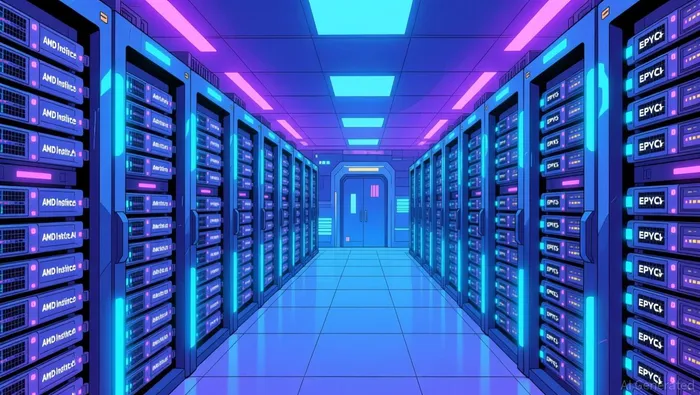
Valuation multiples are also a point of contention for some investors. AMD currently trades with a price-to-earnings ratio of approximately 174, which is considered elevated. This high valuation reflects the market's strong confidence in the company's execution and product roadmap, but it also means that any misstep could lead to significant volatility. The discrepancy between technical weakness and fundamental bullishness highlights a potential mispricing opportunity if execution aligns with the strong AI-driven revenue projections.
Institutional activity supports the bullish view. While institutions took profits in the second quarter, the impact was limited. The group maintains a 71% ownership rate with third-quarter accumulation, aligning with trailing twelve-month activity and limiting downside risk for investors. High insider ownership also indicates that company executives are confident in the long-term prospects of the business.
How Cloud Giants Are Fueling AMD's Growth
The expansion of capital expenditures by major cloud providers is a key driver of AMD's growth. Amazon recently increased its 2026 capital expenditure plan from approximately $200 billion to $220 billion, signaling continued robust demand for AI infrastructure. This move follows Amazon Web Services' reported 37% revenue growth, the fastest expansion in over four years, driven by customers reserving future cloud capacity. While Amazon designs its own Trainium processors internally, it continues to purchase externally supplied chips for AWS customers.
Microsoft's stronger Azure forecast previously drove a broad semiconductor rally, further underscoring the sector's reliance on hyperscaler investment. The additional $20 billion in Amazon's investment supports a wide range of semiconductor suppliers, including those providing processors, networking equipment, memory, and power-management products. Although the precise allocation of these funds to AMD products remains undisclosed, the market reaction highlights AMD's heightened sensitivity to capital-spending signals from major cloud operators.
Competitive pressure remains a key consideration for investors. NVIDIA dominates the AI accelerator market with its full-stack platform, and Intel is aggressively regaining server market share through its Xeon roadmap and advanced packaging technologies. Broadcom is also strengthening its position in custom AI accelerators. However, AMD's full-stack AI pivot and its ability to secure massive deals with leading AI companies suggest that it is well-positioned to capture a significant share of this growing market.
What To Watch For In AMD's Q2 Earnings Report
Investors will closely monitor AMD's Q2 earnings to see if the company can beat consensus estimates and provide strong guidance for the future. Key commentary will likely focus on the MI450 launch and Helios rack sales. While analysts are currently modeling only incremental sequential growth, this view appears disconnected from the robust deal pipeline. The market will be looking for evidence that the expanding cloud budgets are successfully translating into additional data-center revenue and stronger demand for AMD's AI accelerators.
Management's guidance for the third quarter and the back half of the year will be crucial. If AMD can confirm the robust AI deployment trends highlighted by analysts, it could trigger a significant rally in the stock price. The company has historically beaten consensus estimates in the trailing four quarters, which adds to investor confidence. However, any signs of slowing demand or increased competition could lead to volatility.
The bottom line is that while the technical picture is mixed, the fundamental outlook for AMD remains highly positive. The company is at the forefront of the AI revolution, and its strong relationships with major cloud providers and AI companies position it for continued growth. Investors should carefully weigh the company's execution capabilities in a volatile chip market against its current rich multiples, but the potential upside appears significant if the company continues to deliver on its ambitious growth targets.

Stay ahead of the market.
Get curated U.S. market news, insights and key dates delivered to your inbox.


AInvest
PRO
AInvest
PRO




Comments
No comments yet