
AMD's Stock Plummets 4.15% as Volume Surges to Sixth-Highest Amid AI Sector Woes and Macro Worries
 Aime Summary
Market Snapshot
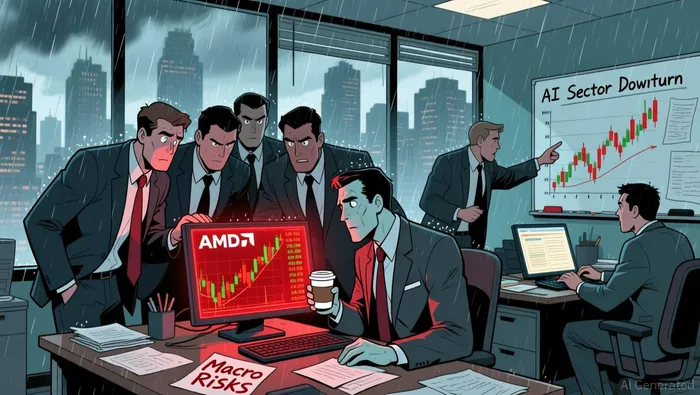
, . , , ranking sixth in volume among all equities. This sharp drop follows a well-received investor day in November, where AMDAMD-- outlined ambitious growth projections, but investors have since become increasingly wary of macroeconomic risks and competitive pressures in the AI sector. The decline reflects broader market concerns about the sustainability of AI-driven capital expenditures, rising memory costs, and uncertainty around Federal Reserve interest rate decisions.
Key Drivers
Rising Competition in AI Hardware
AMD’s stock has been heavily impacted by intensifying competition in the AI chip market. A critical development is the reported interest from Meta Platforms (META) in adopting Google’s custom (TPUs) for its data centers, potentially starting in 2027. This shift, if materialized, could divert significant revenue from AMD and its primary rival, NvidiaNVDA-- (NVDA), which currently dominates the AI hardware landscape. Analysts, including of Bernstein, have highlighted that AMD’s narrative hinges on its ability to leverage its first rack-scale AI offering, Helios, to maintain competitiveness. However, the prospect of Google’s TPUs gaining traction has raised doubts about AMD’s long-term market share in AI infrastructure.
Macroeconomic and Sector-Wide Pressures
Broader macroeconomic factors have exacerbated investor anxiety. The semiconductor sector, including AMD, has faced headwinds from rising memory prices and supply constraints, which could pressure profit margins. Additionally, uncertainty surrounding the Federal Reserve’s potential interest rate cuts in December has dampened enthusiasm for growth-oriented tech stocks, which are sensitive to borrowing costs. The pullback in AI-related spending by hyperscalers like Meta, coupled with concerns about the scalability of AI-driven demand, has further clouded the outlook for AMD and its peers.
Investor Sentiment and Short-Term Volatility
Recent market reactions underscore fragile investor sentiment. Following AMD’s investor day, Mizuho analyst noted that the stock’s rapid rise and subsequent sell-off revealed “weak hands” among momentum traders, with some investors exiting positions to reduce exposure to semiconductor and AI stocks. This volatility has been amplified by comparisons to rival companies like Nvidia, which has maintained a stronger competitive position despite its own recent declines. AMD’s stock has also been perceived as a “least safe long” in the sector, prompting further caution among investors.
Strategic Uncertainty and Market Narratives
The competitive dynamics in the AI sector remain fluid. While AMD has positioned itself as a viable alternative to Nvidia, the emergence of Google’s TPUs and Broadcom’s (AVGO) role in manufacturing these chips has introduced new variables. Bernstein’s Rasgon emphasized that the industry’s scarcity of compute power may ultimately favor companies with scalable solutions, but AMD’s reliance on partnerships with OpenAI and its ability to execute on its AI roadmap remain under scrutiny. The market’s focus on Alphabet’s AI advancements—such as its Gemini model—has further shifted capital allocation away from traditional GPU providers.
Broader Tech Market Correction
The broader tech sector’s correction has compounded AMD’s challenges. As hyperscalers reassess their AI spending strategies, investors are increasingly skeptical about the long-term sustainability of current growth trajectories. This environment has led to a reevaluation of valuations across the sector, with AMD’s stock bearing the brunt of profit-taking and risk-off sentiment. The company’s aggressive expansion into AI infrastructure, while ambitious, faces an uncertain regulatory and competitive landscape, particularly as Google and other tech giants accelerate their custom silicon initiatives.
In summary, AMD’s recent performance reflects a convergence of competitive, macroeconomic, and sector-specific pressures. The stock’s decline underscores the fragility of investor confidence in the face of evolving market dynamics, with the AI hardware race and macroeconomic uncertainties serving as pivotal factors.

Busca aquellos activos que tengan un volumen de transacciones explosivo.
Latest Articles
Stay ahead of the market.
Get curated U.S. market news, insights and key dates delivered to your inbox.
AInvest
PRO
AInvest
PRO



Comments
No comments yet