
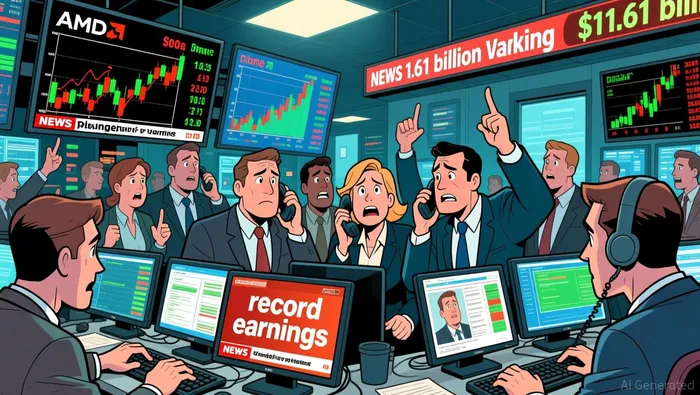
AMD Shares Dip Despite Record Earnings and Sixth-Largest Trading Volume of $11.61 Billion
 Aime Summary
Market Snapshot
Advanced Micro Devices (AMD) experienced a mixed trading session on November 14, 2025, . , suggesting reduced immediate investor activity despite the stock’s high liquidity profile. The modest price decline contrasts with strong recent earnings performance, , , , . The stock’s performance reflects a broader market dynamic where AI-related equities face heightened scrutiny post-earnings.
Key Drivers
Earnings Outperformance and Analyst Outlook
AMD’s third-quarter results underscored its dominance in the semiconductor sector, with revenue and EPS both exceeding forecasts. This performance drew immediate praise from analysts and market commentators, including Morgan Stanley, which reiterated an Equalweight rating and a $260 price target. The firm emphasized that AMD’s MI450 AI chip must gain significant market share to justify its valuation, highlighting the need for sustained execution in high-margin AI segments. The earnings beat reinforced investor confidence in AMD’s ability to capitalize on the AI boom, particularly as demand for advanced computing infrastructure accelerates.
Mixed Sentiment from Market Commentators
’s recent discussions on AMDAMD-- reflected a nuanced perspective. While lauding the company’s “terrific” third-quarter results as “amazing,” Cramer noted a broader softening in the AI sector cohort, attributing it to shifting market dynamics. He referenced the removal of “backstops” in China-related trade policies, which may have contributed to a more cautious stance among investors. Cramer’s remarks highlighted a growing trend of investor discrimination in the AI space, with a focus on companies that can translate ambitious growth targets into tangible revenue. This sentiment aligns with Morgan Stanley’s emphasis on execution risks, particularly for AMD’s long-term financial goals tied to the OpenAI partnership.
Long-Term Targets and Execution Risks
AMD’s recent analyst meeting revealed ambitious long-term financial targets, which Cramer described as “much higher than anybody was expecting.” These projections, contingent on substantial business with OpenAI, have created a dual-edged narrative. While the targets signal management’s confidence in the company’s AI-driven growth trajectory, they also introduce execution risk. Investors are now scrutinizing whether AMD can deliver on these promises, especially given the lack of detailed sales specifics in earlier announcements. The stock’s recent rally has priced in optimistic expectations, but Cramer stressed that the company’s future performance will hinge on its ability to secure and execute on key partnerships, particularly in the data center and AI hardware markets.
Insider Activity and Market Implications
A recent insider filing revealed that AMD’s Vice President, Mark D. Papermaster, plans to sell 17,108 shares via a prearranged 10b5-1 trading plan. While such sales are routine and executed to mitigate market timing risks, they may be interpreted as a bearish signal by some investors. The sale, however, occurs against a backdrop of strong earnings and a generally positive analyst outlook, suggesting that the insider activity is part of a broader liquidity strategy rather than a reflection of internal pessimism. The market’s reaction to this news was muted, .
Broader Sector Dynamics
The news articles also highlight a growing awareness of energy constraints in the AI sector, with Microsoft’s CEO and industry leaders like Elon Musk warning of looming power shortages. While AMD is not directly tied to energy infrastructure, this narrative underscores the sector’s vulnerability to external bottlenecks. For AMD, the challenge lies in maintaining growth momentum as AI demand outpaces physical infrastructure capacity. The company’s focus on high-performance computing and AI chips positions it to benefit from the sector’s expansion, but it must navigate the risk of delayed adoption due to energy and infrastructure limitations.
AMD’s stock performance on November 14 encapsulates the tension between strong fundamentals and a more discerning market environment. The company’s ability to sustain its earnings momentum, execute on long-term partnerships, and navigate sector-wide challenges will likely determine its trajectory in the near term.

Busca aquellos activos que tengan un volumen de negociación explosivo.
Latest Articles
Stay ahead of the market.
Get curated U.S. market news, insights and key dates delivered to your inbox.
AInvest
PRO
AInvest
PRO



Comments
No comments yet