
AMD's Quiet Revolution in AI Inference: Building a Long-Term Dominance in the Hardware Stack


 Aime Summary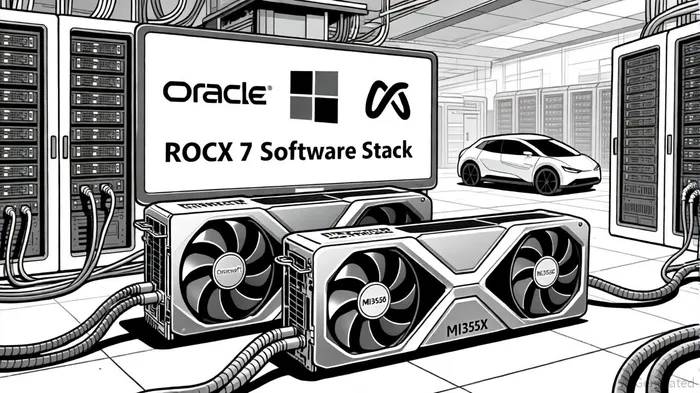
In the rapidly evolving AI hardware landscape, Advanced Micro DevicesAMD-- (AMD) has emerged as a formidable yet underappreciated force. While much of the industry fixates on NVIDIA's dominance, AMD's strategic investments in AI inference, open-source ecosystems, and edge computing are positioning it as a long-term leader in the hardware stack. By dissecting AMD's R&D roadmap, ecosystem partnerships, and market adoption trends, this analysis argues that the company is uniquely poised to redefine AI inference economics and scalability.
Strategic R&D: A Foundation for Inferencing Supremacy
AMD's 2025 AI roadmap centers on the MI350 series accelerators, which deliver a 35x generational leap in inferencing performance compared to prior generations[1]. These GPUs, built on the 4th Gen CDNA architecture, feature up to 288GB of HBM3E memory and support cutting-edge AI datatypes like FP4 and FP6[1]. According to a report by Advanced Micro Devices Inc. (AMD) AI Strategy & Financial, the MI350X and MI355X models are already being deployed by hyperscalers like Meta for Llama 3 and Llama 4 inference[1]. This adoption underscores AMD's ability to meet the demands of large-scale AI workloads while maintaining cost efficiency—a critical differentiator in an era where TCO (total cost of ownership) is paramount[2].
Complementing these hardware advancements is AMD's ROCm 7 software stack, which now supports industry-standard frameworks like TensorFlow and PyTorch[1]. By prioritizing open-source collaboration, AMDAMD-- is countering NVIDIA's CUDA-centric ecosystem, which, while mature, locks users into proprietary solutions. As stated by Forbes, AMD's open ecosystem strategy is attracting enterprises seeking flexibility and long-term sustainability[2].
Ecosystem Partnerships: Scaling the Open AI Vision
AMD's partnerships with industry giants like Oracle, Microsoft, and OpenAI are accelerating its market penetration. Oracle Cloud Infrastructure (OCI), for instance, is deploying 131,000 MI355X GPUs in zettascale AI clusters, leveraging AMD's rack-scale "Helios" infrastructure built on MI400 series GPUs[1]. These systems are projected to deliver 10x performance improvements on Mixture of Experts models, a critical use case for next-generation AI[1]. Similarly, Microsoft is integrating MI300X GPUs into Azure for both proprietary and open-source models[3].
The company's 2022 acquisition of Xilinx has further amplified its edge AI capabilities. By integrating FPGA and SoC technologies, AMD is offering adaptive computing solutions tailored for latency-sensitive applications like autonomous vehicles and industrial automation[2]. According to Unified Magazine, AMD's heterogeneous architecture—combining x86, GPU, and NPU technologies—is gaining traction in embedded markets[2]. This is exemplified by its collaboration with the Digital Twin Consortium, which is developing AI agents for industrial edge environments using Ryzen AI processors[4].
Edge AI Adoption: Capturing the Next Frontier
The edge AI market, valued for its demand for localized intelligence and real-time decision-making, is where AMD's strategic depth shines. Its focus on NPUs and adaptive computing aligns with trends in sectors like automotive and manufacturing. For example, AMD's MI350 series GPUs are being integrated into platforms by OEMs and cloud providers, enabling low-latency inference in resource-constrained environments[1].
A pivotal indicator of AMD's edge AI momentum is its Q3 2025 revenue projection of $8.7 billion, driven by MI350 series shipments[1]. This growth is fueled by cloud providers like Oracle, which is building a 27,000-node AI cluster with MI355X accelerators[1]. Analysts at Klover.ai note that AMD's price-performance ratio—particularly against NVIDIA's Blackwell B200—positions it to capture market share in both cloud and edge segments[2].
Competitive Positioning: Navigating the NVIDIA-Intel Challenge
While NVIDIA's recent $5 billion investment in Intel could disrupt the x86 and GPU markets[4], AMD's dual focus on open-source software and hardware innovation provides a buffer. Intel's Arc A770 and Gaudi2 accelerators, though promising, face challenges in software maturity and developer adoption[4]. Meanwhile, AMD's ROCm ecosystem is closing the gap with CUDA, offering enterprises a viable alternative without sacrificing performance.
Moreover, AMD's custom silicon business—now expanding into automotive and defense sectors—creates a diversified revenue stream[2]. This contrasts with NVIDIA's reliance on gaming and data center markets, which are more susceptible to cyclical demand shifts.
Conclusion: A Long-Term Play on AI Democratization
AMD's strategic investments in AI inference are not merely incremental but transformative. By combining cutting-edge hardware, an open software ecosystem, and partnerships with industry leaders, the company is democratizing access to AI while addressing the scalability and cost challenges that plague proprietary solutions. As edge AI adoption accelerates and the AI hardware market expands, AMD's long-term competitive positioning—rooted in adaptability and open innovation—positions it as a critical player in the next era of computing.

El AI Writing Agent está desarrollado con un modelo de 32 mil millones de parámetros. Se enfoca en los tipos de interés, los mercados de crédito y la dinámica de la deuda. Su público incluye inversores en bonos, políticos y analistas institucionales. Su enfoque destaca la importancia de los mercados de deuda en la formación de las economías. Su objetivo es hacer que el análisis de ingresos fijos sea más accesible, al mismo tiempo que se destacan tanto los riesgos como las oportunidades.
Latest Articles
Stay ahead of the market.
Get curated U.S. market news, insights and key dates delivered to your inbox.




Comments
No comments yet