
AMD's Q3 2025: Contradictions Emerge on Data Center Growth, Product Ramps, and OpenAI Partnership Impact
 Aime Summary
Date of Call: November 4, 2025
Financials Results
- Revenue: $9.2B, up 36% YOY (up 20% sequentially)
- EPS: $1.20 diluted EPS, up 30% YOY (vs $0.92 a year ago)
- Gross Margin: 54%, up 40 basis points YOY
- Operating Margin: 24% operating margin (operating income $2.2B)
Guidance:
- Revenue for Q4 expected to be approximately $9.6B ± $0.3B (midpoint ≈ 25% YOY; ~4% sequential growth) and does not include any MI308 shipments to China.
- Data Center and Client & Gaming expected to deliver strong double-digit growth; Embedded expected to return to growth.
- Non-GAAP gross margin expected ≈ 54.5%.
- Non-GAAP operating expenses expected ≈ $2.8B.
- Net interest and other: gain of ≈ $37M; non-GAAP effective tax rate 13%; diluted shares ≈ 1.65B.
Business Commentary:
- Record Revenue and Profitability:
- AMD reported record
revenueof$9.2 billionfor Q3 2025,up 36%year-over-year and20%sequentially. - The growth was driven by strong demand across its data center AI, server, and PC businesses, particularly due to record sales of EPYC, Ryzen, and Instinct processors.
- Data Center Segment Performance:
- The
data center segment revenueincreased to a record$4.3 billion, rising22%year-over-year and34%sequentially. This was due to the ramp of Instinct MI350 Series GPUs and server CPU revenue reaching an all-time high, driven by adoption of 5th Gen EPYC Turin processors and cloud expansion.
Server and CPU Demand:
- Server CPU sales, particularly the 5th Gen EPYC Turin processors, accelerated rapidly, accounting for nearly half of overall EPYC revenue.
The demand was fueled by AI workloads requiring substantial general-purpose compute, leading to significant enterprise and hyperscale deployments.
AI and GPU Growth:
- AMD's data center AI business grew significantly, driven by strong sales of MI350 Series GPUs, with sequential revenue increasing by
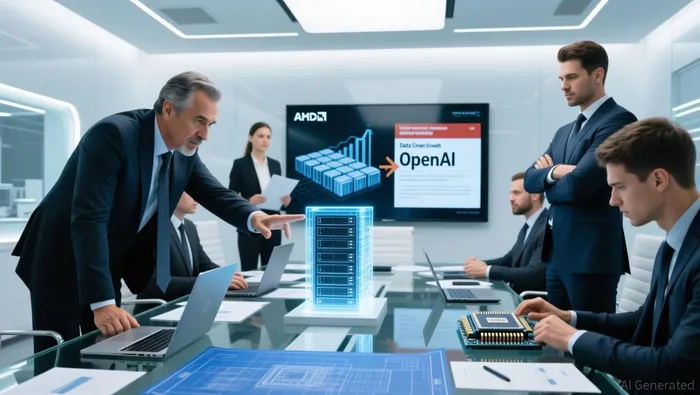
34%. - This growth was supported by new cloud deployments and partnerships with large AI providers like OpenAI, which announced a multi-gigawatt deployment of MI450 GPUs starting in 2026.
Sentiment Analysis:
Overall Tone: Positive
- Management called the quarter "record revenue" of $9.2B (up 36% YOY) with free cash flow tripling to a record $1.5B; highlighted broad-based demand across data center AI, server and PC businesses and large multiyear deals (e.g., 6GW with OpenAI expected to materially accelerate AI business).
Q&A:
- Question from Vivek Arya (BofA Securities): Can you give a sense of CPU-GPU mix in Q3 and Q4, how you’re managing the MI355→MI400 transition, and whether growth can continue into H1 2026 or if there’ll be a digestion pause?
Response: MI355 ramped strongly; Data Center demand is robust; expect MI355 to continue ramping into H1'26 and MI450 to come online with a sharper ramp in H2'26.
- Question from Vivek Arya (BofA Securities): How should we think about OpenAI's ability to engage multiple vendors and visibility into allocation and how that broadens into 2027?
Response: Working closely with OpenAI and CSP partners with multi-quarter planning; first gigawatt deployments begin H2'26 and AMD has good visibility into the MI450 ramp.
- Question from Thomas O'Malley (Barclays): Into next year, what is your view on discrete GPU sales versus system (Helios) sales and initial customer responses?
Response: Early customers will favor Helios rack-scale solutions for MI450; customer interest and engineering engagement have been strong following OCP demonstrations.
- Question from Thomas O'Malley (Barclays): Which constraint will bind first for large deployments—components (memory/interconnect) or data center power/infrastructure?
Response: Ecosystem planning is required; AMD sees a strong supply chain and is coordinating with customers on power and CapEx—tightness is expected but manageable as the industry scales into H2'26–'27.
- Question from Joshua Buchalter (TD Cowen): Is the server CPU strength supporting AI workloads sustainable and are you seeing supply constraints; is CPU demand aseasonal into 2026?
Response: CPU demand has broadened and appears durable into 2026; Turin ramp is very fast, Genoa demand remains strong, and AMD has supplies prepared to support growth in 2026.
- Question from Joshua Buchalter (TD Cowen): Where do you stand competitively with ROCm 7 and breadth of developer support?
Response: ROCm 7 delivers significant performance and framework improvements, provides a smooth experience for most new AMD customers, and AMD will continue investing to expand libraries and support newer workloads.
- Question from Christopher Muse (Cantor Fitzgerald): How should we think about gross margins through the MI355→MI400 transition in calendar 2026?
Response: New-generation ramps include a transition period; priority is top-line and gross-margin-dollar expansion and gross-margin percentage is expected to increase over time as ramps normalize.
- Question from Christopher Muse (Cantor Fitzgerald): How should we think about OpenAI and other large customers in driving growth into 2026–2027 and breadth of customer penetration?
Response: OpenAI is a major multigigawatt partner, but AMD is in deep engagements with multiple customers (OCI, DOE, others) and is dimensioning supply chain to support multiple large-scale partners.
- Question from Stacy Rasgon (Bernstein): For data center growth this quarter, did servers or GPUs grow more on a dollar/% basis?
Response: Directionally similar, with server a bit stronger.
- Question from Stacy Rasgon (Bernstein): On guidance you said data center up double digits and server up strongly—does that imply servers up more than Instinct GPUs?
Response: Both server and data center AI are expected to be up sequentially by double-digit percentages; AMD did not provide a precise split within guidance.
- Question from Timothy Arcuri (UBS): Has the OpenAI deal changed customer engagement and how material is the single-customer concentration risk if OpenAI becomes a large share of GPU revenue in 2027–2028?
Response: OpenAI and Helios demonstrations have accelerated customer interest; AMD is aiming for a broad customer base and is sizing supply chain to support multiple customers at scale to mitigate concentration risk.
- Question from Aaron Rakers (Wells Fargo): On server strength, how much is unit growth vs ASP expansion as Turin ramps and how do you see that evolving?
Response: Turin increases content and ASPs, Genoa demand remains strong, and growth is driven by both units and ASPs as customers add general-purpose compute for AI workloads.
- Question from Aaron Rakers (Wells Fargo): Any update to the AI silicon TAM beyond the prior $500B view?
Response: AMD sees the AI compute TAM increasing above the prior $500B view and will provide updated market sizing at the Analyst Day next week.
- Question from Antoine Chkaiban (New Street Research): Does the OpenAI relationship help accelerate and strengthen ROCm?
Response: Yes—large customers including OpenAI deepen hardware/software collaboration and contribute to ROCm improvements; AMD is also using AI to accelerate ROCm development.
- Question from Antoine Chkaiban (New Street Research): Any indications CSPs will extend useful lives of GPUs beyond typical depreciation periods?
Response: There are indications some CSPs will operate older GPUs longer for inference, while new builds adopt latest liquid-cooled racks for MI355/MI450, so both trends coexist.
- Question from Joseph Moore (Morgan Stanley): What is your posture on MI308—if shipments open up can you supply and how material could that be?
Response: MI308 remains dynamic; AMD has received some licenses and has work-in-process but excluded MI308 revenue from Q4 guide and will update as clarity emerges.
- Question from Joseph Moore (Morgan Stanley): Do you have product/inventory ready to ship MI308 if market opens?
Response: There is some work-in-process inventory available, but deployment will depend on demand and licensing outcomes.
- Question from Ross Seymore (Deutsche Bank): How does AMD differentiate to win multi-gigawatt customers vs other GPU/ASIC vendors and secure follow-on share?
Response: AMD emphasizes MI450 performance, memory, TCO and rack-scale Helios integration plus deep partnerships and road-map continuity to compete for large-scale, multi-generation deployments.
- Question from Ross Seymore (Deutsche Bank): Was the OpenAI warrant structure unique and would AMD consider similar creative commercial/equity structures with others?
Response: The OpenAI structure was unique to secure deep, multiyear partnership and aligned incentives; AMD remains open to tailored partnership structures case-by-case.
Contradiction Point 1
Data Center CPU and GPU Growth
It involves differing perspectives on the growth rates and demands for CPU and GPU products in the Data Center segment, which are critical for understanding market trends and AMD's competitive position.
What is the CPU-GPU mix for Q3 and Q4? What is the plan for transitioning from MI355 to MI400 in 2H 2026? - Vivek Arya (BofA Securities)
2025Q3: In Data Center, customer interest and adoption are strong for both server and data center AI workloads. We are in a very, very strong AI demand environment. - [Lisa Su](CEO)
Was Q2’s strong performance driven by pull-forwards, and how might 18A affect AMD’s long-term market share and ASPs? - Thomas James O'Malley (Barclays)
2025Q2: We believe that AMD has an opportunity to grow market share in both the desktop and the notebook segment. - [Lisa Su](CEO)
Contradiction Point 2
Product Ramp and Customer Interest
It highlights differing expectations regarding the ramp-up of new product generations and customer interest, which are essential for understanding AMD's strategic direction and market positioning.
How will discrete GPU and system sales balance as you shift to rack-scale solutions? - Thomas O'Malley (Barclays)
2025Q3: Early customers for MI450 will focus on rack-scale solutions, with initial interest in the full rack-scale solution and additional form factors. Development and customer engagement for MI450 and Helios are progressing well. - [Lisa Su](CEO)
Can you provide details on the MI355 GPU ramp and its impact on Q3 2025 and beyond? - Timothy Michael Arcuri (UBS Investment Bank)
2025Q2: We have a very strong engagement with customers from a MI400 perspective, and we are currently engaged with customers in preparations for MI400. - [Lisa Su](CEO)
Contradiction Point 3
Data Center GPU Growth
It involves different perspectives on the growth trajectory of data center GPU sales, which impacts revenue expectations and investor confidence.
Which had higher growth, servers or GPUs, in the Data Center segment year-over-year? - Stacy Rasgon (Bernstein Research)
2025Q3: Growth was similar in both areas, but servers showed slightly better performance. - [Jean Hu](CFO)
Are data center GPU sales growing at triple-digit rates as expected? Why is inventory significantly higher than usual? - Timothy Arcuri (UBS)
2025Q1: Data center GPU grew well, with slight Q1 sequential decline, as expected. - [Lisa Su](CEO)
Contradiction Point 4
OpenAI Partnership and Customer Engagement
It highlights differing views on the impact of the OpenAI partnership on customer engagement and revenue projections, which are crucial for strategic planning and investor expectations.
How are you assessing customer engagement and the impact of OpenAI on growth expectations? - Christopher Muse (Cantor Fitzgerald)
2025Q3: OpenAI partnership and multiple customers are expected to achieve significant scale in MI450 generation. Supply chain is being dimensioned to support multiple large-scale customers. - [Lisa Su](CEO)
What are the key drivers of upside in earnings and guidance? How should we assess Q2 growth by segment? Can you discuss the strength in the client segment? - Joshua Buchalter (TD Cowen)
2025Q1: OpenAI deal has increased interest and engagement, with positive indications of broader customer engagement and interest in rack-scale solutions. - [Lisa Su](CEO)
Contradiction Point 5
OpenAI Partnership and Customer Engagement
It involves the company's strategic partnership and customer engagement, which directly impacts revenue expectations and market positioning.
What is the customer concentration risk posed by OpenAI as a major revenue source? - Timothy Arcuri (UBS Investment Bank)
2025Q3: The OpenAI deal has increased interest and engagement, with positive indications of broader customer engagement and interest in rack-scale solutions. - [Lisa Su](CEO)
How should recent AI advancements like DeepSeek influence our approach to semiconductor opportunities? - Joshua Buchalter (TD Cowen)
2024Q4: We have a leading AI portfolio today, including CPUs, GPUs and custom AI accelerators. Our OpenAI partnership is a testament to that. - [Lisa Su](CEO)

Discover what executives don't want to reveal in conference calls
Latest Articles
Stay ahead of the market.
Get curated U.S. market news, insights and key dates delivered to your inbox.
AInvest
PRO
AInvest
PRO



Comments
No comments yet