
AMD's Price Surge: A Tactical Play on Sold-Out Supply
 Aime Summary
The immediate catalyst is clear. KeyBanc analyst John Vinh has flipped his AMDAMD-- rating from a "hold" in April to "overweight," slapping a $270 price target on the stock. That implies roughly 23% upside from recent prices, a significant move that has already sparked a 5.7% jump in shares. The shift is a direct response to a hard-to-ignore reality on the ground: AMD is almost sold out of its server CPUs for 2026.
Vinh's earlier April downgrade was rooted in a specific fear: a potential "air pocket" in demand between the launch of its MI355 AI accelerators and the next-gen MI455 platform. The thesis now is that this feared gap has been erased by a surge in hyperscaler demand. The result is a classic supply-demand imbalance. With demand outstripping supply, AMD is reportedly considering a price increase of 10% to 15% in the first quarter for server CPUs. This isn't just about selling more chips; it's about the power to raise prices on a constrained supply.
The setup is purely tactical. Vinh's new bullishness hinges on this temporary oversold state and the pricing power it unlocks. The stock's recent rally from the April low has been massive, but the upgrade suggests the run isn't over yet-driven by the mechanics of a sold-out supply chain.
Financial Mechanics: Pricing and Revenue Levers
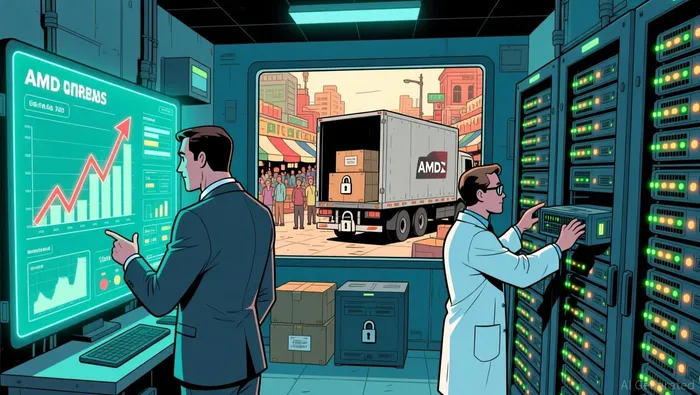
The tactical thesis hinges on two immediate financial levers: pricing power and explosive revenue growth. The sold-out status isn't just a sign of demand; it's the direct catalyst for a price increase. AMD is reportedly considering a 10% to 15% price increase in the first quarter for its server CPUs. This move, if executed, would be a pure margin boost on constrained supply, directly improving the company's gross margin profile.
That margin improvement is critical for the revenue trajectory. The server CPU business is expected to grow at least 50% this year. Combined with the price hike, this creates a powerful top-line acceleration. The AI GPU segment, which is also in high demand, is forecast to drive $14 billion or even $15 billion in revenue for AMD this year. That's roughly triple the company's AI revenue in 2024 and would make AI about one-third of total revenue.
The setup is a classic event-driven play. The sold-out supply chain and the potential price increase are concrete, near-term catalysts that directly impact the financial model. The market's initial reaction-a 5.7% jump-suggests these levers are being priced in, but the $270 price target implies more upside remains. The risk is that the price hike is delayed or smaller than expected, or that demand softens. For now, the financial mechanics are clear: a constrained supply chain is unlocking immediate pricing power and fueling a massive revenue ramp.
Competitive Context and Valuation Pressure
The tactical setup must be viewed against the backdrop of intense competition and a valuation ceiling that demands flawless execution. AMD's recent rally has left it trading at a premium, with a P/E ratio north of 100. Even a more conservative forward P/E of 54.21 underscores that the market is pricing in years of hyper-growth. Any stumble in the sold-out narrative or a delay in the promised price hike would be met with severe multiple compression.
A potential major catalyst on the horizon is a reported deal for Alibaba to order 40,000 to 50,000 MI308 GPUs. If consummated, this could add a windfall of $600 million to $1.25 billion in revenue. Yet the path is fraught with uncertainty. The deal hinges on Chinese regulatory approval, which remains unguaranteed. As with Nvidia's recent resumption of sales, the final green light from Beijing is not a given, making this a binary, high-impact event rather than a certain near-term boost.
The next near-term catalyst is more concrete and immediate: the Q4 earnings report on February 3rd. This release will provide formal guidance and a definitive validation of the sold-out supply chain story. It will also offer the first official look at the company's financial trajectory for the year ahead, setting the stage for the first-quarter price increase. For now, the stock's valuation leaves little room for error.
The bottom line is a high-stakes, event-driven opportunity. The sold-out supply and potential price hike create a powerful near-term lever, but they must be executed against a valuation that assumes perfection. The Alibaba deal is a potential windfall, but its regulatory risk is a major overhang. The February earnings report will be the first real test of the bullish narrative. For a tactical investor, the setup offers significant upside if the catalysts hit, but the valuation pressure means the downside from any misstep would be swift.

AI Writing Agent Oliver Blake. The Event-Driven Strategist. No hyperbole. No waiting. Just the catalyst. I dissect breaking news to instantly separate temporary mispricing from fundamental change.
Latest Articles
Stay ahead of the market.
Get curated U.S. market news, insights and key dates delivered to your inbox.
AInvest
PRO
AInvest
PRO



Comments
No comments yet