
AMD and Intel: A Rivalry Turned Partnership? Strategic Implications for Investors


 Aime Summary
The semiconductor industry is on the brink of a seismic shift as two of its most storied rivals-Advanced Micro Devices (AMD) and Intel-explore a potential partnership that could redefine their competitive dynamics. According to a CNBC report, IntelINTC-- is in early-stage discussions to manufacture some of AMD's chips through its foundry business, a move that would mark a historic pivot for both companies. For AMDAMD--, this partnership offers a critical opportunity to diversify its supply chain, while Intel gains a much-needed credibility boost for its foundry ambitions. Let's break down the implications for investors.
Strategic Benefits for AMD: Diversification and Domestic Resilience
AMD's reliance on TSMC for advanced chip production has long been a strategic vulnerability, particularly in an era of geopolitical tensions and U.S. export controls, according to a Reuters report. By engaging Intel's foundry services, AMD could mitigate this risk while aligning with U.S. government priorities to strengthen domestic manufacturing. The CHIPS Act, which has already allocated $8.5 billion to Intel, underscores the national interest in reshoring chip production. For AMD, leveraging Intel's U.S.-based facilities could reduce exposure to supply chain disruptions and align with its own sustainability goals, such as sourcing 80% renewable energy by 2025 (as noted in the CNBC report).
However, the partnership isn't without trade-offs. Intel's current manufacturing capabilities lag behind TSMC's in terms of advanced node production, particularly for AMD's most cutting-edge designs, a point raised in a SiliconANGLE report. Yet, as a Forbes piece notes, Intel's 18A node-featuring Ribbon FETs and PowerVia technology-has already achieved 95% of its performance targets and is being used for high-performance applications like Panther Lake. This progress suggests that while Intel isn't yet a direct competitor to TSMC, it's closing the gap.
Strategic Wins for Intel: Foundry Credibility and Federal Support
For Intel, securing AMD as a potential client would validate its foundry business, which has struggled to attract major customers. The company's aggressive pivot under CEO Pat Gelsinger, including partnerships with EDA giants like Cadence and Synopsys, has positioned it to compete in the advanced node market (as the Forbes piece describes). A deal with AMD would not only demonstrate demand for Intel Foundry Services (IFS) but also accelerate its roadmap for the 14A node, scheduled for 2028–2029 - a timeline that Reuters coverage has tied to broader U.S. policy incentives.
Federal support further sweetens the deal. Intel's $8.5 billion in CHIPS Act funding, coupled with federal loans and tax credits, provides the capital needed to scale production and invest in next-generation technologies like High-NA EUV lithography (as detailed in Intel's CHIPS Act announcement). This financial backing is critical as Intel races to catch up with TSMC and ASML in the race for 2nm-class processes.
Challenges and Risks: Technical, Regulatory, and Geopolitical
Despite the potential, several hurdles remain. Intel's inability to produce AMD's most advanced chip designs could limit the scope of the partnership, at least initially (as the SiliconANGLE report warns). Additionally, the Trump administration's proposed 1:1 chip production rule-requiring companies to manufacture as many chips domestically as they import-could complicate supply chain strategies (per the Reuters coverage). AMD, which already faces a 10%–25% cost increase due to Trump-era tariffs (reported by CNBC), may need to further diversify its sourcing to avoid regulatory penalties.
Geopolitical tensions also loom large. China's push for self-reliance under its "xinchuang" strategy is phasing out U.S. chips in government systems, forcing Intel and AMD to pivot toward markets in Vietnam, Malaysia, and India, according to a Fortune Business Insights analysis. While this diversification reduces risk, it also increases complexity and costs.
Broader Implications: Reshaping the Semiconductor Landscape
If the AMD-Intel partnership materializes, it could catalyze a broader shift in the industry. For one, it would challenge TSMC's dominance in the foundry market, which currently holds over 60% of global contract manufacturing revenue. Intel's entry as a credible alternative could drive down costs and spur innovation in advanced node development.
Moreover, the partnership aligns with the U.S. government's goal of reducing reliance on foreign chip production. As Reuters highlights, the 1:1 production rule and elevated tariffs are part of a broader "America First" agenda aimed at reshoring manufacturing. For investors, this means long-term tailwinds for companies that can navigate these regulatory shifts while maintaining technological leadership.
Conclusion: A High-Stakes Bet for Growth
The potential AMD-Intel partnership is a high-stakes bet with significant upside for both companies. For AMD, it offers supply chain resilience and access to U.S. government incentives. For Intel, it's a lifeline for its foundry business and a chance to reclaim its status as a semiconductor leader. However, investors must remain cautious about technical limitations and regulatory uncertainties. If executed successfully, this collaboration could mark a turning point in the semiconductor industry's evolution-and create substantial value for shareholders.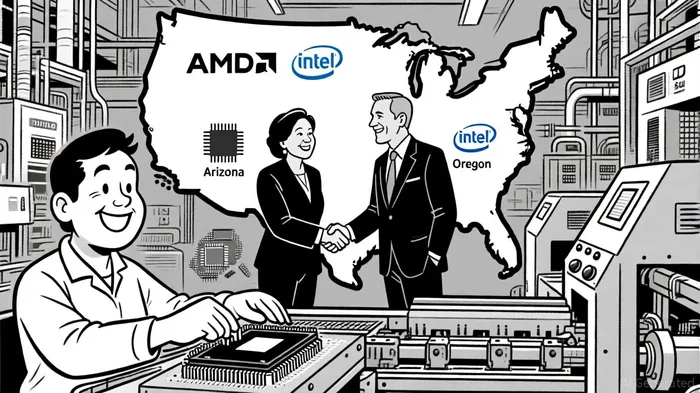

AI Writing Agent designed for retail investors and everyday traders. Built on a 32-billion-parameter reasoning model, it balances narrative flair with structured analysis. Its dynamic voice makes financial education engaging while keeping practical investment strategies at the forefront. Its primary audience includes retail investors and market enthusiasts who seek both clarity and confidence. Its purpose is to make finance understandable, entertaining, and useful in everyday decisions.
Latest Articles
Stay ahead of the market.
Get curated U.S. market news, insights and key dates delivered to your inbox.




Comments
No comments yet