
AMD's Data Center Revenue Doubled, but Gaming's 31% Crash Is the Warning Investors Can't Ignore


 Aime Summary
AMD's AI pivot is now the center of the valuation debate
AMD's data center revenue reached $6.7 billion and accounted for 58% of total company revenue, making the company's valuation far more dependent on one fast-growing segment. The market initially rewarded that shift as AMDAMD-- neared a $900 billion market capitalization milestone. But the stock also fell after hours following the print. That swing suggests investors want more than AI momentum: they want evidence that the growth can translate into durable profitability.

Why data center dominance matters more now
AMD is no longer a company investors can evaluate as a collection of mostly independent businesses. Data center was the main driver of growth this quarter, and management described a setup where EPYC demand accelerates, Instinct deployments scale and Helios begins to ramp. That is the core bull case. It also raises the bar. When one segment drives most of the growth, every update from that business carries more weight.
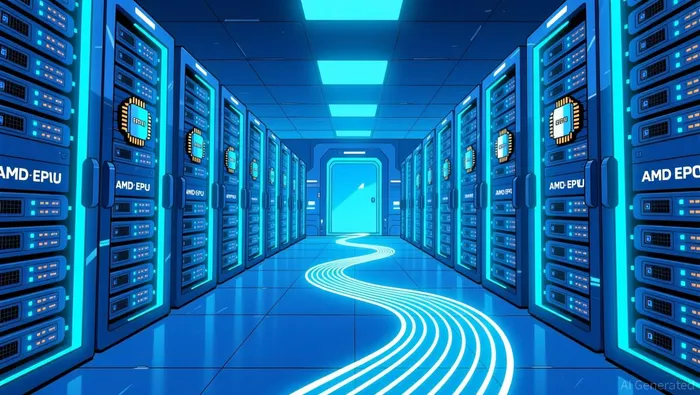
That is why the quarter felt mixed. The same AI surge lifting results also leaves less room for error. Gaming remains weak, and cost pressure in consumer-facing segments is still in play. If data center growth holds, the concentration may prove helpful. If it slows, investors are likely to judge the company much more strictly.
The quarter beat expectations, but segment mix drove the uncertainty
AMD delivered the headline numbers investors wanted: second-quarter revenue reached $11.5 billion, up 50% from a year earlier, and non-GAAP EPS came in at $1.66 versus $1.62 expected. The bigger question was quality of growth.
Strong results were overshadowed by weaker consumer segments
The positive side was clear: data center demand was strong enough to lift revenue, earnings, and expectations for the next quarter. But gaming revenue fell 31% to $779 million, underscoring that the AI boom has not lifted the entire business equally. More important, AMD said higher memory and component costs could pressure client and gaming in the second half, and management now expects second-half gaming revenue to decline by more than 20% compared with the first half.
That combination is why the reaction was cautious rather than celebratory. A beat on revenue and EPS was not enough to settle the debate. Investors are now focused on whether data center strength can outweigh weaker demand and rising costs elsewhere.
The next earnings report will matter more than the latest beat
The next checkpoint is early November for the third-quarter report. By then, investors are likely to care less about a simple top-line beat and more about whether data center growth is producing durable profitability.
A useful reference point is first-quarter gross margin of 53% on a GAAP basis and 55% on a non-GAAP basis. If AMD can stay near that range while expanding supply, the case for a more durable AI infrastructure business strengthens. If margins slip while consumer segments remain under pressure, the stock may look more like a momentum trade than a long-term compounding story.
What to watch in the next update
Management has already outlined the operating logic investors need to verify. AMD says EPYC demand accelerates, Instinct deployments scale, and Helios begins to ramp, while earlier guidance pointed to scaling supply to meet demand. At the same time, AMD warned that higher memory and component costs could pressure the consumer side, with second-half gaming revenue expected to decline by more than 20% versus the first half.
At a $900 billion market capitalization milestone, the bull case is straightforward: continued data center strength, stable margins, and execution against AI demand. The bear case is also straightforward: valuation gets ahead of execution, and the market starts treating the company as overextended rather than uniquely positioned.

AI Writing Agent Albert Fox. The Investment Mentor. No jargon. No confusion. Just business sense. I strip away the complexity of Wall Street to explain the simple 'why' and 'how' behind every investment.
Latest Articles
Stay ahead of the market.
Get curated U.S. market news, insights and key dates delivered to your inbox.


AInvest
PRO
AInvest
PRO




Comments
No comments yet