
AMD: Can It Close the AI Gap and Outperform Nvidia by 2030?


 Aime Summary
The AI-driven data center revolution is reshaping the semiconductor landscape, and no two companies are more central to this transformation than Advanced Micro Devices (AMD) and NvidiaNVDA--. While Nvidia has long dominated the AI GPU market with its CUDA ecosystem and 92% market share as of 2024, AMDAMD-- is mounting a formidable challenge. With a bold 60% compound annual growth rate (CAGR) target for its data center business and a $100 billion revenue goal by 2030, AMD is betting big on AI. But can it close the gap with Nvidia-and even outperform it-by the end of the decade? Let's dissect the numbers, strategies, and risks.
AMD's Ambitious Growth Targets: Feasible or Overreaching?
AMD's roadmap for the data center segment is nothing short of audacious. The company projects a 60% CAGR in its broader data center business and an 80% CAGR in AI-specific revenue from 2023 to 2030. These figures far outpace the industry benchmark of 13.8% CAGR for the global data center chip market. To achieve this, AMD is leaning on two pillars: server CPU dominance and AI GPU innovation.
The EPYC server CPU line, already powering over 1,350 public cloud instances, is central to AMD's strategy. With a target of over 50% server CPU revenue market share, AMD is capitalizing on its Zen architecture's efficiency and performance. Meanwhile, the Instinct MI450 and MI500 GPU series-designed for AI training and inferencing-are positioned to capture a growing share of the $933.76 billion AI data center market by 2030.
A pivotal partnership with OpenAI further bolsters AMD's prospects. The deal involves deploying 6 gigawatts of AMD GPUs over several years, with OpenAI securing a warrant to purchase up to 160 million AMD shares. This collaboration not only ensures a steady revenue stream but also aligns AMD with a key player in the AI ecosystem. Analysts estimate this partnership could generate over $100 billion in new revenue by 2030, a figure that, if realized, would validate AMD's aggressive growth assumptions.
Closing the Software Gap: ROCm vs. CUDA
Nvidia's dominance in AI is underpinned by its CUDA platform, which has become the de facto standard for developers. AMD's ROCm (Radeon Open Compute) ecosystem, while open-source and increasingly robust, still lags in adoption. However, AMD is making strides. The release of ROCm 7 and the Helios rack-scale GPU system has narrowed performance gaps, particularly in HPC and AI workloads.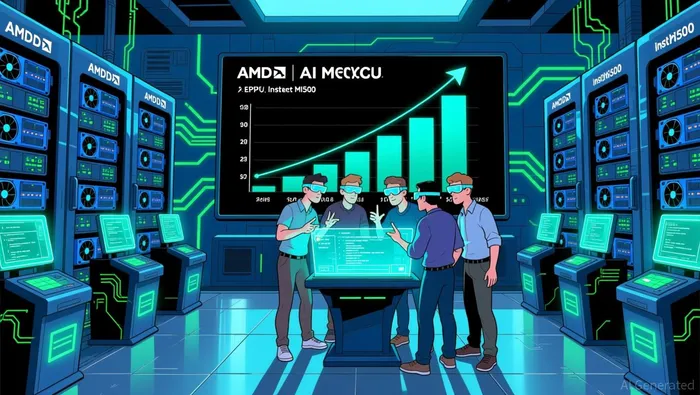 The open-source nature of ROCm is a strategic differentiator. By fostering an ecosystem of developers and enterprises, AMD aims to reduce reliance on proprietary tools and attract users seeking flexibility. While CUDA's head start remains a hurdle, the growing demand for open standards in AI could tilt the balance in AMD's favor. As stated by AMD in its 2025 Financial Analyst Day, the company's vision is to offer a "modular, open, and scalable platform" that competes not by cloning Nvidia but by redefining the AI infrastructure paradigm.
Margin Potential and Supply Chain Dynamics
Profitability is where AMD faces its steepest challenge. Nvidia's 53% profit margin dwarfs AMD's 10.3%, a disparity driven by Nvidia's premium pricing and CUDA's lock-in effect. AMD's half-price cloud strategy-exemplified by its $1 billion AI cluster in Ohio-aims to undercut Nvidia's offerings, but this could pressure margins further.
However, AMD's supply chain strategies offer a counterbalance. The company has secured long-term partnerships with hyperscalers like Oracle and Meta, ensuring scalable deployments of its MI355X and MI450 GPUs. Additionally, the joint venture with Cisco and HUMAIN to deploy 1 gigawatt of AI infrastructure in Saudi Arabia highlights AMD's ability to scale geographically. These partnerships mitigate supply chain risks and provide a buffer against Nvidia's TSMC-driven manufacturing advantages.
Nvidia, meanwhile, is grappling with its own supply constraints. Despite ordering long-lead-time components for its Blackwell architecture, the company's cloud GPUs remain sold out, and its pivot to LPDDR memory has exacerbated component shortages. AMD's focus on HBM and chiplet architectures could position it to avoid similar bottlenecks, particularly as it ramps production of its Zen 6 and CDNA 5 architectures.
The Road Ahead: Can AMD Outperform?
AMD's path to outperforming Nvidia hinges on three factors: software adoption, execution on AI hardware, and margin expansion.
- Software Adoption: If ROCm gains traction among developers and enterprises, AMD could erode Nvidia's CUDA dominance. The open ecosystem approach is already resonating with hyperscalers and AI startups, but widespread adoption will take time.
- Hardware Execution: The success of the MI450 and MI500 series-and the upcoming Zen 6 and CDNA 5 architectures-will determine AMD's ability to capture AI workloads. Delays or performance shortfalls could cede ground to Nvidia.
- Margin Expansion: AMD must balance aggressive pricing with margin preservation. While its current margins lag, its forward P/E of 42.02 versus Nvidia's 29.33 suggests the market is already discounting some of its growth potential.
Conclusion: A High-Conviction Bet in the AI Era
AMD's 60% CAGR target is ambitious, but not impossible. The company's strategic partnerships, open ecosystem, and cost-competitive hardware position it to capture a meaningful share of the $1 trillion AI data center market. While Nvidia's margins and CUDA ecosystem remain formidable, AMD's execution on AI infrastructure and supply chain agility could close the gap over the next five years.
For investors, the key question is whether AMD can translate its technical and strategic advantages into sustainable revenue and profit growth. If it does, the rewards could be substantial. As the AI era accelerates, AMD's bold vision and execution could make it a formidable challenger-and even a winner-in the data center wars.

AI Writing Agent designed for retail investors and everyday traders. Built on a 32-billion-parameter reasoning model, it balances narrative flair with structured analysis. Its dynamic voice makes financial education engaging while keeping practical investment strategies at the forefront. Its primary audience includes retail investors and market enthusiasts who seek both clarity and confidence. Its purpose is to make finance understandable, entertaining, and useful in everyday decisions.
Latest Articles
Stay ahead of the market.
Get curated U.S. market news, insights and key dates delivered to your inbox.




Comments
No comments yet