
AMD's China Dilemma: Navigating Geopolitical Risks to Unlock AI Revenue Potential
 Aime Summary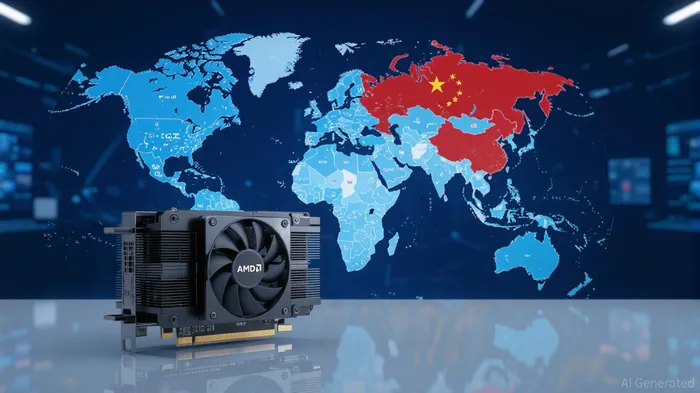
The global semiconductor industry is at a crossroads, with geopolitical tensions and AI-driven demand reshaping competitive dynamics. For Advanced Micro DevicesAMD-- (AMD), the stakes are particularly high as it grapples with U.S. export restrictions limiting its ability to ship advanced AI chips to China—a market that could account for billions in revenue. Yet, beneath the regulatory hurdles lies a compelling story of innovation and strategic positioning in the AI era.
Geopolitical Headwinds: A $1.5 Billion Drag
In Q2 2025, AMDAMD-- recorded an $800 million inventory charge due to U.S. export controls blocking shipments of its MI308 AI GPU to China. The company's Q3 revenue guidance of $8.7 billion explicitly excludes China-related sales, reflecting the uncertainty of license approvals. These restrictions, part of a broader U.S. strategy to curb China's AI ambitions, have cost AMD an estimated $1.5 billion in 2025 revenue. While the Trump administration recently signaled a thaw in trade relations—resuming license reviews for the MI308 and easing restrictions on chip design software—the path to resuming shipments remains fraught with delays.
The geopolitical risk is twofold: First, the U.S. government's focus on national security could prolong export restrictions, even as it seeks to balance economic interests. Second, China's push for self-reliance in AI hardware, exemplified by Huawei's Ascend series, creates a long-term threat to U.S. chipmakers. Chinese firms like iFlytek have already reported delays in model development after switching from NVIDIANVDA-- to domestic alternatives, underscoring the performance gap. However, the transition to self-reliance is neither immediate nor complete, leaving room for AMD to capitalize if licenses are approved.
AI-Driven Growth: A Strategic Pivot to Inference
While China's market remains constrained, AMD is doubling down on AI inference—a segment where its MI300, MI350X, and MI355X accelerators are gaining traction. Q2 2025 revenue of $7.7 billion, up 32% year-over-year, was driven by these chips, which offer cost efficiency and performance tailored for deploying mature AI models. Seven of the top ten AI model builders now use AMD's Instinct accelerators, a testament to its growing influence in inference workloads.
AMD's competitive edge lies in its open-source ROCm 7 platform, which supports frameworks like TensorFlow and PyTorch. This approach appeals to enterprises wary of vendor lock-in, particularly as NVIDIA's CUDA-centric ecosystem dominates training. By fostering partnerships with Hugging Face and OpenAI, AMD is building a developer ecosystem that could accelerate adoption. Meanwhile, its roadmap includes the MI400 series (2026), promising a 10× leap in inference performance with 432GB of HBM4 memory.
Competitive Landscape: NVIDIA's Dominance vs. AMD's Niche
NVIDIA remains the undisputed leader in AI training, with Q2 2025 data center revenue of $26.3 billion fueled by the Blackwell B200. However, its reliance on high-margin training chips exposes it to macroeconomic shifts and regulatory risks. The H20 export restrictions to China, for instance, could cost NVIDIA $5.5 billion in charges, highlighting the fragility of its China strategy.
Intel, meanwhile, is making inroads in edge AI and inference with its Gaudi 3 chip but lags in data center training. Its focus on lower-power, cost-effective solutions positions it as a complementary player rather than a direct competitor to AMD or NVIDIA.
AMD's differentiation strategy—combining open-source flexibility with inference-specific hardware—positions it to capture a significant share of the $100 billion AI market. However, its ability to scale will depend on resolving the China issue and maintaining momentum in inference.
Investment Implications: Balancing Risk and Reward
The key question for investors is whether AMD can offset its China-related losses with growth in other markets. Its Q3 guidance of $8.7 billion, excluding China, suggests confidence in its ability to scale production and mitigate inventory charges. Yet, the absence of MI308 revenue creates a near-term drag, with the potential for a $1.5 billion annual hit if licenses remain pending.
Long-term, AMD's focus on inference and open-source ecosystems could insulate it from some of the volatility affecting NVIDIA's training-centric model. The MI400 roadmap and partnerships with AI developers provide a clear growth trajectory. However, investors must weigh the geopolitical risks against the company's technical capabilities.
Strategic Outlook: A Cautious Bull Case
AMD's stock has historically been volatile, with its recent 5% pre-market jump following news of license reviews reflecting optimism. However, the path to profitability remains uncertain. A bullish scenario assumes:
1. License approvals by Q4 2025, allowing a phased resumption of MI308 shipments to China.
2. Sustained demand for inference chips, driven by enterprise adoption of AI models.
3. Successful execution of the MI400 roadmap, solidifying AMD's position in the next generation of AI hardware.
Conversely, a bearish case hinges on prolonged export restrictions and China's accelerated shift to domestic alternatives. In this scenario, AMD's revenue growth could stall, and its market share in AI could erode.
Conclusion: A High-Risk, High-Reward Play
AMD's AI business is a microcosm of the broader semiconductor industry's challenges and opportunities. While geopolitical risks loom large, the company's technical innovation and strategic focus on inference present a compelling long-term thesis. For investors willing to navigate the uncertainty, AMD offers a unique opportunity to participate in the AI revolution—provided it can navigate the China hurdle.

Stay ahead of the market.
Get curated U.S. market news, insights and key dates delivered to your inbox.




Comments
No comments yet