
AMD Beats and Guides Higher — But the Stock Cracks and Slides to the $222 “Make-or-Break” Line


 Aime Summary
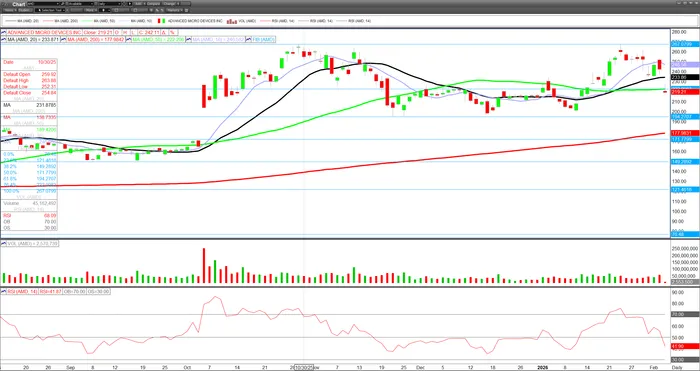
AMD’s Q4 print was solid, but it didn’t deliver the kind of “AI blowout” needed to satisfy a market that has become allergic to anything short of perfection. Shares are selling the news and sliding back toward the 50-day moving average around $222, which is now the key technical line in the sand for near-term sentiment. Fundamentally the quarter showed strong growth, expanding profitability, and accelerating data center momentum, but the reaction reflects two things: expectations were high, and the quality of the beat was muddied by China-related MI308 revenue and accounting tailwinds.
On headline results, AMDAMD-- beat consensus on both the top and bottom line. Adjusted EPS was $1.53 versus $1.32 expected, and revenue was $10.27B versus ~$9.67B expected, a meaningful upside that still managed to feel “not enough” given the tape. The company also posted record non-GAAP operating income ($2.9B), record non-GAAP net income ($2.5B), and record non-GAAP EPS, while free cash flow nearly doubled year over year to a record $2.1B. In other words, execution was strong; the stock’s problem is the market’s demand for an even bigger narrative shift.

Gross margin was a central part of the debate. On a GAAP basis, gross margin was 54%, and on a non-GAAP basis it was 57%—up roughly 290 bps year over year. However, management was transparent that Q4 benefited from a ~$360M release of previously reserved MI308 inventory and related charges, and MI308 revenue to China was about $390M. Excluding the reserve reversal and MI308 China revenue, AMD indicated non-GAAP gross margin would have been ~55% (still up ~80 bps year over year on mix), which is the more “repeatable” takeaway and likely closer to how investors should underwrite margins near-term. For Q1, AMD guided non-GAAP gross margin to ~55%, essentially telling you: the margin profile remains healthy, but don’t expect additional China-related boosts to carry the quarter.
Guidance was technically above the Street, but again, not a fireworks show. AMD guided Q1 revenue to about $9.8B ± $300M versus ~ $9.4B consensus, implying ~32% year-over-year growth and a ~5% sequential decline. Management noted the Q1 outlook includes about $100M of MI308 sales to China and also emphasized they are not forecasting incremental China AI-chip revenue beyond that $100M in Q1. That last point matters: it removes a potential “hidden upside” lever, and it also reinforces that the core story needs to stand on ex-China demand.
The segment breakdown showed the data center engine is doing the heavy lifting. Data Center revenue was a record $5.4B, up 39% year over year and up 24% sequentially, driven by strong EPYC CPU demand and continued ramp of Instinct GPU shipments. Importantly, data center operating income rose to $1.8B (33% of segment revenue) from $1.2B (30%) a year ago, reflecting the scale benefits of growth plus the margin tailwind in the quarter, partially offset by ongoing investment in the AI hardware and software roadmap. Lisa Su highlighted that 5th-gen EPYC “Turin” adoption accelerated and accounted for more than half of total server revenue, while prior-gen EPYC remained robust—essentially AMD is monetizing both the upgrade cycle and the installed base.
AMD Daily:
Client and Gaming revenue was $3.9B, up 37% year over year, with the Client business leading. Client revenue was a record $3.1B, up 34% year over year and up 13% sequentially, driven by strong Ryzen demand, market share gains, and a richer mix. Management also leaned into commercial momentum: Ryzen sell-through in commercial notebooks/desktops grew more than 40% year over year, with wins across verticals (telecom, financial services, aerospace, automotive, energy, and tech). Gaming revenue was $843M, up 50% year over year, primarily on higher semi-custom revenue and strong Radeon GPU demand; sequentially gaming declined, consistent with expected console-cycle seasonality. Looking ahead, Su signaled semi-custom SoC revenue will decline by a significant double-digit percentage in 2026 as the console cycle matures—helpful honesty, but also a reminder that gaming is not the growth engine right now.
Embedded revenue was $950M, up 3% year over year and up 11% sequentially as demand improved across several end markets, led by test/measurement and aerospace. Embedded operating income remained very strong at $357M (38% margin), only slightly down from 39% a year ago. Su also framed embedded as a long-duration design-win story: $17B in design wins in 2025, up nearly 20% year over year, and more than $50B in total embedded designs since the Xilinx acquisition. Translation: growth is lumpy, but the backlog of opportunities keeps building.
On the AI outlook, Su was emphatically bullish—and specific. She reiterated AMD is “well positioned to grow data center segment revenue by more than 60% annually over the next three to five years” and expects to scale the AI business to “tens of billions” in annual sales in 2027. She also emphasized ecosystem progress: ROCm enablement, day-zero support for leading models, upstream integration (e.g., vLLM), and an Enterprise AI Suite aimed at making deployments easier for large businesses. The message is that AMD isn’t just shipping silicon; it’s building a full-stack platform to reduce friction and improve time-to-value, which is critical if the market is going to believe AMD can win meaningful share versus Nvidia in real production environments.
Production and supply chain sounded more like a strength than a constraint, with key ramps described as on track. Su said MI450 development is going “extremely well,” and the company is on track for a second-half launch and beginning of production, with revenue starting in Q3 and “significant volume” in Q4 as the company moves into 2027. She also highlighted “deep engineering engagement” with OEMs to support smooth production ramps for Helios rack-scale systems in 2026, with public partner mentions like HPE and Lenovo. The biggest “issue” is not production capacity as framed here; it’s execution at rack-scale cluster deployments and proving sustained margins and free-cash-flow economics through the cycle—exactly what skeptical investors are demanding.
The China angle is the other key nuance. Q4 included ~$390M of MI308 revenue to China, and Q1 includes ~$100M; beyond that, AMD is not forecasting additional China AI-chip revenue, though it has submitted licenses to ship MI325 to China. Several analysts pointed out that stripping out China revenue and the inventory reserve release makes the beat look less dramatic, which helps explain the stock move. That doesn’t negate the underlying momentum, but it does reduce the “wow factor” and feeds the sell-the-news dynamic.
Bottom line: AMD executed well, margins remain healthy with a clear 55% baseline, and the data center engine is accelerating. But with the stock testing the 200-day near $222, the market is demanding proof that the AI ramp will translate into durable, high-quality earnings without one-time assists—and that AMD can win at-scale deployments where the real money (and scrutiny) lives.

Senior Analyst and trader with 20+ years experience with in-depth market coverage, economic trends, industry research, stock analysis, and investment ideas.
Latest Articles
Stay ahead of the market.
Get curated U.S. market news, insights and key dates delivered to your inbox.




Comments
No comments yet