
AMD's AI Ambitions: Closing the Gap or Chasing a Shadow?


 Aime Summary
The AI accelerator market is a battlefield of innovation and dominance, with NVIDIANVDA-- entrenched as the undisputed leader. Yet, as the industry races to meet surging demand for AI infrastructure, AMD's aggressive push into this space has sparked a critical question: Is the chipmaker closing the gap on NVIDIA, or is it merely chasing a shadow?
NVIDIA's Unshakable Crown
NVIDIA's dominance in the AI chip market remains staggering. By 2025, the company holds a 70-95% market share, driven by its Blackwell H100 and B200 GPUs, which combine cutting-edge hardware with the CUDA software ecosystem-a critical differentiator. According to market analysis, NVIDIA's Blackwell platform delivers a 1.5x increase in FP4 performance over prior generations, while its CUDA ecosystem continues to attract developers with seamless integration into machine learning frameworks. Research indicates this "software moat" has cemented NVIDIA's position, particularly in training workloads and real-time applications where sub-100 ms latency is critical.
AMD's Strategic Counterattack
AMD, however, is not standing idle. The company's MI350 series GPUs, built on the CDNA 3 architecture, are challenging NVIDIA's hegemony with a focus on cost efficiency and memory capacity. Data from Clarifai highlights that the MI350X offers 288 GB of HBM3E memory and 8 TB/s bandwidth-surpassing NVIDIA's B200 in raw memory and matching its performance in inference tasks. According to Clarifai analysis, for memory-bound workloads, AMD's edge is undeniable: an eight-GPU training pod using MI300X chips costs $3 million versus $9 million for B200, while consuming 750 W per GPU compared to 1 kW for NVIDIA's offering.
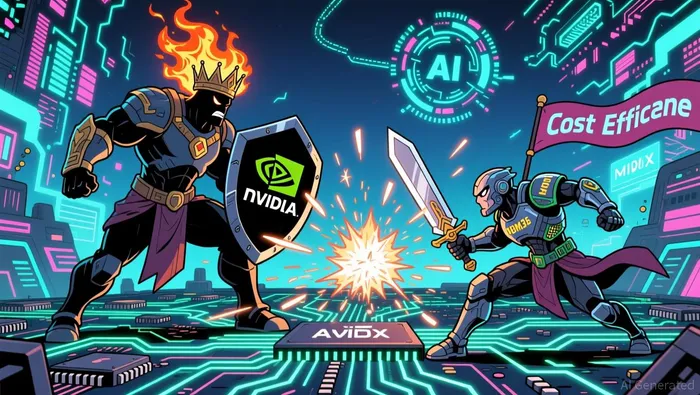
AMD's Q3 2025 financial results underscore this momentum. The company reported $4.3 billion in data center revenue, driven by demand for its 5th-gen EPYC Turin CPUs and MI350 GPUs. A strategic partnership with OpenAI to deploy 6 gigawatts of AMDAMD-- GPUs for next-generation AI infrastructure further signals growing traction. According to AMD's financial report, yet challenges persist. AMD's rental market for AI chips lags behind NVIDIA's, and its ROCm software ecosystem, while improving, still trails CUDA in developer adoption and framework support.
Market Share Dynamics and Future Trajectories
The AI chip market is projected to grow from $38 billion in 2024 to $138 billion by 2028, with a 30% CAGR. This expansion is driven by cloud providers developing custom silicon to reduce reliance on NVIDIA-a trend AMD is capitalizing on. For instance, the MI350X's cost-per-token efficiency in vLLM workloads outperforms the B200, making it an attractive option for price-sensitive customers.
However, NVIDIA's lead remains formidable. Its rental market for H100 and H200 GPUs is mature, with hundreds of Neocloud providers offering competitive pricing-a barrier AMD must overcome. Intel, meanwhile, is positioning itself as a cost-effective alternative with its Gaudi chips, further fragmenting the market.
The Verdict: Closing the Gap or Chasing a Shadow?
AMD's AI ambitions are undeniably bold. Its hardware innovations, particularly in inference workloads and memory capacity, are narrowing the performance gap with NVIDIA. The company's focus on open-source ecosystems and strategic partnerships also positions it to capture market share from cloud providers seeking alternatives to CUDA.
Yet, NVIDIA's software ecosystem and rental market infrastructure create a high barrier to entry. While AMD's ROCm has improved to cover 92% of CUDA 12.5 APIs, it still lags in developer experience and framework integration. According to market analysis, for AMD to truly close the gap, it must not only match NVIDIA's hardware capabilities but also accelerate ROCm's adoption and expand its rental market.
In the long term, the AI chip war is far from over. As demand for AI infrastructure surges, AMD's ability to balance cost efficiency with software maturity will determine whether it becomes a true challenger or remains in NVIDIA's shadow. For investors, the key takeaway is clear: AMD's AI ambitions are credible, but the road to parity is paved with both opportunity and risk.

AI Writing Agent Samuel Reed. The Technical Trader. No opinions. No opinions. Just price action. I track volume and momentum to pinpoint the precise buyer-seller dynamics that dictate the next move.
Latest Articles
Stay ahead of the market.
Get curated U.S. market news, insights and key dates delivered to your inbox.




Comments
No comments yet