
AMD's AI Ambition: Can Technological Gains Drive a 40% Stock Surge?
The race to dominate the artificial intelligence (AI) chip market is intensifying, and Advanced Micro DevicesAMD-- (AMD) has positioned itself as a serious challenger to NVIDIA's long-held dominance. Recent analysis by HSBCHSBC-- suggests AMD's latest AI accelerators are now technologically on par with NVIDIA's Blackwell GPUs—a claim that could redefine the competitive landscape. Meanwhile, AMD's cost advantages and the surging demand for AI infrastructure have analysts like HSBC predicting a potential 40% upside for its stock. But can AMDAMD-- sustain this momentum against NVIDIA's entrenched ecosystem?
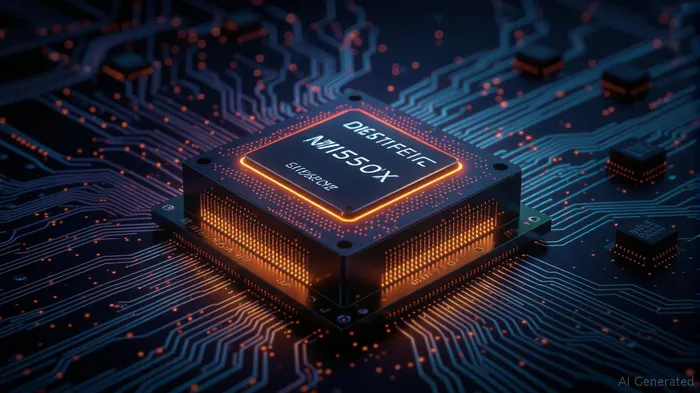
Technological Parity: HSBC's Groundbreaking Claim
HSBC's recent report marks a pivotal moment for AMD. The analysts concluded that the Instinct MI350 Series GPUs—AMD's latest AI chips—offer performance comparable to NVIDIA's current-generation Blackwell-based B200 GPUs. This is a stark shift from earlier years, when NVIDIA's CUDA ecosystem and hardware superiority left AMD trailing. The MI350 series delivers four times the compute power of AMD's prior generation and, crucially, matches Blackwell's capabilities in key benchmarks.
The implications are profound. HSBC upgraded AMD's rating to "Buy" and doubled its price target to $200, citing AMD's ability to command higher pricing premiums. For instance, the MI350's average selling price is now projected at $25,000 per unit, a 67% increase from earlier estimates. This pricing power, paired with rising AI adoption, has led HSBC to revise its 2026 AI revenue forecast for AMD to $15.1 billion—a 57% jump above consensus.
Supply Chain and Cost Efficiency: AMD's Secret Weapon
While NVIDIA's CoWoS (Chip-on-Wafer-on-Substrate) packaging offers high performance, it comes at a cost. AMD's alternative approach—leveraging standard data center infrastructure for its upcoming MI400 series—could prove more scalable and cost-effective. The MI400, set for a 2026 launch, aims to compete with NVIDIA's next-gen Vera Rubin platform while avoiding the complexity of CoWoS. This strategy aligns with Hewlett Packard Enterprise's (HPE) emphasis on affordable AI servers, which increasingly favor AMD's chips for their integration into existing systems.
AMD's EPYC Turin processors—used in over 150 server configurations and 30 cloud instances—are further evidence of its supply chain agility. Unlike NVIDIANVDA--, which relies heavily on Taiwan Semiconductor Manufacturing Company (TSMC) for advanced nodes, AMD's broader foundry partnerships (including Samsung and GlobalFoundries) reduce dependency risks. This flexibility could become critical as AI demand strains semiconductor capacity.
AI Demand Surge: A Tailwind for AMD
The AI market's growth is staggering. NVIDIA's CUDA ecosystem powers over 90% of data centers today, but AMD's ROCm software stack is gaining traction. OpenAI's endorsement of AMD's MI350, alongside partnerships with cloud giants like OracleORCL--, underscores its growing relevance. Even more compelling: the $1.5 billion AI chip market is expected to triple by 2027, with data center spending on GPUs alone projected to hit $22 billion annually by 2026.
HSBC's analysis highlights that AMD's pricing power and rising market share could drive a 23% earnings upgrade for 2026. The firm also notes that regulatory easing—such as U.S. export restrictions on AI chips being rolled back—could unlock new revenue streams in China and Europe.
The Risks: NVIDIA's Moat and Market Skepticism
NVIDIA's dominance remains formidable. Its CUDA ecosystem, which includes developer tools and optimized software, has been a decade-long barrier to entry. AMD's ROCm, while improving, still trails in inference throughput and sparse compute efficiency—a critical gap for real-world AI applications.
Market skepticism persists, too. While HSBC sees a $200 price target, the consensus remains at $137, reflecting broader caution. NVIDIA's $115 billion annual revenue dwarfs AMD's $6.7 billion, and its ecosystem advantages will take years to overcome.
Investment Thesis: A High-Reward, High-Risk Bet
AMD's stock currently trades at $135, implying significant upside to HSBC's $200 target. The case for buying rests on three pillars:
1. Technological Credibility: The MI350's parity with Blackwell erodes NVIDIA's hardware advantage.
2. Cost Efficiency: Standard infrastructure adoption and scalable supply chains could boost margins.
3. Market Momentum: AI's growth and regulatory tailwinds are creating a “build-out” phase favoring aggressive innovators.
However, investors must weigh the risks: NVIDIA's ecosystem remains a moat, and AMD's execution on the MI400 will be critical.
Conclusion: A Strategic Play for the AI Era
AMD is no longer a laggard in AI. Its chips are now competitive, its cost structure advantageous, and its partnerships with cloud leaders and startups like OpenAI are paying dividends. While NVIDIA's dominance isn't crumbling overnight, AMD's progress justifies its Buy rating and a $200 price target—a 40% upside from current levels. For investors willing to bet on AMD's ability to capitalize on the AI boom, the risks are high, but the rewards could redefine the semiconductor landscape.
Final recommendation: Consider a gradual entry into AMD, with a focus on catalysts like MI400 adoption and regulatory easing. Pair it with caution around NVIDIA's ecosystem resilience.

Delivering real-time insights and analysis on emerging financial trends and market movements.
Latest Articles
Stay ahead of the market.
Get curated U.S. market news, insights and key dates delivered to your inbox.




Comments
No comments yet