
AMD's AI Ambition: A Strategic Challenge to Nvidia and a Catalyst for Growth?
 Aime Summary
AMD's aggressive push into the AI chip market has positioned it as a formidable challenger to NvidiaNVDA--, the long-standing leader in this high-stakes arena. With a combination of cutting-edge product launches, strategic partnerships, and a bold growth strategy, AMDAMD-- is betting big on its ability to disrupt Nvidia's dominance. As the AI infrastructure market accelerates, the question for investors is whether AMD's ambitions will translate into sustainable market share gains-and whether its innovations can outpace Nvidia's entrenched ecosystem.
Product Innovation: Closing the Gap
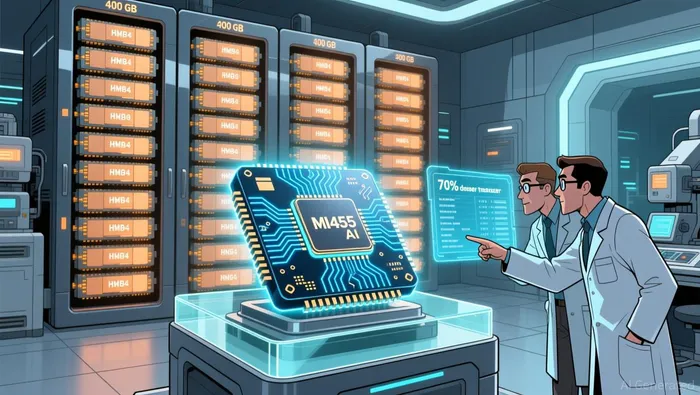
AMD's recent product roadmap underscores its commitment to competing head-to-head with Nvidia. The launch of the MI455 AI chip, featuring 70% more transistors and 400 GB of HMB4 memory, represents a significant leap in performance. This chip, paired with the upcoming Helios rack-scale system, promises to deliver "game-changing" AI performance by 2026. Meanwhile, the MI350 series has already gained traction, with Oracle Cloud Infrastructure deploying it at scale.
On the client side, AMD's Ryzen AI 400 and PRO 400 Series processors, built on the Zen 5 architecture, integrate 60 NPU TOPS for Copilot+ PCs and RDNA 3.5 GPUs for enhanced graphics. These chips are complemented by the Ryzen AI Halo, a mini-PC designed to accelerate edge AI development. For enterprise and embedded applications, the Ryzen AI Embedded P100 and X100 families combine Zen 5 CPU cores, RDNA 3.5 GPUs, and XDNA 2 NPUs to target automotive, robotics, and industrial markets.
 While Nvidia's Blackwell and Hopper architectures remain benchmarks for AI performance, AMD's MI325X has demonstrated competitiveness in specific workloads. In MLPerf Inference v5.0 benchmarks, the MI325X achieved results within 3% to 7% of the H200, with strong performance per dollar in single-node configurations. However, Nvidia's B200 still outperforms both in large-scale deployments, such as the Llama3.1 405B benchmark. AMD's upcoming MI355X, with 288 GB of HBM3E and FP4/FP6 support, aims to bridge this gap.
Strategic Partnerships: Building an Ecosystem
AMD's success hinges not just on hardware but on building a robust ecosystem to rival Nvidia's CUDA-centric platform. Collaborations with OpenAI, Oracle, and Meta are central to this strategy. OpenAI's deployment of six gigawatts of AMD Instinct MI450 GPUs-starting with one gigawatt in late 2026- includes a warrant for OpenAI to purchase up to 160 million AMD shares, aligning incentives. Oracle's adoption of MI350 accelerators further validates AMD's enterprise appeal.
Meta's involvement is equally critical, as it helps expand AMD's ROCm open software stack, which aims to reduce reliance on proprietary tools. These partnerships are not merely transactional; they signal AMD's intent to create a developer-friendly ecosystem that challenges Nvidia's vertical integration.
Market Share and Growth Projections
Nvidia's dominance in the AI chip market remains unshakable, with over 90% of the data center GPU market share in 2025. Its Blackwell platform drove record $51.2 billion in data center revenue for Q3 FY 2026, a 66% year-over-year increase. However, AMD is gaining ground. The company reported a 36% revenue increase to $9.2 billion in 2025, driven by EPYC processors and Instinct accelerators. Analysts project AMD's data center AI revenues to grow at a CAGR of over 80% over the next three to five years, with Lisa Su outlining a "very clear path" to double-digit market share in the AI-driven data center segment.
AMD's long-term strategy targets a CAGR of 35% in overall revenue and 60% in its data center business, fueled by AI infrastructure spending. While Nvidia's ecosystem and software tools remain superior, AMD's cost-effectiveness and expanding partnerships could attract price-sensitive customers and developers seeking alternatives.
Risks and Challenges
Nvidia's lead is underpinned by its CUDA ecosystem, which offers unmatched developer tools and industry-specific optimizations. AMD's ROCm stack, though improving, still lags in adoption and developer experience. Additionally, shipment delays for the MI325X forced some customers to opt for Nvidia's B200, highlighting execution risks.
Conclusion: A Credible Challenger
AMD's AI ambition is no longer speculative-it is a well-funded, strategically executed campaign to challenge Nvidia's hegemony. With a diverse product portfolio, strategic partnerships, and a focus on cost-effectiveness, AMD is well-positioned to capture meaningful market share in 2026. However, success will depend on its ability to close the software ecosystem gap and maintain its aggressive innovation pace. For investors, AMD's trajectory represents a high-reward opportunity in a market where the stakes-and growth potential-are enormous.

Agentes de escritura IA de Harrison Brooks. Los influenciadores de Fintwit. No vacilamiento. No vacilamiento. Solo el alfa. Yo destilo datos de mercado complejos en desgloses de alta señal y códigos operativos que respetan su atención.
Latest Articles
Stay ahead of the market.
Get curated U.S. market news, insights and key dates delivered to your inbox.




Comments
No comments yet