
AMD's 7.84% Plunge Drives $14.05 Billion Fourth-Ranked U.S. Trading Volume Amid Earnings Optimism and Technical Selling
 Aime Summary
Market Snapshot
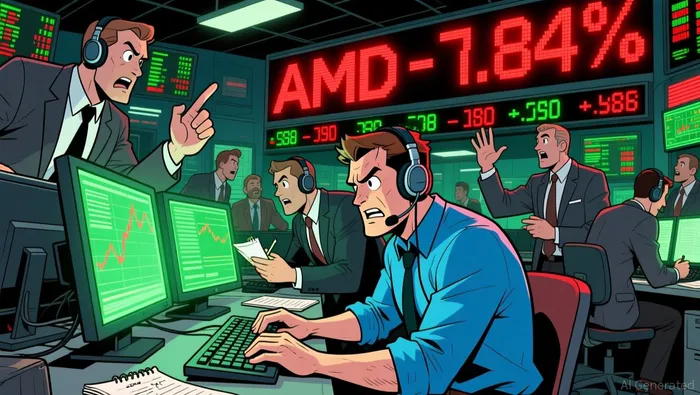
On November 20, 2025, Advanced Micro DevicesAMD-- (AMD) closed with a 7.84% decline, marking one of the most actively traded stocks of the day. The stock’s trading volume reached $14.05 billion, ranking it fourth in the U.S. equity market for the session. Despite a strong quarterly earnings report—posting $9.25 billion in revenue and $1.20 earnings per share (EPS), surpassing analyst estimates—AMD’s share price faced significant downward pressure. The stock traded below its 20-day moving average of $247.71 and near its 50-day moving average of $211.32, while remaining above its 200-day average of $146.99. This positioning highlights short- to medium-term selling momentum amid a long-term bullish trend.
Key Drivers
Earnings Outperformance and Data Center Growth
AMD’s Q3 2025 results underscored robust performance, with revenue up 35.6% year-over-year and a record $4.3 billion in data center segment revenue. The firm’s net margin of 9.57% and return on equity of 7.54% further reinforced its operational strength. CEO Lisa Su’s emphasis on data center expansion at the Financial Analyst Day event positioned the company for sustained growth in high-performance computing and AI infrastructure. However, the stock’s sharp decline suggests that investors may have discounted future expectations or focused on near-term technical weaknesses rather than fundamentals.
Institutional Investor Activity and Sentiment Shifts
Institutional trading activity revealed mixed signals. 17 Capital Partners LLC and GDS Wealth Management increased their stakes in AMDAMD--, reflecting renewed confidence in its long-term prospects. Conversely, ARS Investment Partners LLC and Artisan Partners Limited Partnership reduced holdings, indicating caution. Notably, FineMark National Bank & Trust sold 1,805 shares, while Mizuho Securities Co. Ltd. and Primecap Management Co. CA took new positions, signaling a tug-of-war between bullish and bearish institutional sentiment. These movements highlight the stock’s appeal as a strategic bet amid sector volatility but also underscore uncertainty about its near-term trajectory.
Technical Weakness and Market Dynamics
Technical indicators pointed to short-term bearish pressure. AMD’s price failed to hold above key moving averages, with the 50-day line at $211.32 acting as a critical support level. Analysts noted oversold conditions in daily oscillators, such as RSI and Stochastic RSI, while the MACD and ADX hinted at underlying bullish potential. However, the stock’s sharp reversal from a post-open gap up to a 5.19% drop signaled active intraday selling. Experts from Traders Union emphasized that unless AMD reclaimed control above $241, further downside risks would likely outweigh short-term gains. This technical fragility, despite strong earnings, suggests a market grappling with conflicting momentum signals.
Analyst Outlook and Valuation Considerations
Analyst ratings remained polarized. While JPMorgan and Benchmark raised price targets to $270–$325 with “buy” or “neutral” ratings, Seaport Res Ptn downgraded the stock to “hold.” The average price target of $273.49, based on 39 analyst estimates, reflects optimism about AMD’s growth in AI and data center markets. However, the stock’s high valuation metrics—price-to-earnings ratio of 128.48 and beta of 1.92—highlight its sensitivity to macroeconomic shifts and sector-specific risks. With a market capitalization of $363.95 billion, AMD’s performance will likely hinge on its ability to maintain momentum in high-margin segments while managing execution risks in a competitive semiconductor landscape.
Conclusion
AMD’s 7.84% drop on November 20, 2025, reflects a complex interplay of fundamental strength and technical fragility. While the company’s Q3 results and data center growth justify long-term optimism, institutional selling, mixed analyst sentiment, and short-term technical indicators created downward pressure. The stock’s positioning near critical moving averages and its history of volatility suggest that investors should closely monitor its ability to stabilize above $211 and retest key resistance levels. For now, AMD remains a bellwether for the semiconductor sector’s broader challenges and opportunities.

Stay ahead of the market.
Get curated U.S. market news, insights and key dates delivered to your inbox.
AInvest
PRO
AInvest
PRO



Comments
No comments yet