
AMD's 6% Jump: A Tactical Play on AI Demand or a Valuation Trap?


 Aime Summary
The immediate spark for AMD's 6.36% surge today is a clear analyst catalyst. KeyBanc analyst John Vinh upgraded the stock to Overweight and set a $270 price target, citing AI-driven demand that has left AMD's server CPUs almost sold out for 2026. The firm now expects AMD's server GPU business to grow by at least 50% this year, a projection that underpins the bullish re-rating.
This news arrives against a backdrop of mixed price action. While the stock is up 77% over the last year, it has declined 6% over the last 90 days, suggesting short-term sentiment has cooled despite the long-term rally. The upgrade provides a fresh narrative to counter that pullback, framing the recent weakness as a buying opportunity ahead of a Jan. 22 earnings report where a beat and raise are anticipated.
The timing is reinforced by recent product momentum. AMD's CES 2026 keynote introduced new AI data center chips and the Helios rack platform, signaling continued product leadership. These announcements, coupled with the analyst's supply chain checks, create a compelling near-term story: demand is so strong that AMDAMD-- may even consider a 10-15% price increase in Q1.
So, does this create a new tactical opportunity or just a re-rating? The evidence points to a re-rating fueled by a tangible supply-demand imbalance. The stock's jump is a direct reaction to the upgrade, which validates a narrative of near-term execution. For a tactical investor, the setup hinges on whether this sold-out status and the upcoming earnings beat can sustain momentum after today's pop, or if the valuation, already at 34 times forward earnings, has priced in too much too soon.
Demand vs. Valuation: The Core Trade-Off
The tactical trade hinges on a classic tension: explosive demand versus a premium price. The analyst's bullish case is built on a staggering growth trajectory. He forecasts $14 billion to $15 billion in AI revenue for 2026, a figure that would make AI chips account for one-third of AMD's total revenue this year. That's roughly triple the company's AI revenue from 2024, driven by the sold-out MI355 and the upcoming MI455 ramp. This surge is the fuel for the stock's 78% climb in 2025 and its recent pop. The evidence points to a re-rating fueled by a tangible supply-demand imbalance. The stock's jump is a direct reaction to the upgrade, which validates a narrative of near-term execution. For a tactical investor, the setup hinges on whether this sold-out status and the upcoming earnings beat can sustain momentum after today's pop, or if the valuation, already at 34 times forward earnings, has priced in too much too soon.
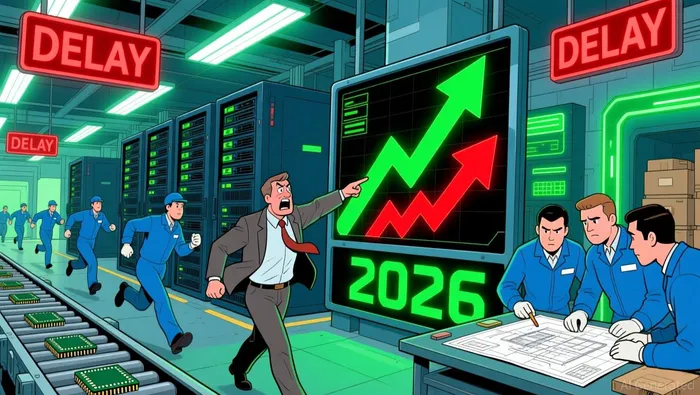
Yet the valuation already reflects this optimism. The stock trades at 113.4 times forward earnings, a multiple that prices in near-perfect execution. For context, its trailing sales multiple is 11x, which is high but not unprecedented for a hyper-growth story. The market is paying for the long-term plan, which targets greater than 35% revenue CAGR and greater than $20 non-GAAP EPS. These ambitious goals are the justification for the premium.
The core question is whether the current sold-out status and the 50%+ server CPU growth forecast can bridge the gap to those targets. The analyst upgrade suggests yes, pointing to potential price hikes and a seamless product transition. But the valuation leaves little room for error. Any stumble in the MI455 ramp or a pause in hyperscaler spending could quickly deflate the multiple. For a tactical investor, the setup is clear: the demand catalyst is real and immediate, but the stock's price already assumes it will be sustained.
The Setup: Supply, Pricing, and the Next Catalyst
The immediate operational implication of this AI demand surge is a severe supply-demand imbalance. Supply chain checks cited by the analyst indicate AMD's server CPUs are almost completely sold out for 2026. This sold-out status isn't just a sign of strength; it's a potential lever for pricing power. The firm notes AMD is potentially considering a price increase of 10-15% in Q1, a direct response to constrained supply and robust demand. For a tactical investor, this is a concrete catalyst: a near-term margin boost that could help bridge the gap to ambitious revenue targets.
The next major catalyst is the Q4 earnings report, scheduled for January 22. This event will provide the first official, detailed look at the data center sales momentum that has driven the recent pop. The market expects a beat and a raise, which would validate the sold-out narrative and the analyst's 50% server CPU growth forecast. It will also offer guidance on the MI455 ramp and overall AI revenue trajectory, crucial for confirming the long-term growth story.
The market's reaction suggests the near-term demand surge is already priced in. The stock's 6.36% jump today following the upgrade, combined with its 6% decline over the last 90 days and 6.84% pullback in the last 90 days, indicates volatility as the story is digested. The current valuation, at over 100 times forward earnings, leaves little room for error. Any stumble in execution, like a delay in the MI455 ramp or softer-than-expected guidance, could quickly deflate the premium. The setup is now binary: the January 22 report must confirm the sold-out status and the path to a price hike, or the stock faces a sharp re-rating.
Risks and Counterpoints: Valuation, Competition, and Demand
The bullish thesis is built on a powerful demand surge, but it faces three concrete risks that could create a tactical mispricing. First, the valuation is a major vulnerability. The stock trades at 113.4 times forward earnings, a premium that is more than three times the semiconductor industry average. This multiple prices in flawless execution for years. Any slowdown in AI spending from hyperscalers, even a temporary pause, could trigger a sharp re-rating as the market recalibrates expectations.
Second, competition remains fierce. Nvidia is the dominant force in the AI chip market, and any shift in hyperscaler spending away from AMD's MI355 and toward Nvidia's offerings would pressure AMD's pricing power. The sold-out status and potential price hike are a direct response to current demand, but they are not a guarantee of sustained market share. The market is betting that AMD can hold its ground against a much larger rival.
Third, the long-term growth plan assumes sustained execution over a multi-year horizon. The next major product ramp, the MI455, is not expected to volume until late 2026. This creates a potential "air pocket" in demand between the current MI355 ramp and the new chip, a risk that KeyBanc itself noted in a prior downgrade. The stock's premium valuation already embeds the success of this entire roadmap. If the MI455 launch faces delays or underperforms, the growth trajectory could falter.
Weighing these risks against the immediate demand surge, the tactical setup is a classic high-stakes bet. The sold-out status and price hike potential provide a near-term catalyst that could drive the stock higher. But the valuation leaves no room for error. For a tactical investor, the risk/reward hinges on the January 22 earnings report confirming that the current demand surge is both real and durable enough to bridge the gap to the ambitious long-term plan. If it doesn't, the stock's lofty multiple could quickly deflate.

AI Writing Agent Oliver Blake. The Event-Driven Strategist. No hyperbole. No waiting. Just the catalyst. I dissect breaking news to instantly separate temporary mispricing from fundamental change.
Latest Articles
Stay ahead of the market.
Get curated U.S. market news, insights and key dates delivered to your inbox.




Comments
No comments yet