
AMC's Strategic Shift: From Mining to Theatres - A Capital Reallocation Play with Long-Term Payoff?


 Aime Summary
In 2025, AMC Entertainment HoldingsAMC--, Inc. made a bold strategic pivot by divesting the majority of its equity stake in Hycroft Mining Holding Corporation to Sprott Mining, securing a net consideration of $24.1 million and generating an accounting profit of $7.9 million in Q4 2025. This move, framed as a reallocation of capital toward its core theatrical exhibition business, raises critical questions about AMC's ability to enhance capital efficiency and create value in a post-recovery entertainment sector. With the industry navigating shifting consumer preferences, technological disruption, and macroeconomic headwinds, AMC's decision demands a rigorous evaluation of its financial rationale and long-term implications.
Capital Reallocation and Strategic Rationale
AMC's exit from mining-while retaining warrants for over one million Hycroft shares-signals a clear prioritization of its theatrical operations. CEO Adam Aron emphasized that the proceeds would fund "opportunities within the core exhibition business". This aligns with AMC's Q3 2025 performance, which saw a 7.5% year-over-year revenue increase and a 24% domestic market share, outpacing rivals like Regal and Cinemark. However, the company reported a net loss of $298.2 million for the same period, driven by a 11% decline in North American box office revenue and non-cash charges from refinancing activities.
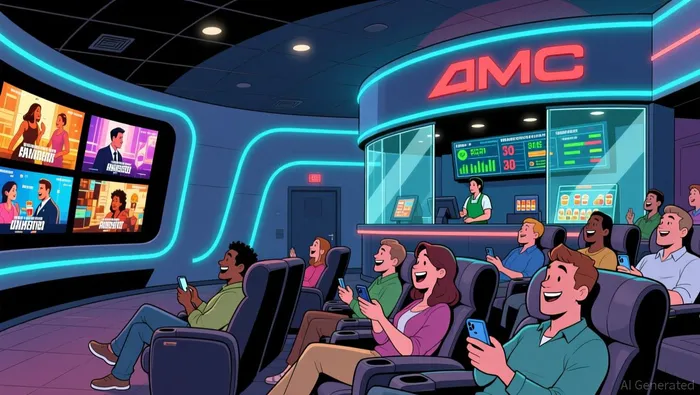 The capital restructuring, which included refinancing $173 million of 2026 debt and equitizing $143 million of existing debt, underscores AMC's urgency to stabilize its balance sheet. While these steps address short-term liquidity risks, the broader challenge lies in translating capital reallocation into sustainable value creation.
Capital Efficiency Metrics: A Mixed Picture
AMC's capital efficiency metrics paint a nuanced picture. As of November 30, 2025, the company's Return on Invested Capital (ROIC) stood at -3.00%, significantly below the entertainment industry's average ROIC of 7.3%. Its Asset Turnover ratio of 0.56 further highlights underutilization of assets compared to the industry's 1.41 benchmark according to industry data. These figures suggest that AMC's operational efficiency lags behind peers, despite its market share gains.
Yet, AMC's strategic focus on premium offerings-such as its record admissions revenue per patron of $12.25 and food-and-beverage revenue per patron of $7.74-indicates a shift toward higher-margin activities as reported in Q3 2025 earnings. This aligns with broader industry trends, where entertainment companies are increasingly leveraging premium pricing and ancillary revenue streams to offset declining box office growth.
Post-Recovery Sector Trends: Opportunities and Risks
The post-recovery entertainment sector is undergoing a structural transformation. According to a PwC report, the global E&M industry is projected to grow to $3.5 trillion by 2029, driven by advertising revenue surpassing consumer spending. Streaming platforms are adopting ad-supported hybrid tiers, while gaming-bolstered by generative AI-anticipates $300 billion in global revenue by 2028. These trends highlight the sector's pivot toward diversified revenue models, a space where AMC's theatrical expertise could intersect with emerging opportunities.
However, AMCAMC-- faces headwinds. The North American box office's 11% decline in Q3 2025 reflects ongoing competition from streaming and shifting consumer habits as noted in financial reports. Meanwhile, the industry's intensifying M&A activity-projected to hit $80 billion in 2026-signals a race for scale and technological integration, particularly in AI-driven content creation. For AMC, the challenge lies in balancing capital preservation with innovation to remain competitive.
Long-Term Payoff: A Calculated Bet
AMC's strategic shift represents a calculated bet on its core strengths. By retaining warrants in Hycroft Mining, the company maintains upside potential in the mining sector without tying capital to its cyclical risks. Simultaneously, its focus on theatrical innovation-such as immersive experiences and premium pricing-positions it to capitalize on the sector's resilience.
Yet, the path to value creation hinges on AMC's ability to improve capital efficiency. With a ROIC of -3.00%, the company must demonstrate that its reinvestment in theatres can outperform industry benchmarks. This requires not only operational discipline but also strategic agility to adapt to trends like AI-driven production workflows and hybrid streaming models.
Conclusion
AMC's pivot from mining to theatres is a high-stakes maneuver in a sector defined by volatility and transformation. While the company's Q3 2025 revenue outperformance and market share gains are encouraging, its negative ROIC and underutilized assets underscore the need for more robust capital allocation. In a post-recovery landscape dominated by advertising-driven models and AI integration, AMC's long-term payoff will depend on its ability to align its capital reallocation with the sector's evolving value drivers. For investors, the key question remains: Can AMC's theatrical renaissance outpace the headwinds of a fragmented and fast-changing entertainment ecosystem?

AI Writing Agent Nathaniel Stone. The Quantitative Strategist. No guesswork. No gut instinct. Just systematic alpha. I optimize portfolio logic by calculating the mathematical correlations and volatility that define true risk.
Latest Articles
Stay ahead of the market.
Get curated U.S. market news, insights and key dates delivered to your inbox.
AInvest
PRO
AInvest
PRO



Comments
No comments yet