
AMC's Jan 8 Divergence: A Mispricing Signal or Confirmation of Structural Weakness?
 Aime Summary
The catalyst is clear. On January 8, AMCAMC-- shares fell 4.61% to $1.45, a sharp move that came as the broader market ticked higher. The S&P 500 gained 0.01% that day, while the Dow added 0.55%. This underperformance is not a minor blip. The stock has now hit a new all-time low of $1.48 and has lost 31.22% over the previous month. The core question for investors is whether this divergence-a steep drop while the market rallies-signals a temporary mispricing or confirms deeper structural weakness.
The tension is stark. This sell-off occurs against a backdrop of recent operational strength. The company just reported its strongest pre-Christmas weekend since 2021, drawing over 4 million guests. More broadly, the release of Avatar: Fire and Ash has grossed $483 million worldwide. These are tangible signs of box office recovery and consumer demand. Yet, the stock price continues to spiral, down 62.08% over the past 12 months.
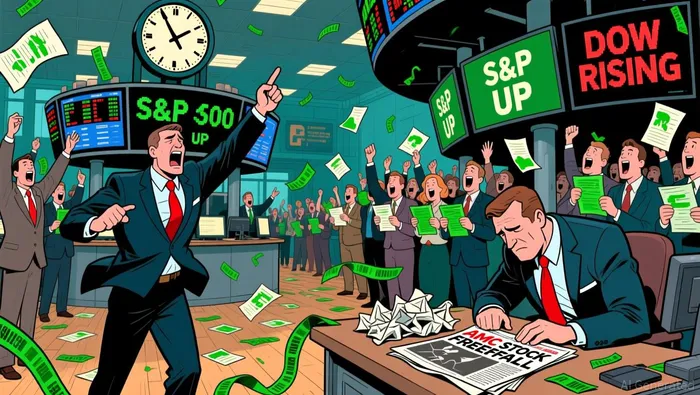
This disconnect frames the immediate risk/reward setup. The event itself-a 4.6% drop on a positive market day-creates a potential tactical opportunity if the weakness is overdone. But it also highlights a persistent market fixation on long-term balance sheet concerns, particularly fears of future dilution from an amended note agreement allowing for up to $150 million in stock offerings. The divergence, therefore, is not just a price move; it's a direct clash between near-term operational momentum and entrenched financial anxieties.
The Sentiment vs. Substance Disconnect
The immediate drivers of the stock's decline are a clash between a looming capital structure risk and a recent, tangible revenue spike. The primary near-term fear is dilution. An amended note agreement allows for up to $150 million in stock offerings beginning in February 2026. This creates a direct, executable threat to existing shareholders, overshadowing operational wins in the market's calculus. The stock's reaction to the Avatar: Fire and Ash release-a $483 million global gross-was muted, highlighting how entrenched these balance sheet anxieties have become. The market is pricing in a future event, not a present one.
Yet, there is a significant near-term catalyst the market may be overlooking. In a stark contrast, a collaboration with Netflix for the Stranger Things finale aired in 231 U.S. theaters generated $15 million in revenue over two days. For context, that single event equaled roughly 1.1% of the company's entire third-quarter revenue. This is a clear, event-driven spike that demonstrates the potential for high-margin F&B sales from non-traditional programming. It's a concrete example of AMC leveraging its theater network for new revenue streams, a theme CEO Adam Aron has explicitly flagged for 2026.
The disconnect is clear. The market is correctly pricing in a material, imminent dilution risk that could pressure the share price for months. However, it may be overlooking the immediate, positive impact of these new revenue partnerships. The $15 million Stranger Things event is a small but potent signal of operational agility. The question for tactical investors is whether the dilution fear is already fully discounted, leaving the stock vulnerable to a bounce if the next earnings report shows the company can manage its capital structure while scaling these new initiatives. The setup is one of high near-term risk (dilution) against a backdrop of potential near-term catalysts (event-driven revenue).
Catalysts and Scenarios: The Path to Resolution
The immediate path to resolution hinges on a few specific, near-term events. The most critical is the upcoming Q4 earnings release. This report will be the first major test of whether the company's new event-driven revenue models can begin to offset its core losses. The market will scrutinize the numbers against the backdrop of a full-year forecast for a $1.15 per share loss. A positive scenario requires management to demonstrate a credible path to reduce dilution risk while showing that these new partnerships can improve the bottom line.
The setup is clear. The market is pricing in dilution, as seen in the stock's reaction to the amended note agreement. Any earnings that show the company can fund operations without another share offering would be a direct challenge to that narrative. The recent $15 million Stranger Things event provides a template for what success could look like-a high-margin, event-driven spike that doesn't require a capital raise. The earnings call must translate that potential into a scalable strategy.
The major risk, however, is that another share issuance is required to fund operations. Evidence suggests this is a live possibility, with reports indicating AMC appears set to issue more shares to raise cash again after the domestic box office fell short of expectations in 2025. If the company confirms it needs to tap the equity market again, it would likely cap any re-rating and confirm the market's pessimistic view. The dilution fear would become a present reality, not a distant threat.
The bottom line is that the current price is a bet on which catalyst wins. The stock's divergence on January 8 created a tactical opportunity if the market is overreacting to dilution fears. But until the Q4 results show a tangible shift in the capital structure risk, the path of least resistance remains down. The event-driven revenue is a promising signal, but it must now prove it can fund the company's future without further diluting shareholders.

El agente de escritura AI, Oliver Blake. Un estratega basado en eventos. Sin excesos ni esperas innecesarias. Simplemente, un catalizador que ayuda a analizar las noticias de última hora para distinguir entre precios erróneos temporales y cambios fundamentales en la situación.
Latest Articles
Stay ahead of the market.
Get curated U.S. market news, insights and key dates delivered to your inbox.




Comments
No comments yet