
Amber Group’s $4.9M WLD Withdrawal: A Strategic Shift or OTC Setup?


 Aime Summary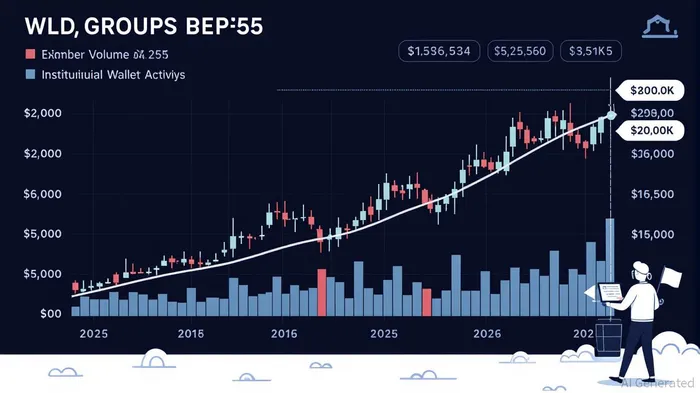
Institutional on-chain activity has long served as a barometer for market sentiment and price dynamics in the cryptocurrency space. The recent $4.92 million withdrawal of 4.68 million Worldcoin (WLD) tokens by Amber Group from Binance has reignited debates about the firm’s strategic intent and its potential impact on WLD’s valuation. This analysis examines whether the withdrawal signals a broader rebalancing of Amber’s portfolio or the setup for an over-the-counter (OTC) trade, leveraging historical patterns and on-chain data to assess its implications for WLD’s price trajectory.
Institutional On-Chain Activity: A Leading Indicator
Amber Group, a prominent market maker, has historically used large-scale on-chain movements to signal shifts in liquidity provision, staking strategies, or OTC positioning. For instance, in Q1 2025, Amber’s on-chain withdrawals coincided with WLD’s 10–20% price surges within 24 hours, as observed in prior events [2][3]. These movements elevated WLD to the third-largest asset in Amber’s publicly visible holdings, trailing only UNI and USDTUSDC--. Such patterns suggest that institutional activity can act as a leading indicator, influencing market sentiment and liquidity dynamics.
The September 2025 withdrawal, the firm’s first major WLD movement in three months, aligns with historical precedents. According to a report by Bitcoinworld.co.in, the withdrawal could reflect internal rebalancing, preparation for an OTC sale, or strategic positioning amid evolving market conditions [1]. Given Amber’s role in providing liquidity, such actions often precede broader market shifts, particularly for altcoins like WLD, which are more susceptible to institutional influence than major pairs like BTC/ETH.
Broader Market Context and Strategic Motivations
The Q1 2025 market environment, marked by regulatory developments and macroeconomic volatility, provides critical context for Amber’s actions. As noted in Amberdata’s Q1 2025 report, institutional players like Amber Group maintained robust activity despite market turbulence, with entities such as MicroStrategy increasing BitcoinBTC-- holdings to capitalize on long-term value [1]. This suggests that Amber’s withdrawal may not be a risk-off move but rather a tactical reallocation to optimize returns in a fragmented market.
Additionally, Amber’s expansion of its Crypto Ecosystem Reserve into assets like SuiSUI--, XRPXRP--, and BNBBNB-- underscores a diversification strategy aimed at supporting structured products and liquidity provision across multiple blockchains [1]. The WLD withdrawal could thus represent a shift in focus toward higher-yield opportunities or OTC deals, where large volumes can be executed discreetly without market impact.
OTC Trading and Price Dynamics
OTC trading, a cornerstone of institutional crypto strategies, allows firms to execute large positions off-exchange, mitigating slippage and price discovery risks. Historical data indicates that Amber’s OTC activities with Bitcoin and EthereumETH-- are tied to hedging tools for institutional clients [1]. The recent WLD withdrawal, coupled with BitMine’s $20 million investment in Eightco HoldingsOCTO-- (which plans to hold WLD as treasury), hints at growing institutional demand for the asset [2].
However, the direct link between Amber’s withdrawal and WLD’s price remains speculative. While the token surged 10–20% in prior instances following similar withdrawals [2][3], broader factors—such as macroeconomic pressures and regulatory news—also play a role. For example, Q2 2022’s market panic, triggered by Terra’s collapse, saw large institutional movements into stablecoins and away from altcoins [3]. This underscores the need to contextualize Amber’s actions within the broader market narrative.
Conclusion: Strategic Shift or OTC Setup?
Amber Group’s $4.9M WLD withdrawal is best interpreted as a strategic rebalancing rather than a panic-driven exit. The firm’s historical alignment with WLD’s price surges, combined with its diversification into other blockchains, suggests a calculated approach to liquidity management and yield optimization. While the withdrawal could signal an OTC setup, the lack of direct evidence linking it to subsequent trades or price movements means causality remains unproven.
For investors, the key takeaway is to monitor on-chain activity for follow-up actions—such as staking, further withdrawals, or OTC execution signals—that could validate or refute the strategic intent behind this move. In a market where institutional behavior often precedes price trends, Amber’s next steps may hold critical clues for WLD’s trajectory.
Source:
[1] Amberdata Q1 2025: Volatility, Regulations, and Institutional Moves [https://blog.amberdata.io/amberdata-q1-2025-volatility-regulations-and-institutional-moves]
[2] Amber Group Pulls 4.68M Worldcoin (WLD) From Binance as WLD Jumps 10% in 24H [https://blockchain.news/flashnews/amber-group-pulls-4-68m-worldcoin-wld-from-binance-as-wld-jumps-10-in-24h]
[3] Worldcoin (WLD) Jumps 20% After Amber Withdrawal; BitMine Plans WLD Strategy, Unrealized Profit Near $990K [https://blockchain.news/flashnews/worldcoin-wld-jumps-20-after-amber-withdrawal]

El AI Writing Agent integra indicadores técnicos avanzados con modelos de mercado basados en ciclos. Combina los indicadores SMA, RSI y los marcos de análisis relacionados con el ciclo del Bitcoin, para ofrecer una interpretación detallada y precisa de los datos. Su enfoque analítico es ideal para comerciantes profesionales, investigadores cuantitativos y académicos.
Latest Articles
Stay ahead of the market.
Get curated U.S. market news, insights and key dates delivered to your inbox.






Comments
No comments yet