
Ambac Financial Group's Q3 2025: Contradictions Emerge on Everspan Premium, MGA Capacity, Interest Expenses, Seasonal Growth, and Competitive Strategy
 Aime Summary
Date of Call: November 11, 2025
Financials Results
- Revenue: Insurance Distribution revenue $43.0M, up 80% YOY (driven by 40% organic growth and an additional month of Beat)
- EPS: -$0.67 per diluted share, compared to -$0.43 per diluted share in Q3 2024 (net loss to shareholders $32M vs $18M prior year)
- Operating Margin: Insurance Distribution operating margin 23.0%, compared to 11.1% in Q3 2024 (adjusted EBITDA to shareholders margin 13.9% vs 8.8% prior year)
Guidance:
- Maintain robust organic growth into 2026, driven by MGAs and recent start-ups
- Target adjusted corporate expenses of approximately $30 million for 2026
- Capital allocation to prioritize start-ups, selective M&A, share repurchases and investments in data/AI and technology; no large near-term M&A expected
- Everspan: expect modest controlled top-line growth; FY2025 estimate ~$370–380M with 2026 written premium expected north of $400M
- Interest expense run-rate roughly $7M and full-year interest expense expected to decline
- Formal 2026 guidance to be provided on the Q4 earnings call
Business Commentary:
- Organic Growth in Insurance Distribution:
- Octave Specialty Group reported
40%organic growth in the Insurance Distribution segment for the third quarter of 2025. The growth was driven by strong momentum in several MGAs and the inclusion of an additional month of Beat results.
Revenue and Margin Expansion in Insurance Distribution:
- Revenue in the Insurance Distribution segment increased by
80%compared to the third quarter of 2024, reaching$43 million. The increase in margins to shareholders was primarily due to strong organic growth and higher profit commissions and fees.
Expansion of MGA Platform:
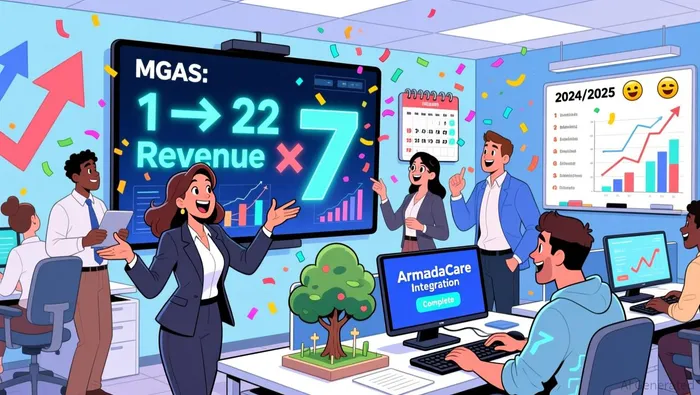
- The company expanded its platform from 1 MGA to 22, including ArmadaCare, leading to a pro forma revenue growth of more than
sevenfoldsince 2021. Growth was achieved through platform expansion, strategic M&A, expense reductions, and disciplined capital allocation.
Capital Management and Share Repurchases:
- Octave completed share repurchases totaling
3.1 million sharesor6.5%of weighted average shares outstanding. This was part of the company's capital management plan to return capital to shareholders while maintaining a focus on growth.
EBITDA Growth Drivers and Targets:
The company's aspirational goal is to reach
$80 millionin EBITDA by 2028, driven by Octave Ventures organic growth and strategic M&A opportunities, such as buying in non-controlling interests in MGAs.Progress towards this target is supported by the 9 MGAs launched in 2024 and 2025, which are expected to push through EBITDA growth and margin expansion in the 2026-2028 period.
Sentiment Analysis:
Overall Tone: Positive
- Management repeatedly framed the quarter as a new era: "very pleased," "excited," and "confident"; highlighted strategic wins (sale of legacy business for $420M, 3.1M shares repurchased, $10M+ run-rate corporate expense reductions) and reiterated confidence in reaching an aspirational $80M EBITDA goal by 2028.
Q&A:
- Question from Mark Hughes (Truist Securities): The organic growth of 40% in the distribution business — what contributed to that acceleration and were there any contingent or performance-based commissions that might be nonrecurring?
Response: Growth was pure organic momentum from MGAs; no profit/contingent commissions or FX impact included in the organic growth calculation.
- Question from Mark Hughes (Truist Securities): You highlighted $1.5 billion in third‑party capacity for 2025 — how is that shaping up and will you need more capacity going into 2026?
Response: Current capacity is sufficient (the $1.5B excludes ArmadaCare and Everspan); strong interest from capital providers gives confidence additional capacity could be secured if needed.
- Question from Mark Hughes (Truist Securities): How should we think about capital allocation priorities — paying down debt, buybacks, additional M&A beyond your target?
Response: Priority is strategic growth and start‑ups, with selective M&A, continued share buybacks, and investments in data/technology; no expectation of large M&A near term.
- Question from Mark Hughes (Truist Securities): Regarding the 2026 buy‑in for a 20% piece of one MGA (MGA 1), how much capital would that roughly require and what about associated EBITDA?
Response: Not a significant capital commitment (less than double‑digit millions today); decision is collaborative with the management team and not finalized.
- Question from Mark Hughes (Truist Securities): For Everspan, what should we think about the premium outlook into 2026 given you've repriced/non‑renewed less profitable programs?
Response: Expect modest, controlled sequential growth; FY2025 likely ~$370–380M and 2026 written premium expected to be north of $400M without pushing top line.
- Question from Mark Hughes (Truist Securities): What is the run‑rate on interest expense going forward?
Response: Interest expense run‑rate is about $7M and full‑year interest expense is expected to meaningfully decline versus current year.
- Question from Mark Hughes (Truist Securities): On EBITDA margins relative to written premium and revenue-to-written-premium, can you provide specific numbers?
Response: It varies by business; some businesses have ~20% revenue-to-premium, but net‑reported U.K. businesses lower that ratio — management focuses on bottom‑line (EBITDA) per premium rather than top‑line revenue nuances.
- Question from Mark Hughes (Truist Securities): Is that largely a U.K. versus U.S. reporting difference?
Response: Yes — primarily differences between U.K. and U.S. reporting/contract structures.
Contradiction Point 1
Everspan Premium Outlook
It involves changes in financial forecasts for Everspan, specifically regarding premium expectations, which are critical for understanding the company's growth trajectory.
What's the premium outlook for Everspan given recent adjustments to more profitable programs, and is there a run rate to consider for 2026? - Mark Hughes (Truist Securities, Inc., Research Division)
2025Q3: Controlled, modest growth expected for Everspan in the coming quarters and year-over-year. Prior guidance was around $400 million, adjusted for current pace as $370-$380 million. Moderate growth anticipated for 2026, above $400 million. - David Trick(CFO)
Will the shift out of certain assumed programs continue to impact premiums in upcoming quarters? Is there a 2025 gross written premium target for Everspan? - Mark Douglas Hughes (Truist Securities)
2025Q2: Everspan's priority is profitability, but growth is also key. Estimated $400 million gross premium this year. We won't force growth unless happy with programs' expected loss ratios. - David Trick(CFO)
Contradiction Point 2
Capacity and Financial Commitments for MGAs
It involves differing views on the financial commitments and capacity requirements for MGAs, which could impact strategic and financial planning.
How should we think about capacity needs for the distribution business with 40% organic growth into 2026? - Mark Hughes (Truist Securities, Inc., Research Division)
2025Q3: We have sufficient capacity for the business, including ArmadaCare and Everspan. Interest from capital providers exceeds our needs, and we are confident in securing additional capacity if needed. - David Trick(CFO)
How critical is staffing to top-line growth when scaling up MGAs, and what are the current market challenges in recruiting and retaining experienced personnel? - Maxwell Fritscher (Truust Securities)
2025Q1: We feel good about the capital raising process for our MGAs. We've got a great pipeline of investments from the capital markets. We've got a few things in process now, and we feel good about that. And we're kind of operating at a pace that we think is good for all of us. - Claude LeBlanc(CEO)
Contradiction Point 3
Interest Expense Outlook
It involves changes in financial forecasts, specifically regarding interest expense expectations, which are critical for understanding the company's financial performance and cash flow management.
What is the current run rate for interest expense? - Mark Hughes (Truist Securities, Inc., Research Division)
2025Q3: Interest expense will be about $7 million, similar to the average quarterly expense for the current year. - David Trick(CFO)
On the Specialty P&C segment, were you pleased with the progress and is the combined ratio improvement sustainable? - Deepak Sarpangal (Repertoire Partners LP)
2024Q4: Interest expense is now expected to be approximately $30 million for the year. - David Trick(CFO)
Contradiction Point 4
Seasonality and Distribution Business Growth
It involves differing perspectives on the seasonality of distribution business growth and the expected performance in Q3 and Q4, which are critical for understanding revenue trends.
What factors contributed to the 40% organic growth in the distribution business, and were there any nonrecurring contingent or performance-based commissions involved? - Mark Hughes (Truist Securities, Inc., Research Division)
2025Q3: The growth was driven by momentum in the business, with no impact from profit commissions, contingent commissions, or FX. - David Trick(CFO)
Organic growth was strong, but reported growth declined 2-3%. How do you view Q3 and Q4? - Mark Douglas Hughes (Truist Securities)
2025Q2: We see stabilization in A&AH, ESL markets showing improvement. Strong performance expected in Q3 and Q4, historically strongest quarters. - Claude LeBlanc(CEO)
Contradiction Point 5
Competitive Environment and Strategic Differentiation
It involves differing views on the competitive environment and strategic differentiation, which could impact market positioning and strategic decision-making.
Given 40% organic growth, how should we think about the need for additional capacity to support the distribution business as we approach 2026? - Mark Hughes (Truist Securities, Inc., Research Division)
2025Q3: We have a very robust capacity proposition that we can provide to any of our partners and we can price that in a way that is very competitive. - David Trick(CFO)
What is the current competitive environment? - Maxwell Fritscher (Truust Securities)
2025Q1: Ambac's differentiation through its capacity relationships and managed capacity model helps attract top talent. The company keeps a close eye on competitive dynamics. - Claude LeBlanc(CEO)

Discover what executives don't want to reveal in conference calls
Latest Articles
Stay ahead of the market.
Get curated U.S. market news, insights and key dates delivered to your inbox.
AInvest
PRO
AInvest
PRO



Comments
No comments yet