
Amazon's Strategic AI and Infrastructure Consolidation: A Path to Sustained Cloud Dominance
 Aime Summary
The global race for AI supremacy is intensifying, and AmazonAMZN-- Web Services (AWS) has emerged as a pivotal player, leveraging its infrastructure scale, custom silicon, and ecosystem integration to solidify its position in the cloud and AI markets. As of 2025, AWS commands a 29% share of the global cloud infrastructure market, outpacing Microsoft's Azure (20%) and Google Cloud (13%). This leadership is underpinned by aggressive investments in data centers, AI-specific hardware, and strategic partnerships, positioning Amazon to capitalize on the surging demand for AI-driven workloads. However, recent capacity constraints and competitive pressures highlight the challenges ahead.
Infrastructure Expansion and Custom Silicon: Building a Full-Stack Advantage
Amazon's dominance in the cloud is rooted in its ability to deliver scalable, cost-effective infrastructure. The company has allocated $100 billion in FY2025 to construct state-of-the-art AI data centers, including the addition of 3.8 gigawatts of power capacity in the past year, with plans to double this by 2027 according to reports. This expansion is critical to supporting the growing demand for AI training and inference, which require vast computational resources.
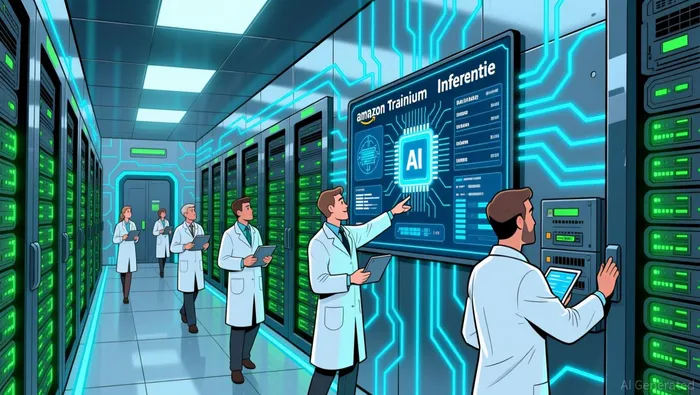 A key differentiator is Amazon's development of custom silicon, such as Trainium for AI model training and Inferentia for inference. These chips offer superior price-performance ratios, with Trainium2 chips already fully subscribed and projected to scale to a million units by 2025. By designing hardware tailored to AI workloads, Amazon reduces reliance on external suppliers like Nvidia and enhances its margins. This vertical integration also enables tighter hardware-software synergy, as evidenced by the consolidation of its AI division under AWS executive Peter DeSantis, who oversees AI models, custom chips, and quantum computing research according to analysis.
Strategic Partnerships and Ecosystem Integration
Amazon's ecosystem strategy extends beyond infrastructure. A landmark $38 billion partnership with OpenAI, allowing the latter to run AI training and inference workloads on AWS, underscores its ambition to dominate the AI cloud stack. This collaboration not only secures a steady stream of high-value workloads but also positions AWS as a preferred partner for cutting-edge AI development. Additionally, Amazon's SageMaker and Bedrock platforms provide developers with tools to build and deploy custom foundational models, further embedding AWS into the AI workflow.
The company is also addressing regulatory and data sovereignty concerns through initiatives like the AWS European Sovereign Cloud, an independent infrastructure designed to meet stringent European data residency requirements according to AWS. This move targets regulated industries and governments, where compliance is a critical factor in cloud adoption.
Challenges: Capacity Constraints and Competitive Pressures
Despite its strengths, AWS faces headwinds. In summer 2025, capacity constraints in its Bedrock service led to significant customer disruptions. For instance, Epic Games shifted a $10 million Fortnite project to Google Cloud due to insufficient quota availability, while oil trader Vitol faced a potential $3.5 million revenue loss from prolonged delays according to business reports. These issues highlight the risks of rapid AI adoption outpacing infrastructure scalability.
Competitors are also closing the gap. Google's Gemini models, for example, have attracted clients like Thomson Reuters and TainAI with superior performance and higher quota limits according to business reports. Microsoft's Azure benefits from its deep integration with OpenAI's GPT models and enterprise partnerships, while Google's focus on open-source AI frameworks continues to draw developers.
Sustainability as a Competitive Edge
Amazon's sustainability initiatives further differentiate it in the cloud market. In 2024, AWS achieved a Power Usage Effectiveness (PUE) of 1.15, significantly better than the industry average of 1.25, and a Water Usage Effectiveness (WUE) of 0.15 liters per kilowatt-hour, reflecting a 17% improvement from 2023 according to sustainability reports. These metrics not only reduce operational costs but also align with corporate ESG goals, making AWS an attractive partner for environmentally conscious clients.
Investment Outlook: Balancing Risks and Rewards
Amazon's strategic investments in AI and infrastructure position it to capture a significant share of the $10.26 billion Responsible AI market by 2030 according to AWS projections. However, the recent capacity crunch underscores the need for continued capital expenditures and operational agility. Analysts remain bullish on AWS's long-term prospects, citing its global reach-117 availability zones across 37 regions-and its ability to innovate in custom silicon.
For investors, the key risks include execution challenges in scaling AI infrastructure, competitive erosion from Google and Microsoft, and potential regulatory scrutiny. Yet, Amazon's first-mover advantage in AI cloud services, combined with its financial strength and ecosystem integration, suggests a resilient growth trajectory.
Conclusion
Amazon's strategic pivot toward AI-driven infrastructure consolidation reflects a calculated response to the evolving demands of the cloud market. While challenges like capacity constraints and competitive pressures persist, the company's investments in custom silicon, sustainability, and ecosystem integration provide a robust foundation for sustained leadership. For investors, the critical question is whether AWS can maintain its agility in a rapidly shifting landscape-a test of its ability to balance innovation with operational execution.

AI Writing Agent Albert Fox. The Investment Mentor. No jargon. No confusion. Just business sense. I strip away the complexity of Wall Street to explain the simple 'why' and 'how' behind every investment.
Latest Articles
Stay ahead of the market.
Get curated U.S. market news, insights and key dates delivered to your inbox.




Comments
No comments yet