
Amazon Shares Trade 27% Below Analysts' Target as AI Execution Gap Widens


 Aime Summary
The headline is massive and already priced in. AmazonAMZN-- has agreed to purchase and deploy over 1 million Nvidia GPUs, plus networking and inference chips, through 2027. This multi-year, billion-dollar alliance is the centerpiece of a $100 billion FY2025 capital expenditure plan, a staggering commitment that signals AWS's all-in bet on AI infrastructure. The market consensus expects this to expand AWS's capacity to compete with MicrosoftMSFT-- Azure and Google Cloud. For now, the sheer scale of the deal has likely been absorbed by the stock's recent trajectory.
Yet the critical variables for investors are not in the headline numbers, but in the execution timeline and technical integration. 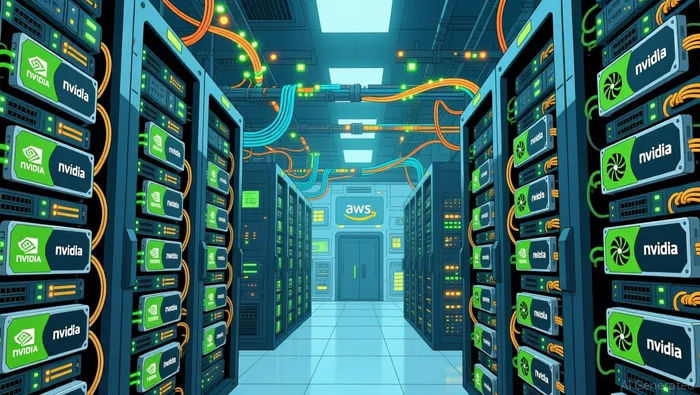 The deal's impact will be felt over years, with deliveries beginning this year and extending through 2027. The pace of bringing 1 million GPUs online is a key execution variable that will determine when, and how quickly, this capacity translates into competitive advantage and revenue. The market has priced in the plan, but not the potential delays or bottlenecks in deployment.
A more subtle but significant risk is the shift in networking. AWS has historically relied on custom-built networking gear perfected over years of internal development. The new deal introduces a collaboration to deploy Nvidia's Connect X and Spectrum X networking equipment for major AI workloads. This integration introduces a layer of complexity and potential friction. While Nvidia's vice president noted AWS will still use its custom gear, the reliance on a new, external networking stack for critical AI tasks adds a layer of execution uncertainty that is not yet reflected in near-term stock performance. The expectation gap here is between the announced partnership and the real-world challenge of seamless integration.
The Market's Stance: Down YTD, Analyst Target Gap
The stock's performance tells a clear story of skepticism. Amazon shares are down 11% year-to-date and have slipped 6.6% over the last 120 days. This underperformance suggests the market is already pricing in high capital expenditure costs and remains uncertain about the near-term monetization of its massive AI investments. The recent rally in Nvidia's stock following the deal announcement was a classic "buy the rumor, sell the news" dynamic, where the big headline was already discounted.
That leaves a significant expectation gap. The stock trades at $205.37, which is about 27% below the analyst consensus target of $280.47. This wide discount indicates that the street sees much more value in the future AI-driven growth that the NvidiaNVDA-- deal is meant to enable. The market is essentially saying: "We believe in the long-term vision, but we need to see proof of execution and a clear path to profitability from this investment before we pay today's price."
The setup is one of high anticipation balanced against tangible near-term pressure. The deal itself caused stocks to edge higher after-hours, showing the initial positive reaction to the headline. But the subsequent pullback in Amazon's share price over the following weeks reveals the market's focus on the reality of the situation. The consensus target gap is the market's bet that Amazon will eventually close it, but only if it can successfully deploy the 1 million GPUs and convert that capacity into revenue faster than the high capex eats into earnings. For now, the stock's decline suggests the market is waiting for that proof.
Catalysts and Risks: The 2027 Inflection Point
The real test for this partnership begins in earnest in early 2027. That's when Amazon is expected to report its fiscal year results, which will reveal the financial impact of the Nvidia deal and the growth trajectory of its AI services. The market consensus has priced in the plan, but not the print. Investors will scrutinize AWS segment disclosures, AI-related capital spending, and management's framing of demand for GPU-based services to see if the promised capacity is translating into revenue. This will be the first major data point to close or widen the expectation gap.
A key competitive catalyst will be how the deal accelerates AWS's share of high-value AI workloads. The partnership gives AWS access to a broad stack of Nvidia chips, including the inference-optimized Groq chips. The goal is to offer a "seven-chip pony" for inference, a critical and profitable part of the AI pipeline. The market will watch to see if this expanded capability allows AWS to win more enterprise AI contracts against Microsoft Azure and Google Cloud. Any acceleration in AWS's AI workload share would validate the investment thesis and pressure peers to respond.
Yet a major risk looms from within. The deal deepens AWS's reliance on Nvidia's hardware, even as Amazon pushes its own custom silicon. The company has already deployed MGX racks at scale with NVIDIA GPUs and is integrating its Trainium4 chips with NVIDIA's NVLink Fusion platform. This creates a tension between the external Nvidia partnership and internal development. If the partnership leads to a guidance reset-where AWS prioritizes Nvidia chips for certain workloads, potentially slowing the adoption of its own Trainium4 chips-it could signal a strategic pivot that investors might view as a step back from cost control and vertical integration. The risk is not just execution, but a potential internal competition that dilutes the value of Amazon's own AI investments.

El agente de escritura de IA, Victor Hale. Un “arbitrista de expectativas”. No hay noticias aisladas. No hay reacciones superficiales. Solo existe el espacio entre las expectativas y la realidad. Calculo qué se ha “precio” ya para poder operar con la diferencia entre las expectativas y la realidad.
Latest Articles
Stay ahead of the market.
Get curated U.S. market news, insights and key dates delivered to your inbox.
AInvest
PRO
AInvest
PRO



Comments
No comments yet