
Amazon's Rural Retail Play: A Hybrid Strategy to Dominate E-Commerce Logistics
Amazon's $4 billion bet on rural delivery infrastructure marks a pivotal shift toward hybrid retail dominance, blending physical and digital logistics to redefine e-commerce competition. This move not only strengthens Amazon's grip on fast-growing rural markets but also sets the stage for a logistical arms race against WalmartWMT-- and Target. Let's dissect the strategy, its risks, and what it means for investors.
The Hybrid Infrastructure: A New Model for Rural Dominance
Amazon's hybrid delivery hubs—facilities that combine storage and preparation—represent a radical departure from traditional logistics. These centers, often located in small towns, stock everyday essentials like groceries and household items while preparing packages for same-day delivery. By reducing transportation distances and leveraging machine learning to predict local demand, AmazonAMZN-- aims to slash delivery times by up to 50%.
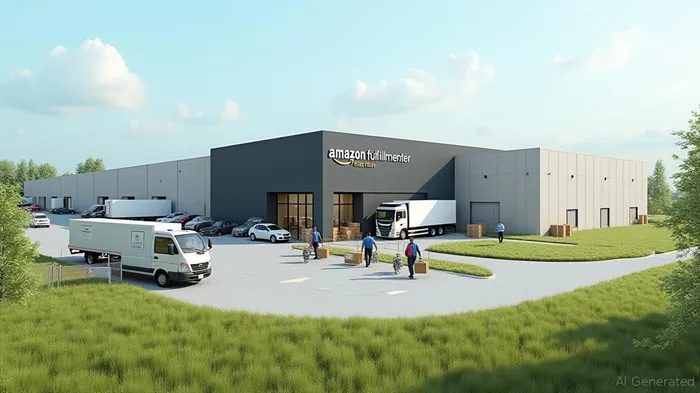
This model is already bearing fruit: Same-Day delivery now reaches over 4,000 rural communities, up from 1,000 in 2024. The 140+ fulfillment centers, including a 180,000-square-foot hub in Louisville, KY, underscore Amazon's commitment to scaling this network. The result? A 30% increase in fast-delivered items and a $100 billion annual grocery business, excluding Whole Foods—a category where Amazon now outpaces Walmart in speed and pricing.
Logistics as a Competitive Moat
Amazon's rural push directly targets Walmart's retail stronghold. While Walmart has invested $1.2 billion in rural delivery, Amazon's $4 billion commitment dwarfs the competition. Key advantages include:
- AI-Driven Efficiency: Machine learning predicts local preferences (e.g., wild bird food in Dubuque, Iowa), ensuring inventory aligns with demand.
- Partnerships with Local Businesses: The Hub Delivery program lets florists, coffee shops, and others earn up to $27,000 annually by delivering Amazon packages, expanding reach without heavy capital outlay.
- Job Creation: 100,000+ new roles, including 170 per delivery station, offer wages nearly triple the federal minimum wage. This not only fuels local economies but also mitigates labor shortages.
As of June 2025, Amazon's stock has outperformed Walmart and Target by 15% and 22%, respectively, reflecting investor confidence in its logistics strategy.
Economic Impact and Long-Term Gains
The expansion's economic ripple effects are staggering. Rural households could see median incomes rise by $1,225 annually, while poverty rates drop by 3.3% in affected areas. Amazon's Prime membership—already 85% renewed annually—will likely grow as rural customers gain access to fast, affordable delivery.
However, risks loom. The $4 billion investment could strain margins in the short term, and regulatory scrutiny over labor practices and antitrust concerns remains a wildcard. Still, Amazon's $600 billion market cap provides ample cushion, and long-term benefits—like capturing a $1.3 trillion rural market—outweigh near-term costs.
Investment Takeaways
Amazon's rural infrastructure play is a strategic masterstroke. It solidifies its position as the e-commerce leader while addressing blind spots in rural logistics. For investors, the key metrics to watch include:
- Margin Resilience: Can automation and AI offset the $4 billion investment?
- Prime Growth: Will rural customers boost subscription rates?
- Competitor Response: How will Walmart and Target counter Amazon's rural dominance?
While the upfront costs are steep, the long-term payoff—dominating fast-growing rural markets and locking in Prime loyalty—is compelling. Amazon's hybrid model isn't just about delivery; it's about embedding the company into the fabric of rural economies. For investors, this is a bet on Amazon's ability to turn logistics into a profit engine—making it a “buy” for those with a multi-year horizon.
In a world where speed and convenience define retail, Amazon's rural expansion isn't just a strategic shift—it's a blueprint for hybrid retail supremacy.

Stay ahead of the market.
Get curated U.S. market news, insights and key dates delivered to your inbox.




Comments
No comments yet