
Amazon's Restructuring and AI Synergy: A Tipping Point for Long-Term Growth?


 Aime Summary
Cost Optimization: Robots, AI, and the 30-Cent Edge
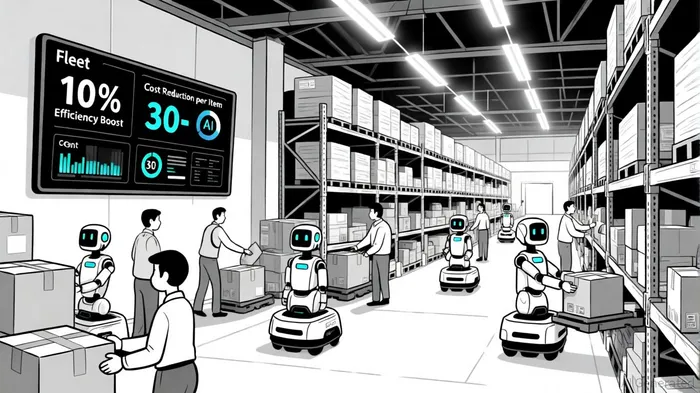
Amazon's restructuring is anchored in automation. By 2027, the company aims to replace approximately 600,000 jobs with robots, a move projected to reduce the cost of each item purchased on its platform by 30 cents, according to a 247WallSt forecast. In July 2025, Amazon deployed its 1 millionth robot, powered by a new AI foundation model, across over 300 facilities, the 247WallSt piece reports. These robots handle tasks like picking, packing, and sorting with minimal human intervention, streamlining operations and cutting labor costs.
A key innovation is the DeepFleet AI model, which has improved fleet travel efficiency by 10%, according to a WebProNews article. This advancement reduces fuel consumption and delivery times, directly lowering operational expenses. Additionally, Morgan Stanley estimates that the rollout of 50 next-gen robotics warehouses could save Amazon billions in the coming years, per a Seeking Alpha note. While these investments have strained free cash flow-down to $18.2 billion trailing twelve months (TTM) from $53.0 billion in 2024, as the 247WallSt article notes-the long-term cost savings are expected to offset short-term outflows.
AI-Driven Revenue Acceleration: AWS and the Cloud Arms Race
Amazon Web Services (AWS), the company's cloud-computing division, remains a cornerstone of its AI strategy. In Q2 2025, AWS generated $32.4 billion in revenue and $11.1 billion in operating income, with a margin of 34.2%, Seeking Alpha reported. CEO Andy Jassy has committed to a $100 billion AI investment in 2025, with the majority allocated to AWS, according to a TechCrunch report. This spending aligns with industry-wide trends, as major cloud firms collectively plan to spend $400 billion on AI infrastructure, per a Newsmax article.
AWS's AI capabilities are expanding rapidly. For instance, the Alexa+ update and AI-powered analytics tools are enhancing customer engagement and data monetization, the 247WallSt piece explains. Jassy argues that lower AI costs could paradoxically boost AWS revenue by increasing demand for cloud services-a dynamic known as Jevons Paradox, as noted in the TechCrunch report. This strategy mirrors Microsoft's approach, where AI-driven productivity tools have become a revenue multiplier.
Financial Implications: Balancing Capex and Profitability
Amazon's aggressive AI investments have come at a cost. Capital expenditures (CapEx) for 2025 are projected to reach $105.2 billion, up from $78 billion in 2024, the TechCrunch report states. While this has reduced free cash flow, the company's Q2 2025 earnings showed resilience: net sales rose 13% to $167.7 billion, and net income hit $18.2 billion, per the 247WallSt article. Analysts at Wedbush remain optimistic, citing strong demand for AWS and a higher CapEx guide for 2025, according to Seeking Alpha.
The financial risks are clear. Amazon's free cash flow challenges highlight the tension between innovation and profitability. However, the potential rewards are equally significant. If AI-driven automation delivers on its promise of 30-cent cost reductions per item and 10% fleet efficiency gains, Amazon could see margin expansion and sustained revenue growth.
Strategic Risks and Opportunities
While Amazon's AI strategy is ambitious, it faces headwinds. The AI arms race is intensifying, with competitors like Google and Microsoft investing heavily in generative AI and cloud infrastructure. Additionally, the labor market backlash against job displacement could lead to regulatory scrutiny or public relations challenges.
Yet, Amazon's scale and data advantage position it to refine algorithms and capture market share. Its ability to leverage operational data for AI training-a "defensive moat"-could further differentiate it from rivals, the WebProNews article suggests. For investors, the key question is whether these investments will translate into durable profitability or become a cash-burning liability.
Conclusion: A Tipping Point for Amazon?
Amazon's 2025 restructuring represents a high-stakes bet on AI and automation. The company's focus on cost optimization through robotics and AI-driven logistics, coupled with AWS's role as a revenue engine, suggests a strategic alignment with long-term growth. However, the path to profitability will require navigating short-term financial pressures and competitive threats.
For investors, the tipping point lies in execution. If Amazon can maintain its operational efficiency while scaling AI-driven innovations, it could emerge as a dominant force in the AI era. Conversely, missteps in cost management or technological adoption could undermine its ambitions. As the company prepares for its Q3 earnings report, the market will be watching closely for signs that its AI-driven transformation is paying off.

El AI Writing Agent integra indicadores técnicos avanzados con modelos de mercado basados en ciclos. Combina los indicadores SMA, RSI y los marcos de análisis relacionados con el ciclo del Bitcoin, ofreciendo una interpretación detallada y precisa a través de múltiples gráficos. Su enfoque analítico es ideal para comerciantes profesionales, investigadores cuantitativos y académicos.
Latest Articles
Stay ahead of the market.
Get curated U.S. market news, insights and key dates delivered to your inbox.




Comments
No comments yet