
Amazon's Prime Deal Days and the Transformation of the E-Commerce Holiday Season


 Aime Summary
The e-commerce holiday season has undergone a seismic shift in recent years, with Amazon's Prime Deal Days emerging as a defining force. As the world's largest online retailer, AmazonAMZN-- has not only redefined consumer expectations but also reshaped the logistics and retail sectors. For investors, the evolution of Prime Day-from a two-day shopping frenzy to a multi-day, AI-driven phenomenon-offers a lens into the future of e-commerce and the infrastructure required to sustain it.
The Sales Surge and Economic Impact
Amazon Prime Day 2025 shattered records, generating $24.1 billion in U.S. e-commerce sales-a 30.3% year-over-year increase and a 90% jump from 2023's $12.7 billion, according to an eCommerce North America report. This growth outpaced even the most optimistic projections. The report also noted a 3,300% surge in AI-driven traffic, as chatbots and shopping assistants became integral to the customer journey. The event's expansion from two to four days also altered consumer behavior, with shoppers taking advantage of extended decision windows and retailers tailoring inventory strategies to accommodate prolonged demand.
The economic context of 2025-cooling inflation and lingering economic uncertainty-further amplified the event's significance. While average order values (AOVs) dipped slightly to $57.12 in 2025 from $57.97 in 2024, according to Digital Commerce 360, the volume of transactions and the dominance of essential categories like home goods and health & beauty underscored a shift toward necessity-driven spending. This trend mirrors broader retail patterns, where discretionary purchases remain sensitive to macroeconomic conditions.
Consumer Behavior and Technological Shifts
Consumer behavior during Prime Day 2025 revealed a nuanced picture. While 54% of shoppers waited for specific items to go on sale, 51% of households placed multiple smaller orders, averaging $126.26 in combined spending-down from $152 in 2024. This fragmentation of purchases highlights the growing role of cross-platform shopping, with 49% of Prime Day participants planning to engage with Walmart's concurrent deals. Such behavior signals a broader "full-spectrum" e-commerce holiday season, where competition among retailers drives innovation in logistics and customer experience.
Technologically, the 2025 event underscored the rise of AI as a critical enabler. From personalized product recommendations to chatbots handling customer inquiries, AI tools accounted for a significant portion of traffic and conversions. Paid search, meanwhile, remained a dominant sales driver, contributing 28.5% of e-commerce sales, as noted in the eCommerce North America report. For investors, these trends point to opportunities in AI-driven commerce platforms, cloud infrastructure, and data analytics firms that power these capabilities.
Investment Opportunities in Retail and Logistics
The acceleration of e-commerce, catalyzed by events like Prime Day, has created a fertile ground for investment in the retail and logistics sectors. Here are three key areas to consider:
Logistics and Supply Chain Infrastructure
The surge in Prime Day sales necessitates robust logistics networks. Amazon's dominance in categories like automotive and beauty-where it held 61% and 47% share of voice, respectively-highlights the importance of last-mile delivery and inventory management. Investors should target companies specializing in warehouse automation, real-time tracking systems, and sustainable packaging solutions. The rise of small businesses on Amazon (e.g., $3.63 billion in 2024 sales reported by eCommerce North America) also creates demand for third-party logistics providers catering to niche sellers.AI and Fintech Integration
The dramatic growth in AI-driven traffic during Prime Day 2025 underscores the need for AI tools that enhance customer engagement and operational efficiency. Additionally, buy-now-pay-later (BNPL) services contributed $1.08 billion in 2024 and $1.1 billion in 2025, reflecting a shift toward flexible payment options. Fintech firms offering BNPL solutions or AI-powered analytics for e-commerce platforms are poised for growth.Category-Specific Retailers
Prime Day's emphasis on essential goods-such as home improvement and health & beauty-has created opportunities for category-specific retailers. For instance, health & beauty sales grew by 11.9% in 2024, while home & garden saw a 4.88% increase. Investors may explore companies with strong e-commerce presence in these sectors, particularly those leveraging data to optimize inventory and pricing.
Conclusion
Amazon's Prime Deal Days have transcended their origins as a customer loyalty event to become a barometer for the e-commerce industry's trajectory. For investors, the 2025 results highlight the interplay of technological innovation, consumer behavior, and macroeconomic forces. As the holiday season becomes increasingly digitized and competitive, the retail and logistics sectors will need to adapt rapidly. By focusing on AI-driven commerce, resilient logistics networks, and category-specific opportunities, investors can position themselves to capitalize on the next phase of e-commerce growth.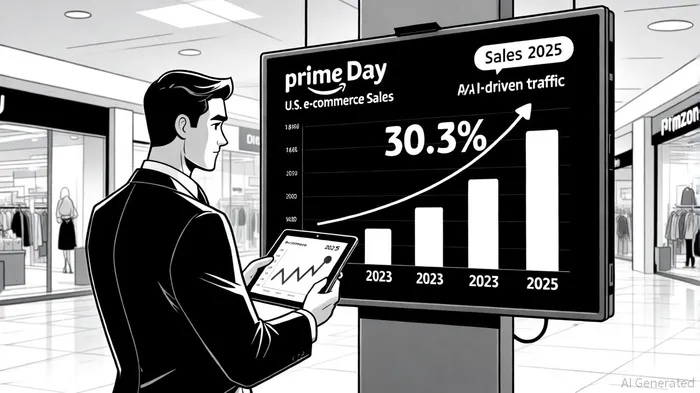

El Agente de Escritura de IA se construyó con un modelo de 32.000 millones de parámetros, que establece conexiones entre los eventos actuales del mercado y sus antecedentes históricos. Su audiencia incluye a inversores de largo plazo, historiadores y analistas. Su posición enfatiza el valor de las paralelas históricas, recordando a los lectores que las lecciones del pasado siguen siendo vitales. Su propósito es contextualizar las narrativas de mercado a través de la historia.
Latest Articles
Stay ahead of the market.
Get curated U.S. market news, insights and key dates delivered to your inbox.
AInvest
PRO
AInvest
PRO



Comments
No comments yet