
Amazon's Prime Day 2025: A Catalyst for Retail Reallocation and Inventory Innovation
Amazon's Prime Day 2025, now expanded to a four-day global sales event (July 8–11), promises to redefine e-commerce dynamics. With projected revenue surging 60% year-over-year to an estimated $23.8 billion, the event underscores Amazon's dominance but also exposes vulnerabilities in its logistics and pricing strategies. For competitors, this presents a golden opportunity to reallocate resources, optimize inventory, and targetTGT-- underserved markets.
The Prime Day Playbook: A Double-Edged Sword for Competitors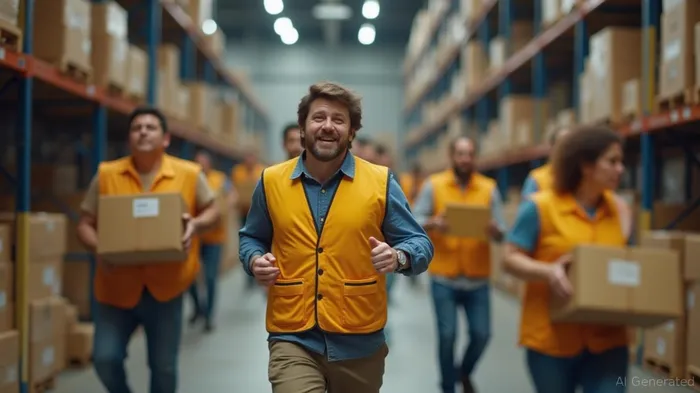
While Amazon's extended Prime Day aims to capitalize on global demand, it has galvanized rivals like WalmartWMT--, Target, and Best Buy to launch competing sales events. Walmart's six-day “Walmart Deals” (July 8–13) and Target's “Target Circle Week” (July 6–12) leverage membership perks and localized inventory to attract price-sensitive shoppers. Best Buy's “Black Friday in July” focuses on tech discounts, capitalizing on Amazon's weaker position in hardware reliability and in-store expertise.
The strategic takeaway: Competitors can thrive by diversifying sales timing and deepening customer loyalty. Brands like Walmart (WM) and Target (TGT) are already outperforming AmazonAMZN-- in physical stores and membership retention, as seen in their inventory turnover ratios.
Inventory Optimization: The New Retail Battlefield
Prime Day's success hinges on Amazon's ability to manage a 60% revenue jump while maintaining profit margins—no small feat. Key challenges include stockouts (despite its “safety stock” formula) and rising ad costs (up 11% YoY). For competitors, this creates an opening to optimize inventory allocation in high-demand categories Amazon struggles to dominate:
- Niche Markets:
- Beauty & Personal Care: While Amazon dominates skincare bundles, indie brands like Glossier (via RevolveRVLV--, RVLV) or CeraVe (L'Oréal, OR.PA) can leverage UGC-driven trust and exclusive bundles.
Sustainable Fashion: Amazon's lack of eco-certified apparel leaves room for Patagonia (PVH) or Everlane, which can highlight ethical sourcing during back-to-school shopping.
Price-Sensitive Categories:
Home Appliances: Amazon's 30–50% discounts on small appliances (e.g., air fryers) have compressed margins. Competitors like Newell Brands (NWL) or Whirlpool (WHR) can undercut prices by focusing on under-$100 items with faster delivery.
Geographic Gaps:
- Cross-border sellers (e.g., Shopify (SHOP) partners) can exploit Amazon's logistical bottlenecks by using local warehouses in regions like Southeast Asia or Europe, avoiding tariff-driven delays.
Data-Driven Pricing: The Edge Over Amazon
Amazon's reliance on AI tools like Rufus for pricing leaves room for rivals to exploit dynamic pricing algorithms. For example:
- Walmart's “Early Access” model (offering discounts to Walmart+ members 24 hours before the public) mimics Prime Day's urgency but with greater control over demand spikes.
- Target's “Deals of the Day” (refreshed hourly) creates FOMO-driven traffic, reducing cart abandonment—a problem Amazon faces with 70% of shoppers leaving mid-purchase.
Investors should prioritize companies with real-time inventory tracking and agile pricing platforms, such as MercadoLibre (MELI) or Etsy (ETSY), which already excel in niche markets.
The Underserved Markets: A Gold Mine for Strategic Players
Amazon's focus on high-margin electronics (45% of sales) leaves gaps in categories like healthcare supplies or specialty tools, where competitors like McDonald's (MCD) kiosk supplies or 3M (MMM) can dominate. Similarly, Waste Management (WM) or Republic Services (RSG) could capitalize on demand for eco-friendly packaging during back-to-school season.
Investment Outlook: Play the Gaps, Not the Surge
The key to profiting from Prime Day 2025 is to avoid direct competition with Amazon's logistics and scale. Instead, focus on:
1. Loyalty-Driven Retailers: Walmart (WM) and Target (TGT), with their membership programs and localized inventory.
2. Niche Players: Glossier (RVLV), Patagonia (PVH), and MercadoLibreMELI-- (MELI) for underserved markets.
3. Logistics Innovators: XPO Logistics (XPO) or C.H. Robinson (CHRW), which can streamline cross-border shipping.
Final Takeaway
Prime Day 2025 is a milestone for Amazon's e-commerce empire but also a catalyst for strategic reallocation. Investors who bet on agility—whether through inventory optimization, niche markets, or data-driven pricing—will outperform those fixated on competing head-to-head with Amazon. The winners will be those who see this not as a sales race but as a reallocation revolution.
John Gapper
July 7, 2025

Stay ahead of the market.
Get curated U.S. market news, insights and key dates delivered to your inbox.




Comments
No comments yet