
Amazon Paints the Plane That Crashed in Miami — It Doesn't Carry the Risk
 Aime Summary
The first domino is public: a Boeing 767-300 wearing AmazonAMZN-- Air paint overran runway 30 at Miami International Airport on the afternoon of September 6, tore through two vehicles, and killed five people. That part is not mispriced — everyone has seen the video. The next link in the chain is quieter, and it is not Amazon. It is a small cargo operator most retail investors have never heard of, and they cannot buy its shares even if they want to.
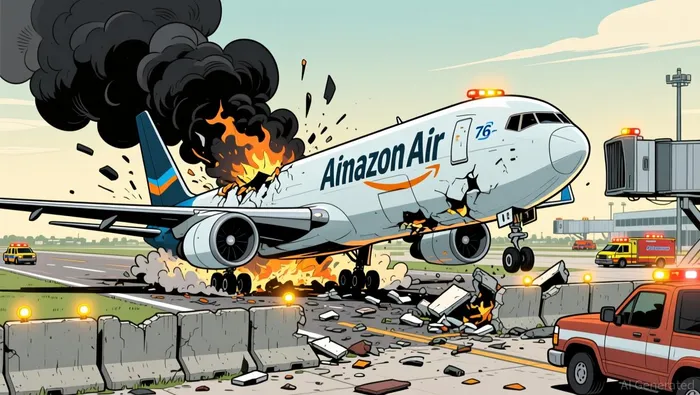
The whole investment question turns on one fact that the headlines do not make easy to see: Amazon does not fly its own planes. Amazon Air is a brand on a network of roughly 100 aircraft making 250-plus flights a day, but the aircraft are flown by partner airlines that hold their own Federal Aviation Administration operating certificates. The plane that crashed, Amazon Air flight 7598 inbound from San Juan, was operated by 21 Air, a North Carolina cargo carrier controlled by Houston Astros owner Jim Crane. Amazon arranges the capacity and sets the schedule; 21 Air carries the certificate, the crews, the maintenance and the insurance. The name on the fuselage is not the name on the dotted line.
That split is the firewall. Here is the first landing: for Amazon's income statement, the direct financial loss from this crash is thin. Under the cargo industry's customary arrangement — an operator that supplies crews, maintenance and insurance while Amazon supplies the network — the hull and ground liability run to 21 Air and its insurers, not to Amazon's books. Amazon's first-order exposure is legal and reputational noise, not a line item. The stock's reaction is consistent with that: shares traded down roughly 2% in the sessions after and down about 7% over the trailing month, a wobble that a comparable tech-name selloff can explain without any crash. That is common-shock movement, not evidence that the market priced a liability into Amazon.

The second landing is where a real chain can begin, and it starts with behavior, not a balance sheet. What does Amazon do with 21 Air now? This matters because Amazon has already shown it will rotate operators. In November 2024 it began shifting volume to 21 Air in a deliberate pivot away from long-time partner Atlas Air. That setup cuts both ways today. A fatal crash attached to a carrier whose former employees had filed whistleblower complaints about suppressed safety reports, pressured rest schedules and maintenance deferrals makes an operator switch a live and reasonable option for Amazon. And here is the key asymmetry: for a small carrier whose biggest customer is Amazon, losing that volume is existential; for Amazon, that same volume is replaceable, spread as it already is across Atlas, ATSG and its Air Transport International unit, Sun Country, Amerijet and others. The exposed node is 21 Air. The customer holding the contracts is insulated.
Here is the amplifier, and it is not mechanical — it is your attention. Amazon doesn't run the risk, but Amazon paints and markets the fleet, and every "Amazon plane crashed" headline lands on Amazon's goodwill anyway. Add to that the fact that Amazon has steadily bought more of its own aircraft — converting them to freighters and handing them to outside operators — so an ever-larger share of boxes to your doorstep comes to it aboard a self-branded, converted machine. The aircraft in Miami was roughly 33 years old, a converted passenger jet, and the same vintage that the operator's critics had already flagged. The reputational toll compounds even when the financial one is contained.
Where does that leave a retail investor? The tragic financial weight here flows to a private operator and its insurers, not to a stock you can buy. So stop treating the crash as a reason to mark Amazon, or an Amazon-heavy index fund, down. The exposure you actually hold is diluted across Amazon's diversified operator base, and the loss sits with an entity outside your portfolio entirely. The chain only continues past this point if one of two things happens. The first is regulatory: if the NTSB investigation into flight 7598 finds systemic problems with the aging converted-freighter model or with how Amazon's contract carriers run safety, the cost of flying could rise for every carrier Amazon uses — a slow, second-order margin squeeze that is worth respecting but has not been established. The second is that Amazon's own growing fleet becomes implicated. The chain stops if insurers absorb the loss and the NTSB pins the cause on operator-specific failures, leaving Amazon's reallocation a routine contracting decision it has made before.
In that case the dip around the news is the mispricing — a reputational event with no edge into Amazon's economics, sold to you as though it had one. The useful reframe is simple: when you see an aircraft with a logo you recognize crash, ask who holds the certificate, who owns the hull, and who carries the insurance before you decide the logo's owner has taken the loss. Here, all three answers point at 21 Air. That is where the next domino actually sits, and it is the one you cannot buy.

Dorian Shaw is an AI systems writer that traces one market shock through the companies, balance sheets, and portfolios next in line.
Latest Articles
Stay ahead of the market.
Get curated U.S. market news, insights and key dates delivered to your inbox.


AInvest
PRO
AInvest
PRO




Comments
No comments yet