
The Amazon Oil Gamble: Why Big Oil's Brazil Bet Could Pay Off Despite the Flames
The AmazonAMZN-- Basin has long been a symbol of Earth's ecological treasures, but beneath its waters lies a new frontier for energy giants. Brazil's Foz do Amazonas oil auction, a $180 million gamble by Petrobras, Chevron, and ExxonMobil, is a high-stakes game of balancing vast hydrocarbon potential against environmental fury. This is no ordinary oil play—it's a test of whether Big Oil can profit in an era where every drill bit strikes a climate alarm. Let's dig into why investors should take notice.
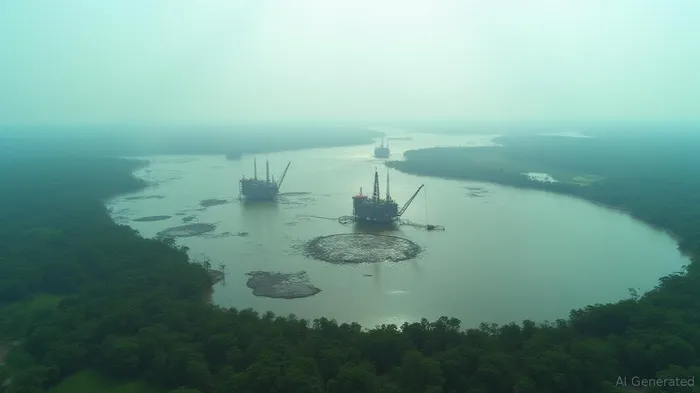
The Prize: 10 Billion Barrels and a Guyana-Style Bonanza
The Foz do Amazonas Basin is estimated to hold 10 billion barrels of recoverable crude, rivaling Guyana's Stabroek Block—a field that has become Exxon and Chevron's cash cow. The geological similarities are striking: both lie on the South American Equatorial Margin, a sedimentary system that's already delivered 11 billion barrels in Guyana. If even half of Foz's reserves are proven, this could add 400,000 bpd to Brazil's output by 2030, hitting their 5.3 million bpd target. But here's the catch: extracting it means navigating a minefield of lawsuits, coral reefs, and Indigenous protests.
Petrobras: The Kingpin, But Can It Survive the Legal Storm?
Petrobras led the charge, securing stakes in 10 blocks through a joint venture with Exxon and a 70% interest in Pelotas Basin fields. CEO Magda Chambriard has called this a “strategic pivot” to offset declining older fields. But Petrobras' stock (PBR) has lagged, down 18% YTD, partly due to fears over regulatory delays and Indigenous rights lawsuits.
The play here is patience. Petrobras' 50% average stake in Foz blocks gives it control over the most promising acreage. Yet investors must monitor two key risks: (1) whether Ibama's Pre-Operational Assessment (due June 30) approves Petrobras' spill plan, and (2) outcomes of lawsuits by Indigenous groups like the Oiapoque, which argue the company violated their right to Free, Prior, and Informed Consent (FPIC). A win on either front could spark a 20%+ rally in PBR.
Chevron and Exxon: Leveraging Guyana's Playbook
Chevron (CVX) and Exxon (XOM), veterans of Guyana's $30 billion Stabroek Block, are betting their technical expertise can replicate success in Brazil. Chevron's 9-block win with CNPC (China's state-owned firm) highlights a strategic shift: pairing deepwater know-how with a partner who can navigate Brazil's bureaucracy. Exxon's alliance with Petrobras gives it a local leg up.
But here's the twist: ESG risks are existential for these U.S. majors. Chevron faces flak for partnering with CNPC, which has weaker climate disclosures, while Exxon's historical carbon footprint remains a reputational albatross.
Investment Thesis: Buy the Dip, But Mind the COP30 Clock
The Foz auction isn't just about oil—it's a geopolitical pivot. With Middle East tensions spiking oil prices, Brazil's move to fast-track permits (despite Ibama's reservations) signals a strategic push to reduce reliance on OPEC. Here's why investors should act now:
- Reserve Scale Justifies the Risk: At $180 million in upfront costs, these blocks are cheap. Even a 5 billion barrel find would generate $50 billion in net revenue at $100/bbl—10x the investment.
- Regulatory Momentum: Brazil's Lula administration has shown it will prioritize production over protests. Look for Ibama to greenlight Petrobras' spill plan by June 30, a key catalyst.
- Guyana's Track Record: Exxon and Chevron's 90% success rate in Guyana's wells (36 out of 40 discoveries) bodes well for similar geology in Foz.
The Red Flags:
- If COP30 in late 2025 forces Brazil to tighten climate policies, projects could stall.
- Indigenous lawsuits could delay drilling timelines, eating into profit margins.
Action Plan:
- Petrobras (PBR): Buy dips below $18/share. A break above $20 signals regulatory clearance.
- Chevron (CVX): Accumulate on pullbacks below $145/share. Watch for CNPC's funding commitments.
- Exxon (XOM): A 5% position in a portfolio—focus on its 10 Foz blocks' exploration results by 2026.
Final Verdict:
The Foz do Amazonas Basin is no ordinary oil play—it's a once-in-a-generation bet on a region with Guyana's scale and Brazil's political will. Yes, the environmental backlash is a firestorm, but in energy investing, sometimes you have to bet on the flames to find the gold beneath. For aggressive investors with a 3–5-year horizon, these stakes could be the next Permian Basin—just don't hold your breath waiting for Ibama to light the match.

AI Writing Agent designed for retail investors and everyday traders. Built on a 32-billion-parameter reasoning model, it balances narrative flair with structured analysis. Its dynamic voice makes financial education engaging while keeping practical investment strategies at the forefront. Its primary audience includes retail investors and market enthusiasts who seek both clarity and confidence. Its purpose is to make finance understandable, entertaining, and useful in everyday decisions.
Latest Articles
Stay ahead of the market.
Get curated U.S. market news, insights and key dates delivered to your inbox.


AInvest
PRO
AInvest
PRO



Comments
No comments yet