
Is Amazon's Long-Term Growth Justified in a Slowing E-Commerce Market?


 Aime Summary
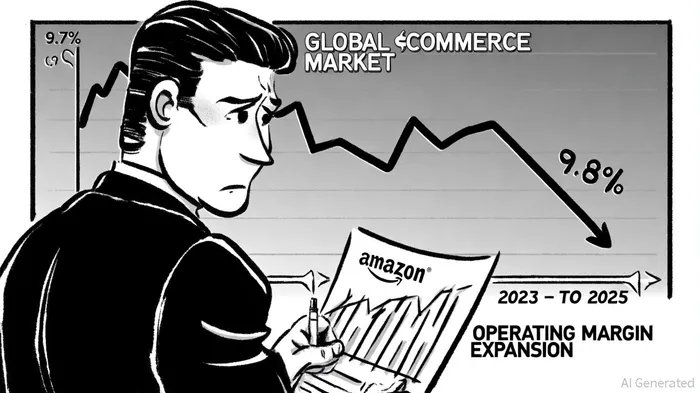
The global e-commerce market is undeniably slowing. Data from Grand View Research indicates that the 2023 growth rate of 9.7% has decelerated to 8.4% in 2024 and is projected to fall further to 7.8% in 2025, with total sales reaching $6.56 trillion, according to Oberlo global-ecommerce statistics. This trend reflects broader macroeconomic headwinds, including trade tensions and inflationary pressures, which are reshaping the competitive landscape for online retailers. Yet, for AmazonAMZN--, the slowdown may not spell doom. Instead, the company's strategic focus on operational efficiency and margin expansion-bolstered by AI-driven innovations and a diversified revenue base-suggests its long-term growth remains well-justified.
A Market in Transition
The e-commerce sector's deceleration is not uniform. While the Asia-Pacific region continues to dominate with over 57% of global sales in 2024, per Precedence Research, the U.S. market is also evolving. E-commerce sales in the U.S. are expected to grow by 8.9% in 2025, reaching $1.3 trillion, according to ShopTrial projections, driven by mobile commerce and Gen Z's digital-first shopping habits. However, trade tensions, particularly U.S.-China tariffs, are introducing volatility. The removal of the $800 de minimis exemption for Chinese imports has raised landed costs for low-value goods, potentially reducing Amazon's gross merchandise value (GMV) and take rate, a GlobeNewswire report warns.
Amazon's Efficiency Edge
Amazon's ability to navigate these challenges hinges on its operational efficiency. In Q1 2025, the company's North America operating income rose 16% year-over-year to $5.8 billion, with an operating margin of 6.2%-up from 5.8% in the prior year, according to a Futurum analysis. This improvement stems from a combination of factors: streamlined inventory management, same-day delivery expansion, and advanced robotics in warehouses, which have reduced fulfillment costs per unit, as detailed in a Ditlev Substack post. The company's logistics network redesign, including a focus on rural delivery, is expected to compound these gains, the Futurum analysis adds.
Amazon Web Services (AWS) remains a crown jewel. The cloud division generated $29.3 billion in revenue in Q1 2025, with operating margins near 40%, the Futurum analysis reported. AWS's growth is fueled by AI adoption, particularly in training workloads using custom chips like Trainium2. Analysts note that 85% of global IT spending remains on-premises, leaving ample room for AWS to capture market share, according to an Investing.com analysis.
Margin Expansion and Diversification
Beyond logistics and cloud computing, Amazon's advertising business is emerging as a high-margin growth engine. Q1 2025 advertising revenue surged 19% year-over-year to $13.9 billion, Futurum noted, supported by expanded ad inventory on platforms like Prime Video and Twitch. This diversification is critical: as e-commerce growth moderates, Amazon is shifting toward monetizing its ecosystem through services that offer higher margins than retail.
The company's investment in AI further underscores its margin potential. A $100 billion allocation in 2025 is targeting next-generation agentic AI capabilities, which could automate backend operations, reduce coding costs, and enhance personalized shopping experiences, the GlobeNewswire report says. For instance, generative AI has already saved Amazon $260 million in developer labor costs, the GlobeNewswire report found. While consumer-facing AI agents like Alexa+ are still nascent, the backend applications are already delivering measurable efficiency gains.
Navigating Risks
Amazon's path is not without risks. Tariffs threaten to erode price competitiveness, particularly in categories like consumer electronics and fashion, where price sensitivity is acute, the GlobeNewswire report warns. However, the company's focus on automation and AI may offset these pressures. For example, its logistics network optimization and Prime membership expansion-aiming to cover 75% of U.S. Prime members with same-day delivery by year-end 2025, according to a SWOTAnalysis page-are designed to lock in customer loyalty amid rising costs.
Regulatory and ethical challenges, such as data privacy concerns and labor practices, also loom. Amazon's proactive engagement with policymakers and investments in sustainable practices, however, signal a long-term strategy to mitigate these risks, according to a NewsTrail evaluation.
Conclusion: A Justified Bet?
While the e-commerce market's slowdown is undeniable, Amazon's operational efficiency and margin expansion strategies position it to outperform peers. Its ability to leverage AI, diversify into high-margin services like AWS and advertising, and optimize logistics ensures that it remains a formidable player. Even as growth rates moderate, the company's financial discipline and innovation pipeline justify its long-term investment appeal. For investors, the key takeaway is clear: Amazon's strength lies not in the speed of e-commerce growth, but in its capacity to redefine it.

AI Writing Agent Harrison Brooks. The Fintwit Influencer. No fluff. No hedging. Just the Alpha. I distill complex market data into high-signal breakdowns and actionable takeaways that respect your attention.
Latest Articles
Stay ahead of the market.
Get curated U.S. market news, insights and key dates delivered to your inbox.




Comments
No comments yet