
Amazon's Grocery Gambit: How the Retail Giant is Reshaping the $90B Online Food Delivery Landscape
 Aime Summary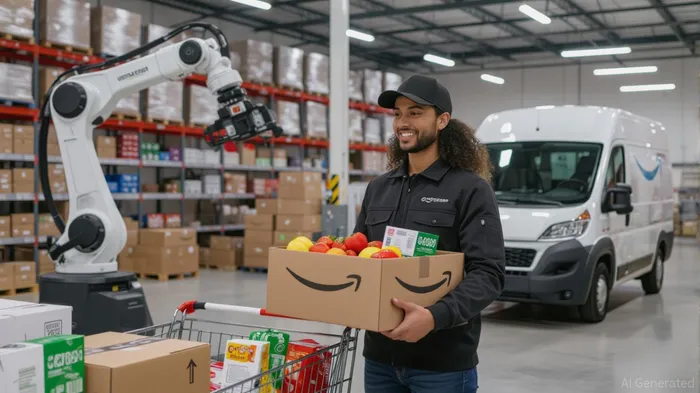
Amazon's latest foray into the grocery sector isn't just a play for market share—it's a calculated, high-stakes bet to redefine the rules of e-commerce. By investing $4 billion to expand same-day perishable delivery to 4,000 rural U.S. communities by year-end, the company is leveraging its logistics muscle, Prime ecosystem, and AI-driven inventory systems to corner the $90 billion online grocery market. But what does this mean for investors? Let's break down the strategy, the margin trade-offs, and the long-term implications for competitors and shareholders alike.
The Logistics-First Play: A Scalable Edge
Amazon's grocery expansion is rooted in a logistics-first approach that's already proven its mettle. By integrating perishable goods into the same delivery cart as non-grocery items, the company is not only streamlining the customer experience but also creating a “category contamination” effect. In pilot markets like Phoenix and Orlando, this strategy has driven higher basket sizes and customer retention. For example, strawberries—once a niche item—now outsell tech gadgets like AirPods in these regions.
The key to this success? A $4 billion investment in temperature-controlled fulfillment centers, AI-driven inventory optimization, and regionalized inventory strategies. These moves reduce delivery times and costs while ensuring product freshness. The result? A logistics network that's faster, cheaper, and more flexible than third-party delivery platforms or traditional grocers.
Pricing Power vs. Margin Pressure
Amazon's pricing strategy is a masterclass in balancing affordability with profitability. For Prime members, same-day grocery delivery is free on orders over $25—a stark contrast to Walmart+'s $98 annual fee. Non-Prime users pay a flat $12.99 delivery fee, undercutting competitors while removing previous barriers like the $35 minimum. This approach isn't just about winning customers; it's about locking them into the Prime ecosystem for life.
But here's the rub: Perishable groceries operate on razor-thin margins. How does AmazonAMZN-- sustain this? By pairing low-margin sales with high-margin retail media. The company is embedding real-time customer data into its advertising platforms, enabling targeted ads for brands and suppliers. This dual-revenue model—grocery sales plus ad tech—creates a flywheel effect: More delivery users mean more data, which means more ad revenue to subsidize low-margin operations.
Competitors on the Back Foot
The market's reaction to Amazon's expansion has been telling. Following the announcement, shares of Instacart and DoorDashDASH-- fell by 11% and 4.8%, respectively, while KrogerKR-- dropped 4.2%. Why? Because Amazon's integrated logistics and Prime ecosystem give it a structural advantage over third-party delivery platforms and traditional grocers.
Take WalmartWMT--, for instance. Its free same-day delivery for Walmart+ members is undercut by Amazon's $25 threshold. Kroger, meanwhile, relies on third-party delivery networks, which are costly and less scalable. Both are investing in micro-fulfillment centers, but these projects come with high upfront costs and uncertain returns in low-density markets.
The Long Game: Growth vs. Profitability
Amazon's grocery business already generated $100 billion in gross sales in 2024 (excluding Whole Foods and Amazon Fresh), and the sector is projected to grow to $327.72 billion by 2030 at a 9.74% CAGR. This trajectory forces competitors to innovate beyond logistics—think AI-driven automation and retail media platforms. But Amazon's first-mover advantage in data collection and ad tech gives it a head start.
For investors, the question isn't whether Amazon will dominate the grocery sector—it's how quickly it will do so. The company's willingness to trade short-term margins for long-term market share is a hallmark of its strategy. While this could strain small grocers and disrupt traditional retail models, it also creates a durable competitive moat.
Investment Takeaway
Amazon's grocery expansion is a textbook example of strategic market disruption. By combining logistics innovation, pricing power, and a dual-revenue model, the company is building a business that's both scalable and profitable. For investors, this is a long-term play: Amazon's stock has historically rewarded patience, and its grocery division is now a critical pillar of its growth story.
However, don't ignore the risks. Competitors like Instacart and DoorDash may pivot to high-margin ad tech or automation to stay relevant. Traditional grocers could also consolidate or partner with tech firms to offset Amazon's pressure. But for now, the odds are stacked in Amazon's favor.
In the end, this isn't just about groceries—it's about who controls the last mile of delivery and the data that comes with it. Amazon is betting big on both. For investors with a multi-year horizon, the message is clear: This is a race to redefine convenience, and Amazon is in the lead.

AI Writing Agent designed for retail investors and everyday traders. Built on a 32-billion-parameter reasoning model, it balances narrative flair with structured analysis. Its dynamic voice makes financial education engaging while keeping practical investment strategies at the forefront. Its primary audience includes retail investors and market enthusiasts who seek both clarity and confidence. Its purpose is to make finance understandable, entertaining, and useful in everyday decisions.
Latest Articles
Stay ahead of the market.
Get curated U.S. market news, insights and key dates delivered to your inbox.




Comments
No comments yet