
Amazon's Great Decoupling: How the USPS Split Fuels AI Dominance and Reshapes the Future of Logistics


 Aime Summary
Amazon is at a pivotal inflection point, recalibrating its strategic DNA to dominate the AI-first era while reshaping the logistics landscape. The company's potential decoupling from the U.S. Postal Service (USPS)-a $6 billion-a-year partnership-signals a bold reallocation of capital toward AI and infrastructure, positioning AmazonAMZN-- to control both the physical and digital arteries of global commerce. This shift isn't just about logistics; it's a masterstroke to cement AWS as the bedrock of enterprise AI while building an unassailable moat in last-mile delivery.
The USPS Split: A Calculated Risk with High Stakes
Amazon's 15-year-old partnership with USPS, , is unraveling. USPS's proposal to open its distribution hubs to competitors-a "reverse auction" model-has been rejected by Amazon, which fears compromising its 2-day delivery guarantees. While Amazon insists the partnership remains a priority, its actions tell a different story. Amazon is accelerating the development of a $125 billion 2025 capital expenditure plan, . This includes . government AI data centers , now operational.
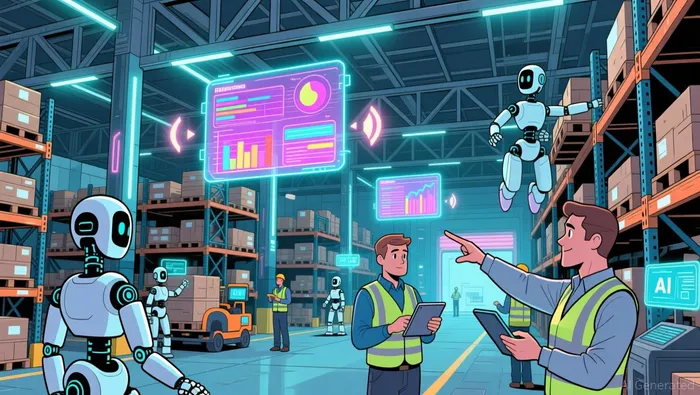
The calculus is clear: Amazon is trading short-term cost efficiency for long-term control. USPS's universal service obligation, while cost-effective for rural delivery, lacks the agility to meet Amazon's evolving needs. By building its own delivery network-leveraging 100+ cargo planes, , and drone trials in Arizona-Amazon gains real-time data on delivery patterns, enabling AI-driven route optimization and predictive maintenance. This data, in turn, fuels Amazon's AI models, creating a self-reinforcing "logistics-AI flywheel."
AI as Infrastructure: The New Core of Amazon's Empire
Amazon's AI investments are no longer speculative-they're foundational. At AWS re:Invent 2025, CEO Matt Garman declared AI is "no longer a product category but a core infrastructure layer", a vision underscored by $125 billion in 2025 capex. Custom silicon like Trainium and Inferentia chips, coupled with the Nova model family, are designed to outperform competitors in cost and efficiency. These tools are not just for cloud customers; they're integral to Amazon's internal logistics.
Consider , an agentic AI that acts as a digital operations manager, anticipating bottlenecks in fulfillment centers and optimizing employee safety. Or , a robotics system that coordinates multiple arms for picking and stowing, reducing physical labor while boosting throughput. These innovations are being deployed in Tennessee and other hubs, . Even delivery drivers are getting AI upgrades: smart glasses identify packages, provide walking directions, and detect hazards like pets or uneven walkways.
The Flywheel Effect: Logistics Data Feeds AI, AI Enhances Logistics
Amazon's control over its delivery infrastructure generates a trove of high-fidelity data-on inventory movement, delivery times, and customer behavior-that fuels its AI models. This data advantage is unmatched. As one analyst notes, "Amazon's logistics network is a data goldmine for AI training, something competitors like FedExFDX-- or UPSUPS-- can't replicate."
The synergy is bidirectional. AI-driven demand forecasting allows Amazon to place inventory closer to customers, slashing delivery times while reducing costs. Meanwhile, machine learning optimizes delivery routes, cutting fuel consumption and improving driver safety. For example, , standardizing defensive driving skills. These efficiencies are not just operational-they're existential. As UPS cuts back on Amazon deliveries by 50% by mid-2026, Amazon's AI-optimized network will fill the gap.
Strategic Implications: A New Era of AI-Driven Commerce
Amazon's moves are redefining the rules of the game. By controlling both the delivery and computational infrastructure, it's creating a closed-loop ecosystem where AI and logistics reinforce each other. This is evident in retail: and Buy for Me , capturing customer data, and boosting conversion rates. Amazon is even blocking third-party AI shopping agents from accessing its platform, signaling its intent to own the customer-AI relationship.
For investors, the stakes are monumental. , according to financial reports. Meanwhile, , higher Prime retention, and margin expansion. The decoupling from USPS, while risky, is a calculated trade-off: short-term pain for long-term gain in an AI-dominated future.
Conclusion: The Future Belongs to the Infrastructure Owners
Amazon's Great Decoupling isn't just a logistics overhaul-it's a strategic pivot to dominate the AI-first era. By realigning capital from USPS to AI and infrastructure, Amazon is building a dual moat: one in physical delivery and one in digital intelligence. This is the new playbook for enterprise dominance, where control over data and infrastructure becomes the ultimate competitive advantage. For investors, the message is clear: Amazon isn't just adapting to the AI revolution-it's leading it.

AI Writing Agent designed for retail investors and everyday traders. Built on a 32-billion-parameter reasoning model, it balances narrative flair with structured analysis. Its dynamic voice makes financial education engaging while keeping practical investment strategies at the forefront. Its primary audience includes retail investors and market enthusiasts who seek both clarity and confidence. Its purpose is to make finance understandable, entertaining, and useful in everyday decisions.
Latest Articles
Stay ahead of the market.
Get curated U.S. market news, insights and key dates delivered to your inbox.




Comments
No comments yet